
Counting the days between two dates looks like subtraction, but calendars fight back — 28-, 30-, and 31-day months, leap years, and the perennial question of whether to count the first day, the last day, both, or neither. That last one causes most of the off-by-one errors people hit in spreadsheets and by hand.
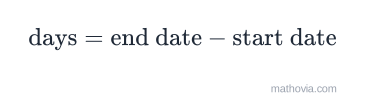
How the calculation works
Each date is converted to a running day number (days since a fixed reference point), and the difference between the two numbers is the answer:
Because each date already accounts for month lengths and leap days in its day number, the subtraction is exact regardless of how the calendar behaves in between.
Worked example
The calculator’s defaults are 1 January 2026 to 31 December 2026.
It’s 364 rather than 365 because the count is the gap between the two dates, not an inclusive tally of both endpoints. Add 1 for an inclusive count.
The 365.25 in the years figure
Dividing by 365.25 rather than 365 folds in the leap day that lands every fourth year. Over a single year the difference is tiny; over a few decades a flat 365 would be off by weeks.
Common uses
This kind of date math comes up constantly — countdown to an event, calculating someone’s exact age in days, determining a project timeline, or figuring out a legal or contractual deadline where the exact day count matters.
Common mistakes
- Expecting an inclusive count. Jan 1 to Jan 31 is 30 days between them, 31 if you count both ends.
- Assuming every year is 365 days when converting a long span to years — leap years add up.
- Ignoring that the result is calendar days, not business days. A two-week gap includes weekends.
- Mixing up start and end. A later start than end gives a negative result.
Counting across months by hand
Count what’s left in the starting month, add the full months in between, then add the days into the final month. From 15 March to 2 June 2026:
- Rest of March:
days. - April and May:
days. - Into June: 2 days.
The knuckle trick helps with month lengths: make a fist and count the months across your knuckles and the gaps between them. Months that land on a knuckle have 31 days; the gaps are the shorter months.
Leap years
A year is a leap year if it divides by 4, except century years, which must also divide by 400. So 2024 and 2028 are leap years, 2000 was one, and 2100 won’t be. The extra day only matters when February 29 falls inside your range: 1 February to 1 March is 29 days in 2024 but 28 days in 2026.
Business days
The calculator counts calendar days. For working days, count full weeks first, since each one holds exactly five weekdays. From Monday 2 March to Monday 30 March 2026 is 28 days, which is exactly 4 weeks, so there are
Age in days
Your age in days is the gap from your birth date to today. Someone born on 15 May 2000 is 9,639 days old on 5 October 2026. The 365.25 rule gives a good approximation: