
A bathroom scale tells you what you weigh, not what you are made of. Two people at 180 pounds and the same height can be carrying twenty pounds’ difference in fat, and body fat percentage is the number that separates them. The tape method below needs nothing but a soft tape measure and gets close enough to be genuinely useful.

The Navy circumference formula
For men, using inches:
For women, with the hip circumference added:
The logarithms look intimidating but they are doing something sensible. Body fat does not rise linearly with waist size; the first few inches above a lean baseline represent much more fat than the same inches added at a larger waist. A logarithmic fit captures that curve, which is why this method beats simple waist-to-height ratios.
Worked example
A man 70 inches tall, 34-inch waist, 15-inch neck, weighing 180 pounds.
Step 1 — the circumference difference.
Step 2 — the two logarithms.
Step 3 — substitute.
Step 4 — split the weight.
Seventeen and a half percent puts him at the top of the fitness range — lean enough to look athletic clothed, not lean enough to show much definition.
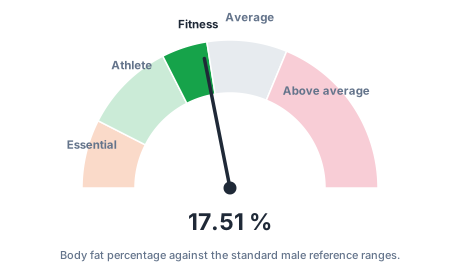
Reference ranges
| Category | Men | Women |
|---|---|---|
| Essential fat | 2–5% | 10–13% |
| Athlete | 6–13% | 14–20% |
| Fitness | 14–17% | 21–24% |
| Average | 18–24% | 25–31% |
| Above average | 25%+ | 32%+ |
The gap between the columns is not a matter of fitness. Women carry more essential fat for reproductive and hormonal function, and dropping below roughly 12 percent has real physiological consequences. A man at 20 percent and a woman at 20 percent are in genuinely different situations.
How to measure so the number means something
Neck. Just below the larynx, tape sloping slightly downward toward the front. Do not flex.
Waist, men. At the navel, level all the way round. Breathe out normally first — not a forced exhale, and definitely not held in.
Waist, women. At the narrowest point of the torso, which is usually an inch or two above the navel.
Hip, women. At the widest point of the buttocks, feet together.
Consistency beats precision. The tape method is more useful for tracking change than for a single absolute figure. Measure at the same time of day, in the same conditions, with the same tape, and compare weeks rather than days.
Round to the nearest half inch. A quarter-inch error on the waist moves the result by roughly 0.4 percentage points, which is smaller than the day-to-day variation from hydration and food in the gut.
How this compares to other methods
| Method | Typical error | Cost |
|---|---|---|
| DEXA scan | ±1–2% | $50–150 per scan |
| Hydrostatic weighing | ±2–3% | lab access |
| Bod Pod | ±2–3% | lab access |
| Skinfold calipers, trained | ±3–4% | cheap, needs skill |
| Navy tape method | ±3–4% | a tape measure |
| Bioelectrical impedance scale | ±4–8% | cheap, very noisy |
| BMI | not a fat measure | free |
The tape method holds up well against far more expensive options, which is why the military uses it on thousands of people rather than buying scanners. Its weakness is at the extremes: very lean people tend to read a few points high, and heavily muscled people with thick necks read low, because the neck term over-corrects for them.
Impedance scales deserve their reputation. They infer body composition from how easily a small current passes through you, which depends heavily on hydration — enough that the same person can read three points apart morning and evening.
Body fat versus BMI
BMI is weight over height squared. It knows nothing about composition, which is why it labels muscular people overweight and misses so-called normal-weight obesity entirely. Two men both at BMI 27 can be at 12 and 30 percent body fat.
That said, BMI is a reasonable population-level screen and takes no tape measure at all. The BMI calculator covers it, and the two numbers are best read together — BMI for a quick check, body fat for what is actually going on.
Common mistakes
- Pulling the tape tight. It should sit flush without compressing skin. Over-tightening the waist reads lean; over-tightening the neck reads fat.
- Measuring the waist at the belt line. Use the navel for men and the narrowest point for women, not wherever trousers happen to sit.
- Sucking in. It moves the result by several percentage points and fools nobody.
- Comparing to a different method. A tape reading and a scale reading will not agree. Pick one and stay with it.
- Reading too much into one measurement. Weekly trends are signal; day-to-day changes are mostly water.
- Using the male formula for women. They are separately fitted and not interchangeable — the female version needs the hip measurement for a reason.
If your measurements are in centimetres, convert them first with the centimeters to inches converter; the formula constants are fitted for inches and will not give a sensible answer in metric.
Sources and assumptions
This calculator assumes:
- Measurements follow the US Navy circumference method: neck, waist (and hips for women), and height.
- The result is an estimate; tape measurements typically differ from lab methods by several percentage points.
Sources:
- Hodgdon, J. A. and Beckett, M. B., Prediction of percent body fat for U.S. Navy men and women from body circumferences and height (1984), Naval Health Research Center
Figures last reviewed: . Educational estimates, not professional advice.