
In July 2026 the Army threw out its body fat rules. The height and weight tables, the tape test and the percentage limits by age are all gone, replaced by a single number: your waist divided by your height. It has to be under 0.55. This calculator checks that first, then gives you a body fat estimate from the equation the Army used until the change — useful if you still track it, but no longer what decides whether you pass.
The 2026 Army body composition standard
Army Directive 2026-13 took effect on July 7, 2026, following a Pentagon order the previous December. It covers the Regular Army, the Army National Guard and the Army Reserve, and it made waist-to-height ratio the only body composition standard.
That’s it. No age groups, no separate numbers for men and women, no weighing in. The waist is measured at the navel, level with the floor, at the end of a normal breath out, in PT uniform. Soldiers are measured twice a year.
What went away:
- the height and weight screening tables
- the circumference tape test and body fat percentage limits
- supplemental assessments by DEXA, Bod Pod or InBody
- the exemption for soldiers scoring 540 or more on the ACFT
Worked example: does this soldier meet the standard?
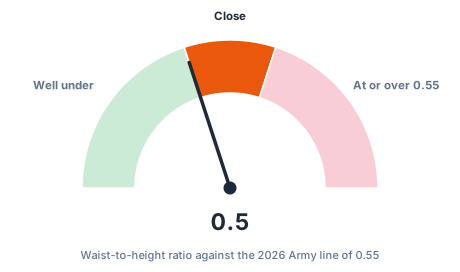
A male soldier, 5 feet 10 inches, 180 pounds, with a 35-inch waist at the navel — the calculator’s default values.
Step 1 — height in inches.
Step 2 — the ratio.
Step 3 — compare with 0.55. 0.500 is under the line, so he meets the standard.
Step 4 — how much room. The waist limit at 70 inches is
and the rule is under 0.55, so a 38.5-inch reading would fail. With a tape read to the half inch, 38 inches is the largest waist that passes — 3 inches more than he has now.
For a female soldier at 5 feet 5 inches (65 in) with a 33-inch waist:
The old body fat estimate, and why it still shows
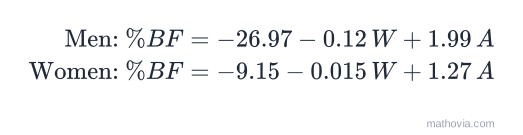
From June 2023 until July 2026 the Army estimated body fat from weight and the same navel measurement:
That splits his 180 pounds into about 37.9 pounds of fat and 142.1 pounds of lean mass.
Under the old rules a man aged 21 to 27 was allowed 22 percent, so he’d have passed there too. He’ll often pass both ways — but not always, and that’s the interesting part.
Where the two methods disagree
The old equation gave heavier men credit for muscle: at the same waist, each extra 10 pounds lowered the male estimate by 1.2 points. The new ratio ignores weight completely. So a big, muscular soldier with a thick waist can fail the new standard while his body fat estimate looks fine, and a lighter soldier with the same waist can pass the ratio with a higher estimated body fat.
Height works the other way. A taller soldier gets a bigger waist allowance under the ratio — 0.55 inches of waist for every inch of height — where the old tape equation didn’t use height at all.
| Height | Waist limit (must be under) | Largest passing half-inch reading |
|---|---|---|
| 5′2″ (62 in) | 34.10 in | 34.0 in |
| 5′5″ (65 in) | 35.75 in | 35.5 in |
| 5′8″ (68 in) | 37.40 in | 37.0 in |
| 5′10″ (70 in) | 38.50 in | 38.0 in |
| 6′0″ (72 in) | 39.60 in | 39.5 in |
| 6′2″ (74 in) | 40.70 in | 40.5 in |
How to measure your waist the way the Army does
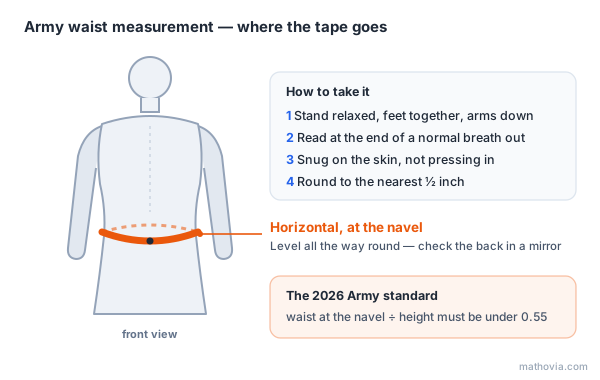
- Stand relaxed, feet together, arms at your sides. Don’t suck in.
- Tape at the navel, level all the way round. A tape that dips at the back reads high.
- Read it at the end of a normal breath out.
- Snug, not tight — flat on the skin without pressing in.
- Measure height barefoot, standing straight against a wall, to the nearest half inch.
Measure in the morning before eating, the way you’d be measured on a record day. A big salty meal can add half an inch by itself, and at the margin half an inch is the difference between 0.54 and 0.55.
What happens if you don’t meet 0.55
A reading of 0.55 or more gets re-measured the same duty day by a different team. If it still doesn’t meet the standard, the soldier is enrolled in the Army Body Composition Program, flagged, and sent for a medical assessment. The Army has said nobody will be separated until a 180-day review of the new standard is finished, so the details of what comes after enrolment may still change.
Common mistakes
- Using an old Army body fat calculator. Anything that tells you pass or fail by body fat percentage and age group is using rescinded rules.
- Measuring at the belt line. Most people’s trousers sit below the navel. The Army measures at the navel itself.
- Rounding your height up. Every inch of height is worth 0.55 inches of waist allowance, so measure it honestly — the unit will.
- Treating 0.55 as a pass. The standard is under 0.55. Exactly 0.55 does not meet it.
- Cutting weight while the waist stays put. Under the new rule only the waist and your height matter.
If your tape reads in centimetres, convert it with the centimeters to inches converter — or just divide centimetres by centimetres; the ratio is the same in any unit. For a fuller body composition picture, the Navy-method body fat calculator uses neck, waist and hip measurements, the BMI calculator gives the quick screen, and the FFMI calculator shows how much of your weight is lean mass.
This calculator is a planning estimate. The official measurement is the one your unit records.
Sources and assumptions
This calculator assumes:
- The waist is measured at the navel and height without shoes, both in inches.
- The 0.55 waist-to-height limit from Army Directive 2026-13 applies to all Soldiers.
Sources:
- Army modifies body composition program, adopts waist-to-height ratio (Army Directive 2026-13), U.S. Army
Figures last reviewed: . Educational estimates, not professional advice.