

What amps to volts actually solves
This is Ohm’s law read in the direction that gives you voltage. You know how much current is flowing through something and how much it resists that flow, and you want the potential difference across it. Two situations account for most of the use:
- Voltage across a component. A resistor, a heating element, a relay coil — anything with a known resistance carrying a known current develops a predictable voltage across its terminals.
- Voltage drop in a wire run. A long cable has resistance too. Multiply that resistance by the current it carries and you get the voltage lost between the panel and the load — the reason a motor at the end of a long undersized run hums instead of starting.
The amps to volts formula
Worked example
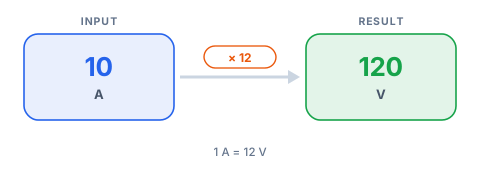
The calculator’s defaults are a current of 10 A through a resistance of 12 Ω.
So 120 V appears across the 12-ohm element. That’s a self-consistent picture of a standard branch circuit: a 12-ohm resistive load — roughly a 1,200 W heater — pulls 10 A from a 120 V supply, and all 120 V is dropped across the load because it’s the only thing in the circuit.
Voltage-drop example
Now use the same formula for a cable instead of a load. Suppose 10 A flows through a run of wire with a total round-trip resistance of 0.3 Ω:
Three volts are lost in the wire, so a load expecting 120 V only sees 117 V. On a 120 V circuit that’s a 2.5% drop, near the 3% figure most electricians treat as the practical ceiling for a branch circuit. Double the run length, or the current, and you’re over it.
Current and resistance to voltage
| Current | 1 Ω | 5 Ω | 12 Ω | 24 Ω | 50 Ω |
|---|---|---|---|---|---|
| 0.5 A | 0.5 V | 2.5 V | 6 V | 12 V | 25 V |
| 2 A | 2 V | 10 V | 24 V | 48 V | 100 V |
| 10 A | 10 V | 50 V | 120 V | 240 V | 500 V |
| 20 A | 20 V | 100 V | 240 V | 480 V | 1,000 V |
Reading across the 10 A row shows how a fixed current produces wildly different voltages depending on what it’s flowing through — the same 10 A drops 10 V across a 1-ohm element and 500 V across a 50-ohm one.
What the result means
The voltage returned is the potential difference across the resistance you entered, at the current you entered. It assumes the resistance is constant and the load is purely resistive. Real conductors warm up and gain a few percent of resistance as they do, so a figure calculated from a cold measurement will run slightly low at operating temperature. For diodes, LEDs, and semiconductors, current and voltage aren’t proportional and this formula doesn’t apply.
Common mistakes
- Using one-way wire length for a voltage-drop estimate. Current flows out and back, so use twice the run length, or the manufacturer’s round-trip resistance figure.
- Treating a motor or power supply as a fixed resistance. Their current draw isn’t proportional to voltage; get their operating current from a nameplate or a measurement.
- Measuring resistance cold and expecting an exact match hot. Copper gains roughly 0.4% resistance per °C.
For the reverse, use the volts to amps calculator. To find the power dissipated in that resistance, see amps to watts, and for picking a conductor size that keeps voltage drop in check, the wire gauge calculator.