
Every conductor is a resistor. Push current down a hundred feet of 12 AWG and some of your supply voltage is spent heating the cable instead of arriving at the load. On a short kitchen circuit that loss is invisible; on a run out to a workshop it is the difference between a table saw that starts cleanly and one that groans, stalls and eventually cooks its own windings.
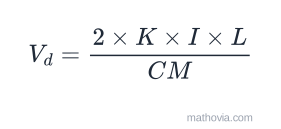
The voltage drop formula
The 2 is there because current has to make a round trip. You measure the distance from the panel to the load once, and the formula accounts for the return conductor.
For a three-phase circuit the geometry changes and the factor becomes
That is why three-phase distribution suffers noticeably less drop than single phase for the same power delivered — one of several reasons it is used for long runs and large loads.
Worked example
A 20-amp circuit feeding a detached garage, 100 feet from the panel, wired in 10 AWG copper on a 240-volt supply.
Step 1 — look up the conductor area. 10 AWG is 10,380 circular mils.
Step 2 — substitute into the single-phase formula.
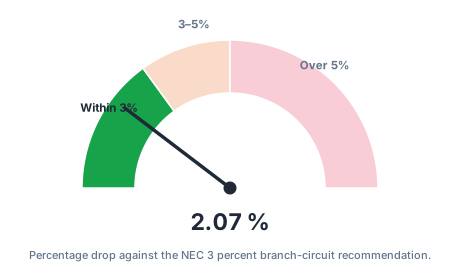
Step 3 — express it as a percentage of the supply.
Step 4 — check it against the recommendation. 2.07 percent is inside the 3 percent target, so 10 AWG is the right choice here.
The load sees
What happens if you drop to 12 AWG
Same run, same load, one gauge smaller:
Over the limit — and on a 120-volt supply the same 7.90 volts would be 6.58 percent, which is genuinely bad. This is the single most useful thing the formula tells you: drop in volts does not care about supply voltage, but drop as a percentage halves when you double the voltage. Running an outbuilding at 240 V instead of 120 V solves most long-run problems on its own.
Longest run within 3 percent
Rearranged for length, the formula answers the question people actually have:
At 20 amps on a 240-volt single-phase circuit in copper:
| Wire | Circular mils | Max run at 3% |
|---|---|---|
| 14 AWG | 4,107 | 57 ft |
| 12 AWG | 6,530 | 91 ft |
| 10 AWG | 10,380 | 145 ft |
| 8 AWG | 16,510 | 230 ft |
| 6 AWG | 26,240 | 366 ft |
| 4 AWG | 41,740 | 583 ft |
Halve every figure for a 120-volt circuit, because the allowed drop in volts halves with it. Multiply by roughly 0.61 for aluminium.
The 3 and 5 percent figures
These come from informational notes in the National Electrical Code, not from enforceable articles. Article 210.19(A) suggests 3 percent maximum on a branch circuit, and 215.2(A) suggests 5 percent for the feeder and branch circuit combined.
| Circuit | Recommended maximum |
|---|---|
| Branch circuit alone | 3% |
| Feeder alone | 3% |
| Feeder plus branch, total | 5% |
Because they are recommendations rather than requirements, an inspector cannot usually fail an install on drop alone. Equipment manufacturers are less forgiving: most motors are rated for ±10 percent of nameplate voltage, and running persistently near the bottom of that band shortens their life.
Why oversizing for drop is not the same as sizing for ampacity
Two different constraints, and both have to be satisfied.
Ampacity is about heat in the conductor and its insulation. It sets the minimum legal size for a given load and is a hard code requirement — 12 AWG copper for a 20-amp circuit, for example. The wire gauge calculator covers this side.
Voltage drop is about performance at the far end. It can push you above the ampacity minimum on a long run, but it can never let you go below it.
So on the garage example, 12 AWG is legal for 20 amps and 10 AWG is chosen purely for drop. That is the normal situation on any long run: ampacity sets the floor, drop sets the answer.
Ways to fix an excessive drop
| Change | Effect on drop |
|---|---|
| One AWG size larger | roughly 20% less |
| Two AWG sizes larger | roughly 37% less |
| Double the circular mils | exactly half |
| Copper instead of aluminium | roughly 39% less |
| 240 V instead of 120 V | percentage halves |
| Halve the run length | exactly half |
Raising the voltage is usually the cheapest fix by a wide margin, because it improves the percentage without a single extra pound of copper. Splitting one long circuit into two shorter ones helps as well, since each carries less current.
Common mistakes
- Doubling the distance yourself. The formula’s 2 already accounts for the return path. Enter the one-way length.
- Using 1.732 on a single-phase circuit. That understates the drop by about 13 percent.
- Using AWG numbers directly. The formula needs circular mils. 12 AWG is 6,530 cmil, not 12.
- Sizing on drop alone. Ampacity is the code minimum and comes first.
- Forgetting aluminium’s penalty. Same gauge, about 64 percent more drop.
- Calculating at nameplate rather than actual load. For motors, use the running current, but check the starting surge too — inrush can be six times the running figure and that is what causes visible light flicker.
For picking the code-minimum size in the first place, use the wire gauge calculator. For the underlying relationship between volts, amps and resistance that this formula is built on, see the Ohm’s law calculator.