Mathovia

Electrical / Power & Wattage

Kilowatts (kW) to Kilowatt-Hours (kWh) Conversion Calculator

Calculate energy consumption from power and hours.

Energy
12.000 kWh
001.2552.5103.7515520kWkWh3 kW12 kWh
Energy is power held for the number of hours you enter.

Use the stated electrical relationship and enter values in the displayed units.

Source: Formula conventions follow standard electrical engineering relationships. Verify equipment ratings and local code requirements before installation.

Written by
MPhil in Mathematics, Founder of Mathovia
Published

Mathematics verification: Mathematical formulas, calculations, worked examples and solutions are reviewed for accuracy before publication. How we check our work

Kilowatts (kW) to Kilowatt-Hours (kWh) Conversion Calculator formula
The Kilowatts (kW) to Kilowatt-Hours (kWh) Conversion formula

Power versus energy

Kilowatts and kilowatt-hours sound alike but measure different things. A kilowatt is a rate — how fast a device uses energy at any moment. A kilowatt-hour is a quantity — the total energy used, which is what a utility meter counts and what you pay for. A 3 kW load isn’t 3 kWh of anything until you say how long it runs.

This conversion is the everyday tool for turning an appliance’s power rating and its hours of use into an energy figure, and from there into a cost.

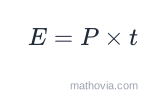
The kW to kWh formula

is energy in kilowatt-hours, is power in kilowatts, and is time in hours. Both sides are already kilowatt-based, so there’s no conversion factor — a kilowatt-hour is defined as one kilowatt for one hour.

Worked example

The calculator’s defaults are 3 kW running for 4 hours.

Twelve kilowatt-hours. At an electricity rate of, say, 16 cents per kWh, that session costs about 1.92 dollars. Run the same load 4 hours a day for a month and it’s roughly 360 kWh, close to 58 dollars.
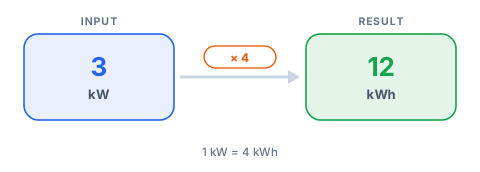
Kilowatts (kW) to Kilowatt-Hours (kWh) Conversion Calculator worked example diagram
A visual read of the worked example above — the same numbers the calculator returns for its default inputs.

kW to kWh at a glance

Power1 hr4 hr8 hr24 hr
0.5 kW0.5 kWh2 kWh4 kWh12 kWh
1.5 kW1.5 kWh6 kWh12 kWh36 kWh
3 kW3 kWh12 kWh24 kWh72 kWh
5 kW5 kWh20 kWh40 kWh120 kWh

When the load isn’t constant

The multiplication assumes steady power for the whole interval. A resistance heater running flat-out fits that. A refrigerator, a thermostat-controlled space heater, or a variable-speed pump does not — they draw full power only part of the time. For those, multiply the rated kW by the duty cycle (the fraction of the interval the device actually runs) or split the time into stretches where the draw is roughly constant and add the results.

Common mistakes

  • Using rated kW for a cycling appliance, which overstates the energy.
  • Mixing minutes and hours. The time must be in hours; 90 minutes is 1.5 hr.
  • Confusing the kWh result with kW. One is the total; the other is the rate.

For the reverse, use the kWh to kW calculator. To start from a wattage instead, see watts to kWh.

About the formula: Use the stated electrical relationship and enter values in the displayed units.

Frequently Asked Questions

How do I convert kW to kWh?+

Multiply the power in kilowatts by the number of hours it runs. kWh = kW × hours. A 3 kW load for 4 hours uses 12 kWh. Both quantities are already kilowatt-based, so there's no conversion factor.

How many kWh does a 1500 W heater use in a day?+

1,500 W is 1.5 kW. Running continuously for 24 hours that's 36 kWh; at 8 hours a day it's 12 kWh. Multiply by your electricity rate for the cost.

What if the appliance cycles on and off?+

This assumes constant power for the whole time. A refrigerator or a thermostat-controlled heater draws full power only part of the time, so it uses less than kW × hours. Multiply the rated kW by the duty cycle — the fraction of time it actually runs — for a closer figure.

Can I estimate my electric bill with this?+

For a rough number, yes: kWh × rate per kWh. A real bill can add tiered pricing, time-of-use rates, demand charges, and fixed fees, so treat it as a planning estimate.

What's the difference between kW and kWh?+

kW is power — the rate of energy use at an instant. kWh is energy — the total accumulated over time. A 2 kW heater always draws 2 kW; how many kWh it costs you depends on how long it's on.

How do I go from kWh back to kW?+

Divide the energy by the hours: kW = kWh ÷ hours. 12 kWh used over 4 hours is an average of 3 kW.