
Subtracting one inch measurement from another comes up constantly: trimming a board to fit, finding the gap between two marks, or working out how much is left after a cut. The method is the same as adding fractions of an inch, with one extra move, borrowing, for when the fraction you’re taking away is bigger than the one you have.
Get a common denominator first
Before you subtract, both fractions need the same denominator. Tape-measure fractions make this easy: every mark on a standard tape (1/2, 1/4, 1/8, 1/16) is a power of two, so the larger denominator is always the common one. Halves become sixteenths by multiplying top and bottom by 8, quarters by 4 and eighths by 2.
| Fraction | As sixteenths |
|---|---|
| 1/2 | 8/16 |
| 1/4 | 4/16 |
| 3/8 | 6/16 |
| 5/8 | 10/16 |
| 3/4 | 12/16 |
Subtracting fractions of an inch
Subtract 1 3/16” from 3 1/2”. Convert to sixteenths (1/2 = 8/16), subtract the fraction parts, then the whole numbers:
3 8/16” − 1 3/16” = 2 5/16”
If the result can be reduced, reduce it so it matches a mark on your tape: 2 6/16” is easier to find as 2 3/8”.
Borrowing when the top fraction is smaller
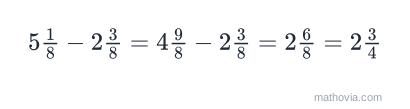
Sometimes the fraction you’re subtracting is larger than the one you’re subtracting from. To do 3 1/4” − 1 5/8”, convert to eighths first: 3 2/8” − 1 5/8”. You can’t take 5/8 from 2/8, so borrow one whole inch from the 3. That inch becomes 8/8, so the 3 turns into 2 and the fraction grows from 2/8 to 10/8:
2 10/8” − 1 5/8” = 1 5/8”
Borrowing on a fraction subtraction is exactly like borrowing in column subtraction: you’re moving one unit down from the whole-number place. The only thing to remember is that the borrowed inch is written in the same denominator you’re using, so it’s 8/8 in eighths and 16/16 in sixteenths.
Subtracting feet and inches
Longer measurements work the same way, except that one foot is 12 inches. Subtract inches from inches and feet from feet, and borrow a foot when the inches on top run short.
For 6’ 2” − 3’ 7”, you can’t take 7 inches from 2, so borrow one foot: 6’ 2” becomes 5’ 14”. Then 5’ 14” − 3’ 7” = 2’ 7”.
If the inches carry fractions too, do the borrowing in two places. For 8’ 3 1/4” − 2’ 5 3/4”:
- Fractions: 1/4 is smaller than 3/4, so borrow an inch: 3 1/4” becomes 2 5/4”.
- Inches: now 2 is smaller than 5, so borrow a foot: 8’ 2” becomes 7’ 14”.
- Subtract: 7’ 14 5/4” − 2’ 5 3/4” = 5’ 9 2/4”, which simplifies to 5’ 9 1/2”.
A quick check is to add your answer back to the smaller measurement: 2’ 5 3/4” + 5’ 9 1/2” should give 8’ 3 1/4”, and it does. For the addition side of the same problem, see how to add fractions in inches.
When to round to 1/16” vs 1/32”
- 1/16” is the standard precision for framing, general carpentry, and most DIY projects; it matches what a typical tape measure displays clearly.
- 1/32” matters for finish work, cabinetry, and joints where a tight fit is visible: trim, inlay and drawer slides are common cases.
- 1/8” is often enough for rough construction measurements like stud layout or subfloor cuts, where a little slack won’t affect the result.
Choosing too fine a rounding for rough work just adds mental overhead; choosing too coarse a rounding for finish work can leave a visible gap. One rule matters more than the denominator you pick: don’t round the intermediate steps. Keep the measurements exact and round only the final result, because rounding each step can drift by an eighth of an inch over a few operations.
Common mistakes
- Subtracting the smaller fraction from the larger. In 3 1/4” − 1 5/8”, it’s tempting to do 5/8 − 2/8 instead. That gives the wrong answer; borrow instead.
- Borrowing 10 instead of a whole inch. The borrowed inch is 8/8 or 16/16, not 10 of anything.
- Borrowing 10 inches from a foot. A foot is 12 inches.
- Leaving the answer unreduced. 10/16” and 5/8” are the same length, but only one of them is marked on your tape.
Skip the manual conversion
The math above is exactly what our Inch Fraction Calculator automates: type in measurements as mixed numbers, fractions, or decimals, choose your rounding precision, and it returns the result instantly, with the decimal equivalent alongside it for reference. For pure-number fractions without the inch context, use the subtracting fractions and adding fractions calculators.