
You cut a board 3/4” thick, glue a 5/8” panel on top, and now need to know the combined thickness so you can set your table saw fence. Two fractions, different denominators, and your tape measure doesn’t show decimals. Here’s how to handle it cleanly every time.
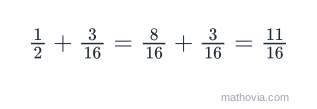
Why Inch Fractions Always Share a Common Ground
Standard inch fractions use denominators that are powers of two: 2, 4, 8, 16, and occasionally 32. This isn’t arbitrary — it’s because tape measures subdivide each inch by halving repeatedly. Half of 1” is 1/2”, half of that is 1/4”, and so on down to 1/32” on fine-scale tapes.
This means finding a common denominator is simple: just use the largest denominator already in the problem. If you’re adding 3/4 and 5/16, your common denominator is 16. No prime factoring required.
The Steps
- Look at all the fractions you’re adding and find the largest denominator.
- Convert every fraction to that denominator by multiplying top and bottom by the same factor.
- Add the numerators. Keep the denominator.
- If the numerator is larger than the denominator, pull out whole inches.
- Simplify the remaining fraction so it matches a mark on your tape.
Worked Example: Three Measurements Combined
Suppose you’re stacking materials: 3/4” plywood + 5/8” hardwood + 7/16” spacer.
Step 1: The largest denominator is 16.
Step 2: Convert each fraction:
- 3/4 = 12/16 (multiply by 4/4)
- 5/8 = 10/16 (multiply by 2/2)
- 7/16 = 7/16 (already there)
Step 3: Add numerators: 12 + 10 + 7 = 29
Step 4: 29/16 = 1 whole inch + 13/16
Result: 1-13/16”
Check whether 13/16 simplifies: 13 is prime, so it doesn’t. Your tape measure has a 13/16” mark, so you’re done.
Our Fraction Calculator handles all of this automatically — enter your fractional measurements and it returns the simplified result in increments your tape measure can actually show.
Adding Feet and Inches
Longer measurements add the same way, with one extra carry: every 12 inches make a foot. Add the fractions, then the inches, then the feet, carrying as you go.
For 4’ 8 3/4” + 2’ 6 1/2”:
- Fractions: 3/4 + 1/2 = 3/4 + 2/4 = 5/4 = 1 1/4”. Write down 1/4 and carry 1 inch.
- Inches: 8 + 6 + 1 carried = 15”. That’s 1 foot and 3 inches, so write down 3 and carry 1 foot.
- Feet: 4 + 2 + 1 carried = 7’.
Result: 7’ 3 1/4”
Adding measurements this way keeps everything on the marks your tape shows, with no decimals and no rounding until the very end. If you need to go the other way and take one measurement from another, borrowing a whole inch or a whole foot works like carrying in reverse; see subtracting fractions of an inch.
When You Need to Simplify
If your answer were 12/16 instead of 13/16, you’d reduce it. Divide both numerator and denominator by their greatest common factor: 12 ÷ 4 = 3, 16 ÷ 4 = 4, so 12/16 = 3/4”. Always reduce to the smallest denominator that works — your tape is easier to read at 3/4” than at 12/16”.
A quick rule: if the numerator is even, you can simplify. Keep halving until the numerator is odd.
Common Mistakes to Avoid
Adding denominators. 3/4 + 5/8 is not 8/12. You never add the bottom numbers when adding fractions — you find a shared denominator, then add only the tops.
Leaving an unusable fraction. If your answer is 11/32 but your tape only marks sixteenths, you need to either round to the nearest sixteenth (11/32 falls roughly halfway between 5/16 and 6/16) or use a tape with thirty-second markings.
Forgetting to carry whole inches. When adding measurements like 2-3/4” + 1-7/8”, add the whole inches (2 + 1 = 3) and the fractions (6/8 + 7/8 = 13/8 = 1-5/8”) separately, then combine: 3” + 1-5/8” = 4-5/8”.
For anything more complex — subtracting, multiplying, or dividing fractions in a measurement context — the Fraction Calculator saves real time, especially when you’re at the saw and don’t want to second-guess your arithmetic.