
What this calculates
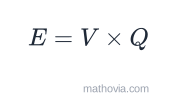
Voltage is energy per unit of charge — that’s its definition. Turn that around and the energy delivered is the charge multiplied by the voltage it moved through. This calculator does that product, giving you the electrical energy in joules for a given amount of charge crossing a fixed potential difference.
It’s the relationship behind a few practical estimates: how much energy a battery delivers as it pushes a known charge at its terminal voltage, roughly how much energy a capacitor dumps during a discharge, and the energy side of physics problems that hand you volts and coulombs.
The volts to joules formula
with current in amps and time in seconds. A battery supplying 3 A for 20 seconds has moved 60 coulombs.
Worked example
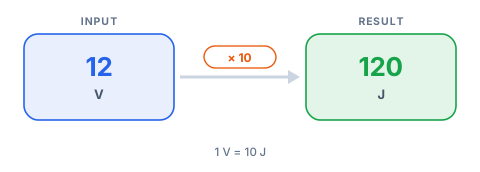
The calculator’s defaults are 12 V and 10 C of charge.
So moving 10 coulombs across a 12-volt difference transfers 120 joules. Put in everyday terms, if that 10 C moved in 5 seconds, the current was 2 A and the power was 24 W — and 24 W for 5 seconds is 120 J, which matches. The two ways of getting to energy agree, as they must.
Charge and voltage to energy
| Charge | 5 V | 12 V | 48 V | 120 V |
|---|---|---|---|---|
| 1 C | 5 J | 12 J | 48 J | 120 J |
| 10 C | 50 J | 120 J | 480 J | 1,200 J |
| 100 C | 500 J | 1,200 J | 4,800 J | 12,000 J |
| 3,600 C (1 Ah) | 18,000 J | 43,200 J | 172,800 J | 432,000 J |
The bottom row is a battery-sized amount of charge: one amp-hour is 3,600 coulombs, so a 1 Ah cell at 12 V holds about 43,200 J, which is the same as 12 watt-hours.
What the result assumes
The formula treats the voltage as constant while the charge moves. That’s a fair approximation for a battery under a light, steady load, but not for a capacitor charging from empty — a capacitor’s voltage rises as charge piles onto its plates, so its stored energy is ½ × C × V², exactly half of what a constant-voltage product would suggest for the same endpoint. Use this calculator for fixed-voltage transfers, and the capacitor energy formula for anything with a rising or falling voltage.
Common mistakes
- Using amp-hours directly as coulombs. Multiply amp-hours by 3,600 first.
- Applying V × Q to a charging capacitor. That overstates the stored energy by a factor of two; use ½ C V².
- Forgetting the load determines where the energy goes. The joules are delivered regardless; whether they become heat, motion, or chemical change is up to what’s connected.
For the reverse, use the joules to volts calculator. To work from power and time instead of charge, see watts to joules.