
What this calculates
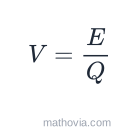
Voltage is defined as energy per unit of charge — one volt is one joule per coulomb. So if you know how much energy was transferred and how much charge carried it, dividing the first by the second gives the potential difference they moved through. This calculator does exactly that division.
It shows up whenever the energy and charge are the known quantities and voltage is the unknown: checking a capacitor’s stored energy against its charge rating, working out the effective voltage a battery delivered over a discharge, or the potential-difference part of a physics problem framed in joules and coulombs.
The joules to volts formula
amps times seconds. A circuit that carried 4 A for 2.5 seconds moved 10 coulombs.
Worked example
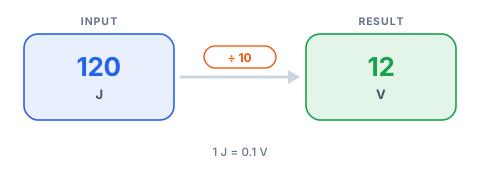
The calculator’s defaults are 120 J of energy and 10 C of charge.
The charge moved through an average potential difference of 12 volts. Check it against power: if those 10 C moved in 5 seconds, the current was 2 A, the power was 24 W, and 24 W for 5 s is 120 J — consistent with the input.
Energy and charge to voltage
| Energy | 1 C | 10 C | 100 C | 3,600 C (1 Ah) |
|---|---|---|---|---|
| 12 J | 12 V | 1.2 V | 0.12 V | 0.0033 V |
| 120 J | 120 V | 12 V | 1.2 V | 0.033 V |
| 1,200 J | 1,200 V | 120 V | 12 V | 0.33 V |
| 43,200 J | 43,200 V | 4,320 V | 432 V | 12 V |
The bottom-right cell is a battery-scale figure: 43,200 J delivered by one amp-hour of charge works out to 12 V, the same result the Wh = Ah × V shortcut gives.
What the result assumes
The formula returns the average voltage over the transfer. It assumes the voltage held steady while the charge moved. That’s fine for a battery under a light, slow load, but a capacitor’s voltage falls as it discharges, so dividing its total energy by its total charge gives a figure partway between its start and end voltage — specifically half the peak for a capacitor taken fully to zero. For a live circuit, a voltmeter is the better tool.
Common mistakes
- Using amp-hours where coulombs are expected. Multiply amp-hours by 3,600.
- Expecting a capacitor’s rated voltage. Its energy is ½ C V², so energy ÷ charge gives half the rated voltage, not the full value.
- Confusing this with joules to watts. That one needs time, not charge, and gives power rather than voltage.
For the reverse, use the volts to joules calculator. To find power from the same energy figure, see joules to watts.