
Turning a rate into a total
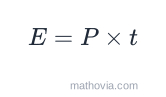
Watts measure how fast energy is being used. Joules measure how much has been used. To get from one to the other you multiply by the length of time the power was flowing. A 60-watt draw isn’t a quantity of energy on its own — sustain it for a second and it’s 60 joules, sustain it for a minute and it’s 3,600.
This conversion is the everyday tool for “how much energy did that take?” questions on a small scale: a resistor dissipating heat for a set number of seconds, a pump running for a fixed interval, a heating element in a lab, or the energy side of a physics problem stated in watts.
The watts to joules formula
Worked example
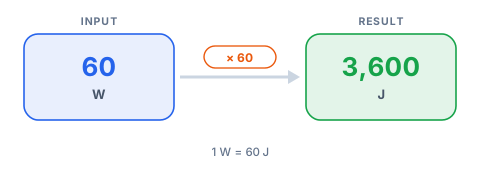
The calculator’s defaults are 60 W held for 60 s.
That’s 3,600 joules — the energy a 60 W bulb turns into light and heat in one minute. Cross-check it against energy in another form: 3,600 J is exactly one watt-hour, since a watt-hour is one watt for 3,600 seconds. The units line up.
How time scales the energy
| Power | 10 s | 1 min | 10 min | 1 hour |
|---|---|---|---|---|
| 5 W | 50 J | 300 J | 3,000 J | 18,000 J |
| 60 W | 600 J | 3,600 J | 36,000 J | 216,000 J |
| 1,500 W | 15,000 J | 90,000 J | 900,000 J | 5,400,000 J |
Once the totals climb into the hundreds of thousands, joules stops being a comfortable unit. The last cell, 5.4 million joules, is just 1.5 kWh — the way that same energy would appear on an electricity bill. See the watts to kWh calculator for that scale.
What the result assumes
The multiplication treats power as flat for the entire interval. A resistive heater or an incandescent lamp holds close to that. A motor draws a surge at startup and settles lower; a thermostat-controlled device switches fully on and off and spends only part of the interval running. For those, use the average power over the interval, or multiply the rated wattage by the duty cycle, before converting.
Common mistakes
- Entering minutes or hours in the seconds field. Convert to seconds first, or the answer is off by 60× or 3,600×.
- Using rated wattage for a cycling load. Scale it by the fraction of time the device actually runs.
- Reporting a huge joule figure where kWh would be clearer. Divide joules by 3,600,000 for kilowatt-hours.
For the reverse calculation, use the joules to watts calculator. To express the same energy in the units on your power bill, see watts to kWh.
A real example: boiling a kettle
Heating 1 kg of water by 1 °C takes about 4,186 joules. Bringing 1 litre of water from 20 °C to 100 °C needs:
A 1,500 W kettle supplies 1,500 joules every second, so the minimum time is
Joules to calories and kWh
- 1 kWh = 3,600,000 J.
- 1 kilocalorie (a food “Calorie”) = 4,184 J.
A 1,000 W microwave running for 2 minutes delivers 120,000 J, which is about 28.7 kcal, or 0.033 kWh. The food calorie comparison is a useful reminder of how much energy food holds: a single 250-kcal snack holds about the same energy as that microwave running for 17 minutes.