
“Am I strong?” is a hard question to answer with a single number, because a 300-pound squat means something very different at 150 pounds of bodyweight than at 250. This calculator answers it the way coaches usually do: turn your set into an estimated one-rep max, divide by your bodyweight, and compare that multiple with the line for your lift and sex.
How your strength level is worked out
There are three steps, and you can do all of them on a phone calculator.
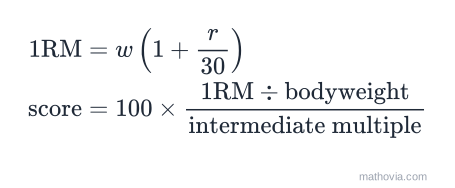
1. Estimate your one-rep max. Nobody should test a true max just to use a calculator. The Epley formula turns any set of up to about ten reps into an estimate:
where
2. Divide by bodyweight. This gives the lift as a multiple of your bodyweight, so a lighter and a heavier lifter can be put on the same scale.
3. Compare with the Intermediate line. Each lift has an Intermediate multiple — for men 1.5 on the squat, 1.0 on the bench, 1.8 on the deadlift and 0.65 on the overhead press. Dividing by it gives a score where 100 means Intermediate on any lift:
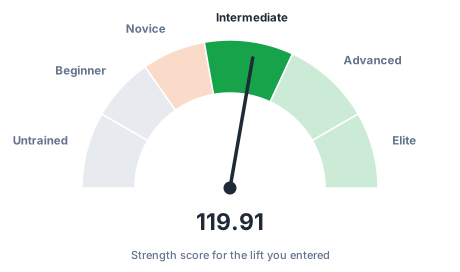
The levels start at 50 (Beginner), 75 (Novice), 100 (Intermediate), 135 (Advanced) and 170 (Elite). Below 50 is Untrained.
Worked example: bench press, 185 × 5 at 180 lb
A man who weighs 180 lb benches 185 lb for 5 reps — the calculator’s default values.
Step 1 — one-rep max.
Step 2 — bodyweight multiple.
Step 3 — score. The Intermediate bench line for men is 1.0 × bodyweight:
That sits between 100 and 135, so this lifter is Intermediate on the bench.
Step 4 — the next level. Advanced starts at 1.35 × bodyweight:
so the estimated max needs to climb by
A second example: squat, 135 × 3 at 140 lb
A 140 lb woman squats 135 lb for 3 reps. Her one-rep max is
Strength standards by lift
Every value is a one-rep max as a multiple of bodyweight. Multiply by your own bodyweight to get pounds or kilograms.
Men
| Lift | Beginner | Novice | Intermediate | Advanced | Elite |
|---|---|---|---|---|---|
| Squat | 0.75 | 1.13 | 1.50 | 2.03 | 2.55 |
| Bench press | 0.50 | 0.75 | 1.00 | 1.35 | 1.70 |
| Deadlift | 0.90 | 1.35 | 1.80 | 2.43 | 3.06 |
| Overhead press | 0.33 | 0.49 | 0.65 | 0.88 | 1.11 |
Women
| Lift | Beginner | Novice | Intermediate | Advanced | Elite |
|---|---|---|---|---|---|
| Squat | 0.53 | 0.79 | 1.05 | 1.42 | 1.79 |
| Bench press | 0.33 | 0.49 | 0.65 | 0.88 | 1.11 |
| Deadlift | 0.65 | 0.98 | 1.30 | 1.76 | 2.21 |
| Overhead press | 0.20 | 0.30 | 0.40 | 0.54 | 0.68 |
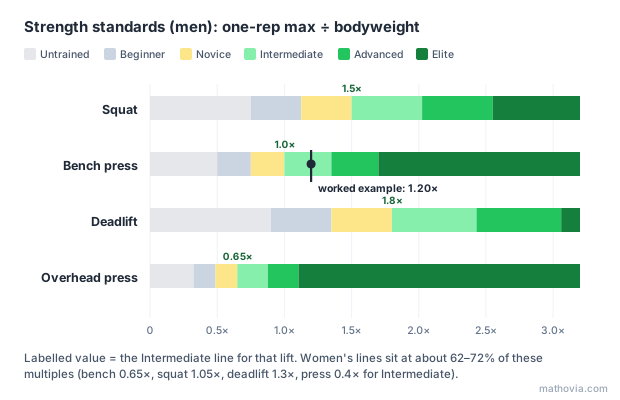
A word on where these come from: they are Mathovia’s own standards, set around milestones coaches have used for decades — a bodyweight bench, a squat of one and a half times bodyweight, a deadlift near double. They are not percentiles, and they are not taken from any app’s user data. Use them to track your own progress, not to rank yourself against strangers.
Roughly, Beginner is a few weeks of training, Novice a few months, Intermediate one to three years of consistent work, Advanced several years of focused training, and Elite the level of competitive lifters.
Reps to one-rep max
The Epley formula implies a fixed percentage of your max for each rep count:
| Reps | % of one-rep max | Reps | % of one-rep max |
|---|---|---|---|
| 1 | 100% | 6 | 83% |
| 2 | 94% | 7 | 81% |
| 3 | 91% | 8 | 79% |
| 4 | 88% | 9 | 77% |
| 5 | 86% | 10 | 75% |
These only hold for sets taken close to failure. If you stopped at 5 reps with three more in the tank, your estimate will come out low.
Why bodyweight multiples favour lighter lifters
Muscle strength scales roughly with the cross-section of the muscle, while bodyweight scales with its volume. The result is that doubling your size gives you well under double the strength. A 130 lb lifter benching 1.5 times bodyweight lifts 195 lb; a 260 lb lifter at the same ratio needs 390 lb, which is a far rarer feat.
So if you are heavy, expect this calculator to rate you a little harshly, and if you are light, a little generously. For comparing lifters across weight classes, allometric formulas such as DOTS or Wilks correct for this.
Common mistakes
- Using a set that wasn’t hard. The estimate assumes the set was close to failure.
- Using sets above 10 reps. Accuracy falls off quickly past ten.
- Counting partial reps. A squat above parallel or a bench that doesn’t touch the chest inflates the number.
- Mixing units. Bodyweight and lift must both be in pounds or both in kilograms.
- Comparing lifts with different standards. A 1.2× bench is a better result than a 1.2× squat; the score, not the multiple, is the fair comparison across lifts.
For a read on how much of your bodyweight is muscle, pair this with the FFMI calculator and the body fat calculator.
Sources and assumptions
This calculator assumes:
- One-rep max is estimated with the Epley formula from a set of reps.
- The strength levels are Mathovia’s own standards built around common bodyweight multiples, not an official ranking.
Figures last reviewed: . Educational estimates, not professional advice.