
Landscape stone is sold by weight, spread by depth and measured by area, and the number that connects those — density — swings more than people expect. River rock and lava rock look like similar quantities in the yard, but a cubic yard of one weighs twice what the other does. Order by volume and you might be fine; order by tonnage using the wrong density and you will be well out.
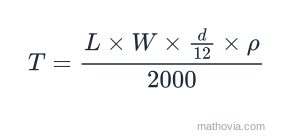
The stone tonnage formula
If your supplier sells by volume rather than weight, stop after the first three terms and divide by 27:
That figure does not depend on density at all, which is why volume is the safer unit to order in when you are not certain what the material weighs.
Worked example
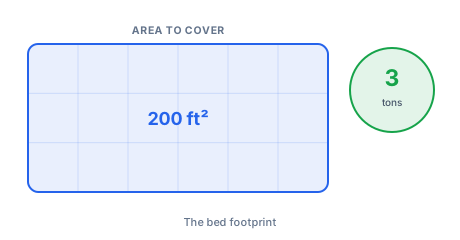
A 20 ft by 10 ft bed, filled with river rock to a depth of 3 inches.
Step 1 — convert the depth to feet.
Step 2 — volume in cubic feet.
Step 3 — multiply by river rock’s density.
Step 4 — convert to tons.
That is 1.85 cubic yards, or 100 of the half-cubic-foot bags sold at garden centres — which is the moment bulk delivery stops being optional and starts being obvious.
Swap river rock for lava rock and the same bed needs
Stone density reference
| Stone | lb per cu ft | Tons per cu yd |
|---|---|---|
| Lava rock | 50 | 0.68 |
| Sandstone / flagstone chips | 85 | 1.15 |
| Crushed limestone | 95 | 1.28 |
| Pea gravel | 96 | 1.30 |
| Crushed stone (#57) | 100 | 1.35 |
| Marble chips | 101 | 1.36 |
| River rock, rounded | 105 | 1.42 |
| Decomposed granite | 110 | 1.49 |
These are loose densities, which is what a delivered pile actually weighs. Compacted figures run 10 to 20 percent higher and are the right ones for a driveway base, not a decorative bed. The tons-per-cubic-yard column is just the middle column times 27 divided by 2,000, and it is the number most suppliers quote from.
Coverage per ton
For stone around 100 lb/cu ft:
| Depth | One ton covers |
|---|---|
| 1 in | 240 sq ft |
| 2 in | 120 sq ft |
| 3 in | 80 sq ft |
| 4 in | 60 sq ft |
| 6 in | 40 sq ft |
The rough field rule for 100 lb stone is 240 divided by the depth in inches. For lava rock at 50 lb/cu ft, double it. For decomposed granite at 110, knock off about 10 percent.
How deep to spread it
| Use | Depth |
|---|---|
| Decorative bed, planted | 2 in |
| Decorative bed, weed suppression | 3 in |
| Walking path | 3–4 in |
| Dry creek bed / drainage | 4–6 in |
| Driveway surface course | 3–4 in over a compacted base |
Two inches is genuinely enough for a bed you are only looking at. Three is the number worth paying for if weeds are the reason you are laying stone, because that is roughly where light stops reaching seed at the soil surface. Beyond four inches on a bed you are buying depth nobody will ever see.
Landscape fabric underneath is worth the cost on a decorative bed and actively counterproductive on a path, where it eventually surfaces in ripples. Either way it does not change the volume you need.
Bags versus bulk
Half-cubic-foot bags are the standard retail size, so a cubic yard is 54 of them. The worked example above needs 100 bags, which is two pallets and a lot of carrying.
| Volume needed | Sensible way to buy |
|---|---|
| Under 0.25 cu yd (about 14 bags) | bags |
| 0.25 to 0.5 cu yd | bags, unless delivery is cheap |
| Over 0.5 cu yd | bulk, delivered |
| Over 3 cu yd | bulk, and expect a better per-ton rate |
Bagged stone usually costs three to five times as much per cubic foot as bulk. The break-even is not really about the material price though — it is about whether a truck can get to where the stone needs to end up, and whether you have somewhere to put a pile for a weekend.
What changes the answer most
Density. The single largest lever. Getting it wrong by picking “stone” generically instead of the actual material can be a factor of two on lava rock.
Depth. Multiplies straight through. Going from 2 to 3 inches is 50 percent more stone, not a small adjustment.
Shape. Beds are curved. Measure the bounding rectangle for ordering and accept a small over-estimate, or split a complex bed into rectangles with the square footage calculator first.
Settlement. Stone works into soft soil over the first season, especially without fabric. That is most of why the 10 percent margin exists.
Common mistakes
- Using one density for every stone. Lava rock at 50 lb/cu ft and decomposed granite at 110 are more than twice apart.
- Leaving depth in inches inside the multiplication. Divide by 12 first.
- Using compacted density for a decorative bed. Loose is what gets delivered and what fills the bed.
- Ordering tons when the quote was in yards. Confirm which unit the supplier means before agreeing a number — they are not interchangeable and the ratio depends on the material.
- Measuring a curved bed as its outline. You will over-order. Break it into rectangles instead.
- Forgetting edging. Stone spreads sideways without a border, and a bed with no edge needs topping up every year.
For driveway base and graded gravel rather than decorative stone, the gravel calculator handles metric units and gravel-specific densities. For bark and wood chips, the mulch calculator works the same way with a much lighter material.