Mathovia

Electrical / Power & Wattage

Joules to Watts Conversion Calculator

Convert joules to watts by specifying duration.

Power
60.00 W
001,25020.832,50041.673,75062.55,00083.33JW3,600 J60 W
Watts are joules spread over the number of seconds you enter.

Use the stated electrical relationship and enter values in the displayed units.

Source: Formula conventions follow standard electrical engineering relationships. Verify equipment ratings and local code requirements before installation.

Written by
MPhil in Mathematics, Founder of Mathovia
Published

Mathematics verification: Mathematical formulas, calculations, worked examples and solutions are reviewed for accuracy before publication. How we check our work

Joules to Watts Conversion Calculator formula
The Joules to Watts Conversion formula

Energy and power are not the same thing

A joule is an amount of energy. A watt is a rate — how fast energy is being used or delivered. The bridge between them is time. Ten thousand joules could be a trickle or a jolt depending on whether it’s spread over an hour or dumped in a millisecond. So “joules to watts” only makes sense once you say over how long.

This comes up when you have a measured or specified energy total and want the power behind it: a capacitor bank rated in joules that discharges over a known interval, a battery-test log that reports watt-seconds, a physics problem that gives you energy and time, or a utility reading you want to turn back into an average load.

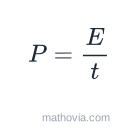
The joules to watts formula

is average power in watts, is energy in joules, and is time in seconds. The definition of the watt is built into this: one watt is one joule per second, so the division needs no conversion factor as long as the time is in seconds.

Worked example

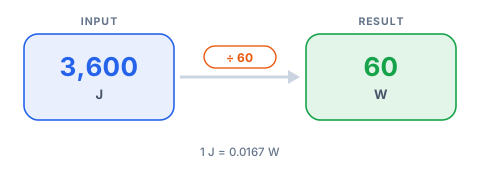
The calculator’s defaults are 3,600 J delivered over 60 s.

The energy was moved at an average rate of 60 watts — the same as a 60 W bulb running for that minute. Notice how much the answer depends on the time: the identical 3,600 J delivered in 1 second would be 3,600 W, and stretched over an hour it would be just 1 W.
Joules to Watts Conversion Calculator worked example diagram
A visual read of the worked example above — the same numbers the calculator returns for its default inputs.

The role of time

Energyover 1 sover 10 sover 60 sover 1 hour
100 J100 W10 W1.7 W0.028 W
3,600 J3,600 W360 W60 W1 W
50,000 J50,000 W5,000 W833 W13.9 W

Every row holds the same amount of energy. The wattage only reflects how quickly that energy was spent.

Reading the result

The number this returns is average power over the interval. Real devices rarely deliver energy at a flat rate — a motor spikes at startup, a thermostatically controlled heater switches fully on and fully off — so the instantaneous power wanders above and below the average. The average is still the right figure for sizing a supply or estimating cost, because it’s what a constant load would have to draw to do the same work in the same time.

If you need energy over a longer, real-world span, kilowatt-hours are the friendlier unit: 1 kWh equals 3,600,000 J. See the kWh to watts calculator for that scale.

Common mistakes

  • Entering minutes or hours as if they were seconds. A 10-minute interval is 600 s. Skip the conversion and the answer is off by 60×.
  • Expecting the result to match a nameplate. Nameplate wattage is a rated maximum under set conditions; this is a measured average that includes idle time, cycling, and partial loads.
  • Treating average power as peak power. For protection and inrush questions, the momentary peak matters more, and it can be many times the average.

For the reverse calculation, use the watts to joules calculator. To work from voltage and charge instead of time, see joules to volts.

About the formula: Use the stated electrical relationship and enter values in the displayed units.

Frequently Asked Questions

How does this joules to watts conversion calculation work?+

A watt is defined as one joule per second, so dividing total energy in joules by the number of seconds it was delivered over gives average power directly. It's the same move as getting miles per hour from a distance and a time.

How many watts is 3600 joules?+

It depends entirely on how long the energy took to deliver. Over 1 second, 3,600 J is 3,600 W. Over 60 seconds it's 60 W. Over an hour it's 1 W. Joules is a quantity of energy; watts is a rate, so you can't convert one to the other without a time.

Does this give instantaneous or average power?+

Average power over the interval you enter. If the energy was delivered in bursts, the real power rose above and fell below this figure moment to moment; the average is what a steady draw would have to be to move the same total energy in the same time.

How does this relate to kilowatt-hours on my electric bill?+

One kWh is 3,600,000 joules. If you know an appliance used a certain number of joules and for how long, this gives its average wattage, which you can compare against its nameplate rating or multiply by hours of use to estimate its share of the bill.

What's the difference between this and watts to joules?+

This divides energy by time to get power. Watts to joules multiplies power by time to get energy. Use this one when you have a total energy figure and a duration; use the other when you have a wattage and want to know the energy it consumes over some period.

Why does the calculator ask for seconds rather than minutes or hours?+

Because the watt is tied to the second: one watt is one joule per second. Entering the time in seconds keeps the units consistent. For a duration in minutes or hours, multiply by 60 or 3,600 first.

Related calculators