
What a capacitor’s charge tells you
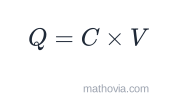
A capacitor’s job is to hold charge on two plates separated by an insulator, and to give it back quickly when the circuit needs it. How much charge it holds is set by two things: the capacitance, which is how much charge it stores per volt, and the voltage actually across it. Multiply them and you get the charge in coulombs.
This is the starting point for a lot of circuit design — sizing the reservoir capacitor in a camera flash, the smoothing capacitor after a rectifier, or the timing capacitor in an RC circuit all begin with “how much charge do I need at this voltage?”
The capacitance to charge formula
Worked example
The calculator’s defaults are a 0.001 F (1,000 µF) capacitor at 12 V.
The capacitor holds 0.012 coulombs. For scale, a coulomb is a large unit — that same 0.012 C is what a 12 mA current carries in one second, and it’s thousands of times less charge than a small battery stores. Capacitors trade capacity for speed: they can dump their charge in microseconds, which a battery cannot.
Capacitance and voltage to charge
| Capacitance | 5 V | 12 V | 50 V | 400 V |
|---|---|---|---|---|
| 100 µF | 0.5 mC | 1.2 mC | 5 mC | 40 mC |
| 470 µF | 2.35 mC | 5.64 mC | 23.5 mC | 188 mC |
| 1,000 µF | 5 mC | 12 mC | 50 mC | 400 mC |
| 4,700 µF | 23.5 mC | 56.4 mC | 235 mC | 1,880 mC |
(1 mC = 0.001 C.) A photo-flash capacitor — a few hundred µF at 300–400 V — sits in the bottom-right region, holding enough charge to be dangerous well after the device is unplugged.
Charge versus energy
Stored charge and stored energy are different quantities. Charge is
Common mistakes
- Entering microfarads as farads. A 470 µF part is 0.00047 F, not 470.
- Using the supply voltage when the capacitor only sees part of it — in a divider or filter, use the voltage actually across the capacitor.
- Exceeding the working voltage rating. The formula won’t warn you; the dielectric will fail.
For the reverse relationship, see the joules to volts calculator, and for the energy a charged capacitor delivers, volts to joules.
How fast a capacitor charges
Charging through a resistor takes time. The time constant is
After one time constant it holds about 63% of its final charge, and after five time constants (50 seconds here) it’s above 99%, which is usually treated as fully charged.
Capacitors in series and parallel
- Parallel: capacitances add. Two 100 µF capacitors in parallel make 200 µF and hold twice the charge at the same voltage.
- Series: capacitance falls. Two 100 µF capacitors in series make 50 µF. Each one carries the same charge, and the voltage splits between them.
How much charge is that, really?
A 1,000 µF capacitor at 12 V holds 0.012 coulombs. In battery terms that’s about 0.0033 mAh, while a phone battery holds several thousand mAh. Capacitors store far less charge than batteries, but they can release it almost instantly, which is why they’re used for smoothing, timing and short bursts of power.