
For decades the Army’s first check was a table: find your height, find your age group, and see whether you weighed less than the number in the box. If you didn’t, you got taped. That table no longer exists. Since July 2026 the only number that matters is your waist divided by your height, and it has to come in under 0.55 — the same line for every soldier of any age, man or woman.
The 2026 Army height and weight standard
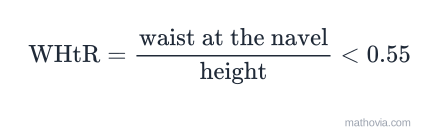
Army Directive 2026-13 took effect on July 7, 2026, for the Regular Army, the Army National Guard and the Army Reserve. It rescinded the AR 600-9 height and weight screening tables, the circumference tape test and the body fat percentage limits, and put one rule in their place:
Both measurements are in inches. Rearranged, that gives a waist limit for any height:
Your waist has to be under that number. It isn’t a weight standard at all — two soldiers of the same height can weigh 40 pounds apart and have exactly the same limit.
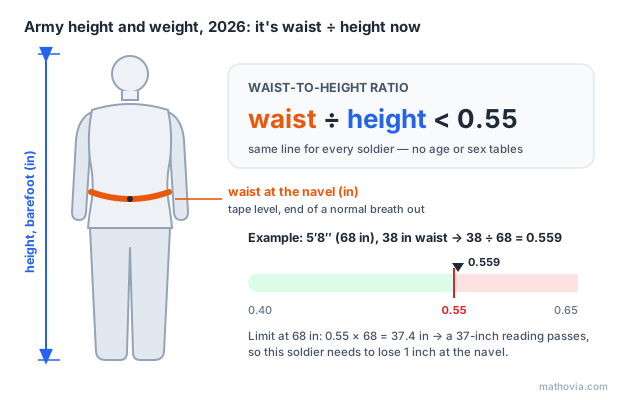
Worked example: 5 foot 8 with a 38-inch waist
The calculator’s default values.
Step 1 — convert height to inches.
Step 2 — the ratio.
That’s over 0.55, so this soldier does not meet the standard.
Step 3 — the waist limit.
Step 4 — the largest reading that passes. The tape is read to the half inch, so the candidates are 37.0 and 37.5. Only 37.0 is under 37.4:
Step 5 — the gap. From 38 inches down to 37 inches is 1 inch at the navel. That’s the whole job: no weight target, no body fat target, one inch of waist.
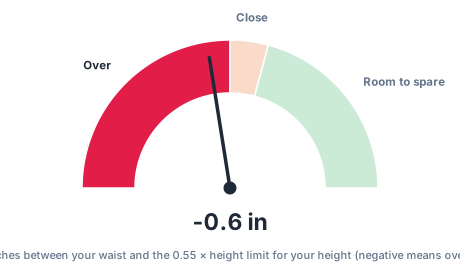
Army maximum waist by height
The limit is 0.55 times your height; the right-hand column is the largest half-inch tape reading that stays under it.
| Height | Waist limit (must be under) | Largest passing reading |
|---|---|---|
| 4′10″ (58 in) | 31.90 in | 31.5 in |
| 4′11″ (59 in) | 32.45 in | 32.0 in |
| 5′0″ (60 in) | 33.00 in | 32.5 in |
| 5′1″ (61 in) | 33.55 in | 33.5 in |
| 5′2″ (62 in) | 34.10 in | 34.0 in |
| 5′3″ (63 in) | 34.65 in | 34.5 in |
| 5′4″ (64 in) | 35.20 in | 35.0 in |
| 5′5″ (65 in) | 35.75 in | 35.5 in |
| 5′6″ (66 in) | 36.30 in | 36.0 in |
| 5′7″ (67 in) | 36.85 in | 36.5 in |
| 5′8″ (68 in) | 37.40 in | 37.0 in |
| 5′9″ (69 in) | 37.95 in | 37.5 in |
| 5′10″ (70 in) | 38.50 in | 38.0 in |
| 5′11″ (71 in) | 39.05 in | 39.0 in |
| 6′0″ (72 in) | 39.60 in | 39.5 in |
| 6′1″ (73 in) | 40.15 in | 40.0 in |
| 6′2″ (74 in) | 40.70 in | 40.5 in |
| 6′3″ (75 in) | 41.25 in | 41.0 in |
| 6′4″ (76 in) | 41.80 in | 41.5 in |
| 6′5″ (77 in) | 42.35 in | 42.0 in |
| 6′6″ (78 in) | 42.90 in | 42.5 in |
| 6′7″ (79 in) | 43.45 in | 43.0 in |
| 6′8″ (80 in) | 44.00 in | 43.5 in |
Watch the heights where 0.55 × height lands exactly on a half inch — 5′0″, 5′10″ and 6′8″. At 5′10″ the limit is 38.5 inches, and a 38.5-inch waist gives a ratio of exactly 0.550, which does not meet “under 0.55.” Those three heights lose a full half inch compared with a naive reading of the table.
What changed from the old tables
| Old system (AR 600-9 tables) | 2026 system (Directive 2026-13) | |
|---|---|---|
| First check | weight against a height table | waist ÷ height |
| Adjusted for age | yes, four age groups | no |
| Adjusted for sex | yes, separate columns | no |
| Second step | tape test for body fat % | same-day re-measure by a new team |
| Fitness exemption | 540+ ACFT exempt from tape | removed |
| How often | weighed every six months; taped only if over the table | measured twice a year, everyone |
The biggest practical shift is that weight has dropped out entirely. A heavily muscled soldier who used to fail the weight table and then pass the tape can now pass on the first measurement, if the waist is in range. And a soldier who used to squeak under the weight table with a thick waist can now fail. For the body fat side of the story, and how the old tape equation compares, see the Army body fat calculator.
How to measure height and waist
Height. Barefoot, heels, buttocks and shoulders against a wall, looking straight ahead. Put a book flat on your head, mark the wall, and measure to the nearest half inch. Every inch of height is worth 0.55 inches of waist allowance, so an honest number matters.
Waist. Tape horizontally at the navel, level all the way round, snug on the skin without pressing in, read at the end of a normal breath out. Don’t suck in — it’ll only make your home number wrong, not your official one.
Measure first thing in the morning, before eating, and take it on two or three days. A single evening reading after a big meal can be half an inch high, and around the limit half an inch is the whole margin.
Common mistakes
- Looking for a weight limit. There isn’t one any more. Losing weight only helps if it comes off your waist.
- Using an old height and weight chart. Anything with age groups or a maximum weight is the rescinded AR 600-9 table.
- Treating 0.55 as a pass. The standard is under 0.55. At 5′10″, 38.5 inches fails.
- Measuring at the belt line instead of the navel.
- Rounding height up. It raises your limit on paper, not on the day.
If you’ve been measuring in centimetres, you don’t even need to convert — the ratio is the same in any unit, as long as waist and height use the same one. For a quick general screen alongside this, the BMI calculator still works, and the inches to centimeters converter handles any unit switching.
This calculator is a planning estimate. The official measurement is the one your unit records.
Sources and assumptions
This calculator assumes:
- The waist is measured at the navel and height without shoes, both in inches.
- The 0.55 waist-to-height limit from Army Directive 2026-13 applies to all Soldiers.
Sources:
- Army modifies body composition program, adopts waist-to-height ratio (Army Directive 2026-13), U.S. Army
Figures last reviewed: . Educational estimates, not professional advice.