
From a wattage to a bill
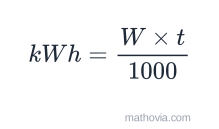
An appliance’s wattage tells you how fast it uses energy. Multiply that rate by how long it runs and you get the energy it consumes — watt-hours, or after dividing by 1,000, kilowatt-hours. Kilowatt-hours are the unit your utility bills against, so this conversion is the step between “this heater is 1,500 W” and “this heater costs X per month.”
The watts to kWh formula
Worked example
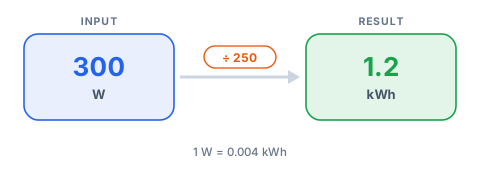
The calculator’s defaults are 300 W running for 4 hours.
Watt-hours:
Kilowatt-hours:
At a rate of 16 cents per kWh, that 4-hour session costs about 19 cents. Repeat it daily and it’s roughly 36 kWh a month, close to 6 dollars.
Monthly energy and cost by wattage
Assuming the device runs the hours shown every day for a 30-day month, at 16 cents per kWh:
| Device | Watts | Hours/day | kWh/month | Cost/month |
|---|---|---|---|---|
| LED bulb | 9 | 5 | 1.35 | ~0.22 |
| Desktop PC | 150 | 6 | 27 | ~4.30 |
| Refrigerator (avg) | 120 | 24 | 86 | ~13.80 |
| Space heater | 1,500 | 4 | 180 | ~28.80 |
| Central AC | 3,500 | 6 | 630 | ~100.80 |
The pattern is clear: a low-wattage device left on all day can still cost less than a high-wattage one used briefly, but the big-ticket items — heating, cooling, anything resistive over 1,000 W — dominate a bill.
What the estimate assumes
The formula uses full rated wattage for the whole time entered. Appliances that cycle (fridges, AC, water heaters) or modulate their draw (variable-speed motors, dimmed lights) use less than rated watts times hours-plugged-in. For those, use a measured average from a plug-in meter, or scale the wattage by the fraction of time the device actually runs.
Common mistakes
- Using rated watts for a cycling appliance, which overstates energy and cost.
- Entering minutes as hours.
- Forgetting the ÷ 1,000, reporting watt-hours as kilowatt-hours.
For the reverse, use the kWh to watts calculator. For the kilowatt-scale version, see kW to kWh.
Appliances that cycle on and off
A fridge rated at 150 W doesn’t draw 150 W all day. Its compressor runs perhaps a third of the time. Multiply by that fraction to get a realistic daily figure:
Using the full 24 hours would triple the estimate to 3.6 kWh. A plug-in energy meter left on for a few days gives the real figure.
Standby power adds up
Devices on standby draw a few watts around the clock. A 5 W standby load running all year:
At 16 cents per kWh that’s about 7 dollars a year from one device that’s “off”. A home with ten such devices can spend 70 dollars a year on standby alone.
Sizing a battery or solar setup
The same kWh figure tells you how big a battery must be. The 1.2 kWh fridge load above, running from a 12 V battery, needs:
Allow roughly 10% more for inverter losses. Lead-acid batteries shouldn’t be drained much past half, so a battery bank of about 220 Ah is a sensible minimum for one day of that fridge.