
A 100 freestyle in a 25-yard pool and a 100 freestyle in a 50-meter pool are different races. The meter race is about 9% longer, and it has two fewer walls to push off. So a yards time can’t be turned into a long course time with a simple unit conversion; you need a distance factor and a turn adjustment. This converter does both, using the defaults most US club meet software applies.
How swim times are converted
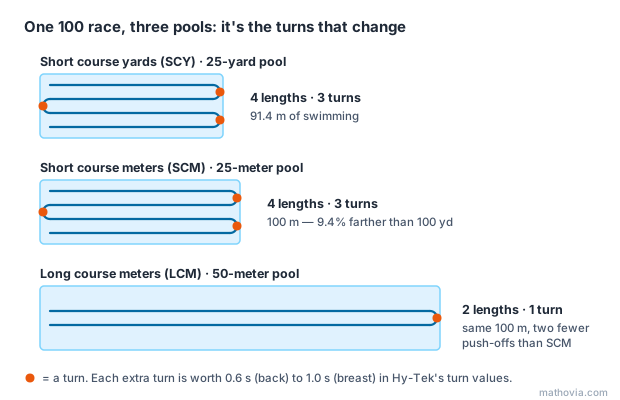
There are three pools in competitive swimming: short course yards (SCY, 25 yards), short course meters (SCM, 25 meters) and long course meters (LCM, 50 meters). Two things change between them.
The distance. A meter is longer than a yard, so every yards time is multiplied by a factor to get a meters time. For the standard events that factor is 1.11. The distance freestyle events pair up differently — the 500 yards stands in for the 400 meters, the 1000 for the 800, and the 1650 for the 1500 — so they get their own factors.
The turns. Every wall is a push-off and a streamlined glide, which is faster than swimming. A 25-meter pool has twice as many walls as a 50-meter one, so a long course swim loses time for every turn it doesn’t get. Each turn is given a fixed value by stroke:
| Stroke | Seconds per turn |
|---|---|
| Freestyle | 0.8 |
| Backstroke | 0.6 |
| Breaststroke | 1.0 |
| Butterfly | 0.7 |
| Individual medley | 0.8 |
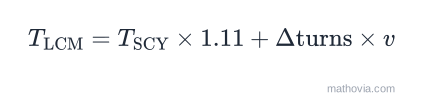
Putting it together, a yards time converts to long course like this:
where
The number of turns in a race is simply the number of lengths minus one. A 100 in a 25-yard or 25-meter pool is four lengths and three turns; in a 50-meter pool it is two lengths and one turn.
Worked example: 100 free, 50.00 in yards to long course
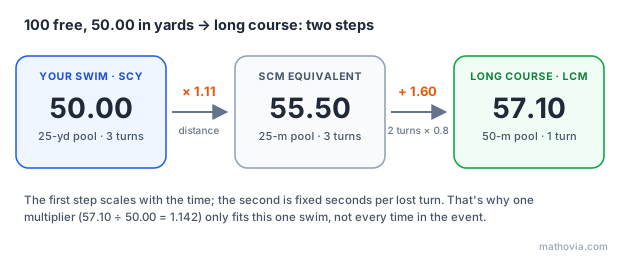
The calculator’s default: a 100 freestyle swum in 50.00 seconds in a 25-yard pool.
Step 1 — distance factor.
That is the short course meters equivalent.
Step 2 — turns. The yards race had 3 turns; a long course 100 has 1. Freestyle turns are worth 0.8 seconds each:
Step 3 — add them.
So a 50.00 in yards is roughly a 57.10 in a long course pool. A plain “multiply by 1.11” converter would say 55.50, which is really the short course meters time, not long course.
Going the other way: 100 breast, 1:10.00 long course to yards
Take off the turns first — breaststroke turns are worth 1.0 second, and there are two fewer in long course — then divide by the factor:
That’s a 1:01.26 in yards.
A distance event: 800 long course to 1000 yards
An 800 freestyle in 11:40.89 long course has 15 turns; a 1000 in yards has 39. Take off 24 turns at 0.8 seconds, then divide by the distance factor of 0.875:
or 12:59.07 for the 1000 yards. This is the example Hy-Tek uses to document its own method, so it’s a good check that the converter follows it.
Quick reference: 100 freestyle
| SCY | SCM | LCM |
|---|---|---|
| 45.00 | 49.95 | 51.55 |
| 50.00 | 55.50 | 57.10 |
| 55.00 | 1:01.05 | 1:02.65 |
| 1:00.00 | 1:06.60 | 1:08.20 |
| 1:05.00 | 1:12.15 | 1:13.75 |
Distance event factors
| Yards event | Meters event | Factor (yards → meters) |
|---|---|---|
| 500 free | 400 free | 0.875 |
| 1000 free | 800 free | 0.875 |
| 1650 free | 1500 free | 1.006 |
| All other events | same distance | 1.11 |
For long course, the turn difference is counted against the yards race, so a 500 yards (19 turns) against a long course 400 (7 turns) adds 12 turns’ worth.
How much to trust a converted time
A conversion gives the time an average swimmer would be expected to post, and real swimmers aren’t average. Sprinters with fast underwater work lose more than the standard turn value moving to long course, while swimmers with weak walls often convert up better than the table says. Distance events drift the most, because pacing over 1500 meters is not just a longer 1650.
Use a converted time for seeding, goal-setting and checking whether a cut is realistic. Many meets accept converted times only in specific cases, so check the meet information before you enter one.
Common mistakes
- Using 1.11 for long course. That gives the short course meters time. Long course also needs the turn adjustment.
- Converting the 500 as a 500. It pairs with the 400 meters, using 0.875, not 1.11.
- Adding turns in the wrong order. Going to a slower pool, apply the factor first, then add turns; coming back, remove turns first.
- Using the wrong stroke. Breaststroke turns are worth more than backstroke turns, so the same time converts differently.
For another way to track training, the strength level calculator rates your gym lifts against bodyweight standards.
Sources and assumptions
This calculator assumes:
- Conversions use the standard yards-to-meters factors and turn allowances used by meet software.
- Converted times are estimates; actual swims vary with pool, turns and conditions.
Sources:
- Hy-Tek Team Manager course conversion defaults, Hy-Tek Sports Software
Figures last reviewed: . Educational estimates, not professional advice.