
Turning Retirement Savings Into Income
A retirement balance only becomes useful when it can support spending. This calculator compounds current savings and planned contributions until retirement, then converts the projected balance into monthly withdrawals over the years between your retirement age and life expectancy.
The level-income result keeps the monthly payment constant. The inflation-adjusted result starts lower but increases each year at the assumed inflation rate, which is designed to preserve purchasing power more effectively. Neither result is guaranteed: actual market returns vary, and withdrawals during a market decline can permanently reduce the portfolio’s recovery potential.
Treat the output as a planning range. Test lower returns, longer life expectancy, and higher inflation. Also account separately for taxes, healthcare, fees, Social Security, pensions, and any income from property or part-time work.
How to Calculate Retirement Withdrawals
Step One: Grow the current balance
Compound current savings until the planned retirement age.
future value of current savings = currentSavings × (1 + annual return)^(retirementAge - currentAge)
$30,000 × 1.06^32 = $30,000 × 6.4534 = $193,602
Step Two: Add future contributions
Calculate the future value of monthly and annual contributions, then add both to the grown starting balance to get the balance at retirement.
future value of monthly deposits = monthlyContribution × (((1 + monthly return)^months - 1) / monthly return)
$500 × ((1.005^384 - 1) / 0.005) = $500 × 1,157.68 = $578,840
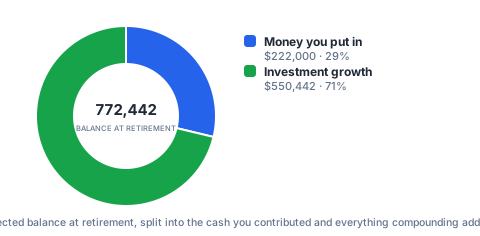
balance at retirement B = $193,602 + $578,840 = $772,442
Step Three: Calculate a level monthly payment
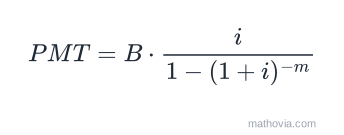
Use the ordinary annuity payment formula over the expected retirement months (
where
Step Four: Calculate an inflation-adjusted payment
Use the growing-annuity formula when withdrawals are intended to rise with inflation, where
The inflation-adjusted first payment is lower than the level payment because every subsequent payment steps up with inflation.
How return and retirement length change the income
Using the same 772,442-dollar balance at retirement, the level monthly income depends on the return during retirement and on how many months it has to last:
| Return in retirement | 18 years (216 months) | 25 years (300 months) |
|---|---|---|
| 4% | about 5,022 dollars | about 4,077 dollars |
| 5% | about 5,431 dollars | about 4,516 dollars |
| 6% | about 5,856 dollars | about 4,977 dollars |
| 7% | about 6,299 dollars | about 5,459 dollars |
Planning for a longer retirement lowers the monthly figure by roughly 15%. Because nobody knows their exact lifespan, many people plan to an age beyond their average life expectancy.
Level income or rising income?
The level payment stays at about 5,856 dollars a month for all 18 years, so its buying power shrinks. The inflation-adjusted payment starts lower, at about 4,641 dollars, and rises 3% a year. By year 10 it’s about 6,263 dollars a month, and in the final months it’s about 7,939 dollars. Both use up the same balance over the same period; they just spread the spending differently.
Common mistakes
- Comparing the payment with today’s spending. The balance and payments are in future dollars. Divide by the growth in prices since today to compare.
- Forgetting taxes. Withdrawals from many retirement accounts are taxable income, so the spendable amount is lower than the payment shown.
- Planning to life expectancy exactly. About half of people live longer than average. Running the calculation to a later age gives a safety margin.
- Ignoring other income. A pension or social security payment reduces what the savings must supply.
Sources and assumptions
This calculator assumes:
- Returns and inflation are constant every year.
- Income starts at the planned retirement age, shown both as a level monthly amount and as an amount that rises with inflation each year.
- Taxes, fees and required minimum distributions are not modeled.
Sources:
- Compound interest calculator, U.S. Securities and Exchange Commission (Investor.gov)
- Consumer Price Index (inflation data), U.S. Bureau of Labor Statistics
- Required minimum distributions FAQs, Internal Revenue Service
Figures last reviewed: . Educational estimates, not professional advice.