
How Long Can Retirement Savings Last?
A retirement balance can look large and still disappear quickly if withdrawals are too high. This calculator estimates the number of monthly payments available from a starting balance after applying a constant monthly return and a fixed withdrawal amount.
The result is useful for comparing scenarios. Try several withdrawal levels, reduce the expected return, and remember that inflation will usually push spending higher over time. The calculation does not model market volatility, taxes, fees, required distributions, healthcare costs, or changing spending patterns.
If the withdrawal is no greater than the interest earned in the first month, the simplified model reports an indefinite duration. That is a mathematical result, not a guarantee that the purchasing power of the account will remain intact.
How to Calculate Retirement Duration
Step One: Convert the annual return to a monthly return
Monthly withdrawals require a monthly rate.
monthly return = annual investment return / 12
6% / 12 = 0.5% per month
Step Two: Check the first month’s interest
Compare the first month’s interest with the planned withdrawal.
first month interest = startingBalance × monthly return
$600,000 × 0.005 = $3,000
Because the planned withdrawal is $5,000, it exceeds the first month’s interest and the balance declines.
Step Three: Solve for the number of payments
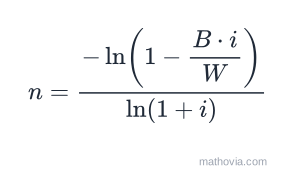
Use the declining-annuity duration formula, where
With
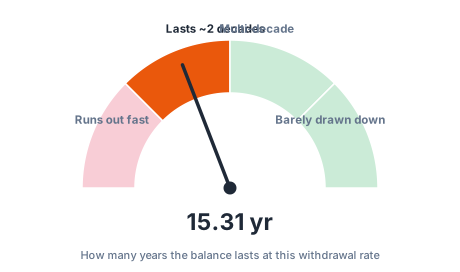
Step Four: Convert months into years
How much the return assumption matters
The return you enter changes the answer more than most people expect. Here is the same 600,000-dollar balance and 5,000-dollar monthly withdrawal at different constant annual returns:
| Annual return | Months | Years |
|---|---|---|
| 0% | 120.0 | 10.0 |
| 3% | 142.8 | 11.9 |
| 4% | 153.5 | 12.8 |
| 5% | 166.7 | 13.9 |
| 6% | 183.7 | 15.3 |
| 7% | 207.0 | 17.2 |
Moving from 6% to 4% takes about two and a half years off the result. Because real returns vary from year to year, it’s worth running a cautious return alongside your central estimate.
Allowing for inflation
The calculator holds the withdrawal flat, so each later payment buys a little less. One simple way to allow for inflation is to enter a real return: roughly the expected return minus expected inflation. With a 6% return and 3% inflation, enter about 3%. The answer then describes withdrawals that keep their buying power, and in this example the money lasts about 11.9 years instead of 15.3.
Finding a withdrawal that doesn’t run out
The calculation turns on the first month’s interest,
Common mistakes
- Entering the monthly return as the annual return. The calculator divides by 12 for you, so enter 6 for 6% a year, not 0.5.
- Using take-home spending as the withdrawal. Withdrawals from many retirement accounts are taxed, so the gross amount you take out is usually higher than what you spend.
- Ignoring other income. A pension or social security payment reduces how much the savings have to supply each month, which can lengthen the duration a lot.
- Treating the result as a guarantee. A run of poor returns early in retirement shortens the real duration even when the long-term average matches.
Sources and assumptions
This calculator assumes:
- The investment return is constant and compounds monthly.
- Withdrawals are the same amount every month and are not adjusted for inflation.
- Taxes and investment fees are not deducted.
Sources:
- Compound interest calculator, U.S. Securities and Exchange Commission (Investor.gov)
- Consumer Price Index (inflation data), U.S. Bureau of Labor Statistics
Figures last reviewed: . Educational estimates, not professional advice.