
Planning a Retirement Nest Egg
Retirement needs are driven by spending, not by a magic balance. This calculator estimates the amount your portfolio may need at retirement after accounting for your current income, expected raises, inflation, other retirement income, investment return, and the number of years you want the money to last.
Use the percentage target when you want retirement spending to track your final working income. A 75% target means the first year’s retirement income is based on 75% of your projected income at retirement. Use the dollar target when you already have a specific annual budget in mind. That amount is entered in today’s dollars and inflated to retirement.
The result is a planning estimate based on constant average rates. It does not model taxes, fees, changing returns, healthcare shocks, Social Security claiming choices, or portfolio risk. Try conservative and optimistic assumptions rather than treating one output as a promise.
How to Calculate the Retirement Nest Egg
Step One: Project income at retirement
Grow current income by the assumed annual income increase for each year until retirement.
projected final income = currentIncome × (1 + incomeGrowth / 100)^(retirementAge - currentAge)
$70,000 × 1.03^32 = $70,000 × 2.5751 = $180,256
Step Two: Set the first retirement income target
The percentage mode applies the chosen share to projected final income. The dollar mode inflates today’s annual target.
percent target = projected final income × retirementIncomePercent / 100
$180,256 × 75% = $135,192 per year
dollar target = retirementIncomeDollars × (1 + inflation / 100)^(retirementAge - currentAge)
$52,500 × 1.03^32 = $135,192 per year
Both targets land on the same figure here because $52,500 is exactly 75% of $70,000.
Step Three: Subtract other retirement income
Convert monthly outside income into annual income and grow it to the retirement date.
portfolio income needed = target income - otherIncome × 12 × (1 + inflation / 100)^years
$135,192 - $0 = $135,192 per year
Step Four: Find the required nest egg
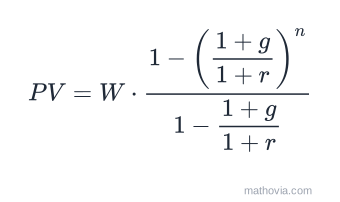
Discount the inflation-growing retirement withdrawals back to the retirement date using the growing-annuity present-value formula.
where
The growing-annuity factor works out to:
So the nest egg needed is:
This assumes withdrawals rise with inflation and continue through the selected life expectancy.
How the assumptions move the number
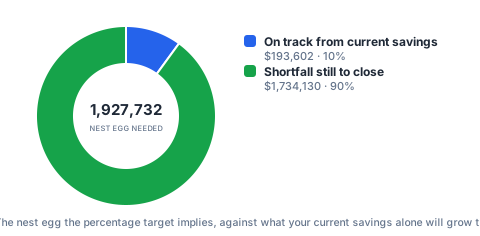
Using the default first-year target of 135,192 dollars and 3% inflation, here is the nest egg needed at retirement for different retirement lengths and investment returns:
| Years in retirement | 5% return | 6% return | 7% return |
|---|---|---|---|
| 18 (to age 85) | about 2.08 million | about 1.93 million | about 1.79 million |
| 23 (to age 90) | about 2.54 million | about 2.31 million | about 2.11 million |
| 28 (to age 95) | about 2.96 million | about 2.64 million | about 2.37 million |
Planning to 95 instead of 85 adds roughly 700,000 dollars at a 6% return. Because nobody knows how long they’ll live, many planners use an age beyond average life expectancy.
The effect of other income
Outside income comes straight off the amount the portfolio must supply. Suppose a pension or social security pays 2,000 dollars a month in today’s money. Grown at 3% for 32 years, that’s about 61,800 dollars a year at retirement, which leaves about 73,400 dollars a year for the portfolio. The nest egg needed falls from about 1.93 million to about 1.05 million dollars.
Comparing with the 4% rule
The 4% rule divides the first year’s spending by 0.04, which gives about 3.38 million dollars for the default target. That’s much higher than this calculator’s 1.93 million because the 4% rule aims for a portfolio that survives about 30 years of uncertain markets, while the default case here assumes a steady 6% return for 18 years. Neither number is right on its own. The gap between them shows how much the result depends on how long the money must last and how cautious the return assumption is.
Sources and assumptions
This calculator assumes:
- Income grows at the constant rate you enter until retirement.
- Your savings earn a constant return and your spending need lasts until the life expectancy you enter.
- Other income such as Social Security reduces the amount you need to cover yourself.
Sources:
- Retirement benefits, Social Security Administration
- Consumer Price Index (inflation data), U.S. Bureau of Labor Statistics
- Compound interest calculator, U.S. Securities and Exchange Commission (Investor.gov)
Figures last reviewed: . Educational estimates, not professional advice.