
Saving Toward a Retirement Target
This calculator works backward from the balance you want at retirement. It first compounds your existing savings, then calculates the regular deposits needed to grow the remaining gap to your target. You can use the monthly result for payroll or automatic transfers and the annual result for a yearly contribution plan.
The calculation assumes a constant average return and regular end-of-period contributions. Markets do not move in a straight line, so a target that looks reachable under a 6% average return can still be missed if poor returns arrive near retirement. Re-run the calculation with a lower return and a higher target to create a margin of safety.
The result also excludes taxes, account fees, employer matches, and contribution limits. Add employer contributions to your own savings plan before comparing it with the displayed required amount.
How to Calculate Retirement Savings
Step One: Count the years until retirement
Subtract your current age from your planned retirement age.
years = retirementAge - currentAge
67 - 35 = 32 years
Step Two: Grow current savings
Compound the balance you already have over the full saving period.
future value of current savings = currentSavings × (1 + investmentReturn / 100)^years
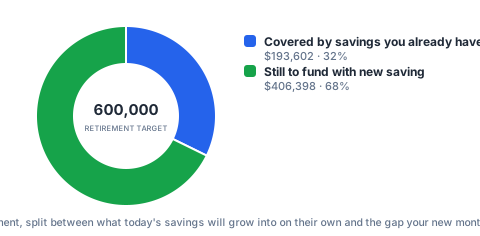
$30,000 × 1.06^32 = $30,000 × 6.4534 = $193,602
Step Three: Find the remaining gap
Subtract the future value of existing savings from your target.
remaining gap = targetBalance - future value of current savings
$600,000 - $193,602 = $406,398
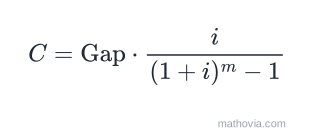
Step Four: Convert the gap into monthly savings
Use the future-value factor for monthly end-of-period deposits — this is the standard “sinking fund” formula.
where
The annual-contribution version of the same formula gives about $4,472 per year.
Starting age makes the biggest difference
Here is the monthly saving needed to reach 600,000 dollars by age 67, starting from zero, at a constant 6% return:
| Start saving at | Years of saving | Monthly saving needed |
|---|---|---|
| 25 | 42 | about 264 dollars |
| 35 | 32 | about 518 dollars |
| 45 | 22 | about 1,098 dollars |
| 55 | 12 | about 2,855 dollars |
Each ten-year delay roughly doubles the monthly amount, because the money saved has less time to compound. The calculator’s default case needs only about 351 dollars a month because the existing 30,000 dollars does a lot of the work.
How the return assumption changes it
For the default case (age 35, 30,000 dollars already saved, a 600,000-dollar target), different constant returns give:
| Annual return | Monthly saving needed |
|---|---|
| 4% | about 637 dollars |
| 5% | about 484 dollars |
| 6% | about 351 dollars |
| 7% | about 237 dollars |
A cautious return assumption builds in a margin. If returns come in higher, you finish ahead of target.
The target is in future dollars
A 600,000-dollar balance in 32 years won’t buy what 600,000 dollars buys today. At 3% inflation, it has the buying power of about 233,000 dollars today, since
Common mistakes
- Treating the target as today’s money. See the inflation note above.
- Leaving out an employer match. If an employer adds to your account, part of the required monthly amount is already covered.
- Assuming a high return to make the number smaller. It lowers the figure on screen, not the risk.
- Forgetting contribution limits. Tax-advantaged accounts cap yearly contributions, so a large required amount may need more than one account.
Sources and assumptions
This calculator assumes:
- The investment return is constant and savings are made monthly.
- The target amount is in future dollars; inflation is not applied on top of it.
- Taxes and investment fees are not deducted.
Sources:
- Compound interest calculator, U.S. Securities and Exchange Commission (Investor.gov)
- Consumer Price Index (inflation data), U.S. Bureau of Labor Statistics
Figures last reviewed: . Educational estimates, not professional advice.