
Markup and margin both describe the profit in a price, and they’re easy to mix up — which is how many small businesses end up earning less than they planned. Markup measures profit against what an item costs you; margin measures it against what you sell it for. This calculator works out both, turns a cost and markup into a selling price, and tells you the markup you need for the margin you actually want.
Markup and margin: the formulas
Both start from the same profit — the selling price minus the cost:
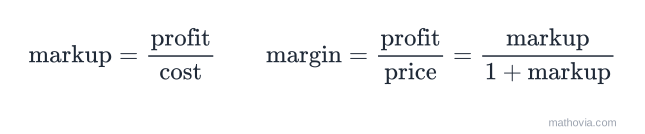
Markup divides that profit by the cost; gross margin divides it by the price:
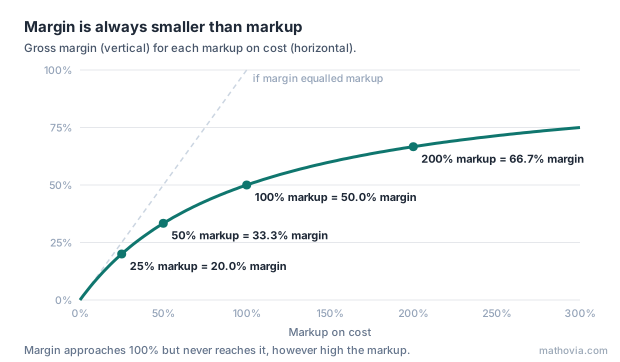
Because the price is always bigger than the cost (when you make a profit), the margin is always smaller than the markup. The two convert directly:
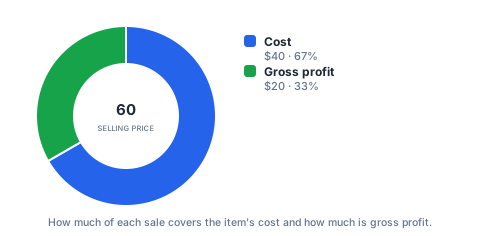
Worked example: a $40 item with a 50% markup
These are the calculator’s default values.
Step 1 — selling price.
Step 2 — gross profit. $60 − $40 = $20 per item.
Step 3 — gross margin.
So a 50% markup is only a one-third margin. On 100 units that’s $6,000 of revenue and $2,000 of gross profit.
Step 4 — pricing for a 40% margin instead.
That’s a markup of 66.67%. In other words, to keep 40% of every sale you add two-thirds to the cost, not 40%.
Markup to margin conversion table
| Markup on cost | Gross margin | Price of a $100-cost item |
|---|---|---|
| 10% | 9.09% | $110 |
| 20% | 16.67% | $120 |
| 25% | 20.00% | $125 |
| 33.33% | 25.00% | $133.33 |
| 42.86% | 30.00% | $142.86 |
| 50% | 33.33% | $150 |
| 66.67% | 40.00% | $166.67 |
| 100% | 50.00% | $200 |
| 150% | 60.00% | $250 |
| 200% | 66.67% | $300 |
| 300% | 75.00% | $400 |
The most common pricing mistake
Suppose you need a 30% margin to cover rent, wages and a profit. Adding 30% to a $40 cost gives $52 — but that’s a 23.1% margin, because $12 is 23.1% of $52. To really keep 30% of every sale you need:
a markup of 42.86%. On 1,000 sales the difference between the two prices is $5,140 of gross profit.
Discounts eat margin faster than you expect
A discount comes off the selling price, so it cuts straight into your margin. With a 100% markup (a 50% margin), a 20% sale leaves a 37.5% margin, and a 50%-off sale brings you exactly back to cost. Before running a promotion, check the margin at the discounted price, not the original one.
Gross profit is not net profit
Markup and gross margin only cover the cost of the goods themselves. Your net profit is what’s left after rent, wages, shipping, card fees, marketing and taxes. A shop with a healthy 50% gross margin can still lose money if its overhead eats more than half of revenue. That’s why businesses usually set markups by working backwards from the gross margin their overhead requires.
Common mistakes
- Adding the target margin to cost. A 30% margin needs a 42.86% markup.
- Quoting margin and meaning markup (or the reverse) when talking to suppliers, lenders or buyers.
- Pricing from the cost of goods alone. Include freight, packaging and payment fees in “cost” if you pay them per item.
- Forgetting discounts. Plan your markup so your margin survives your usual promotions.
This calculator gives gross figures before operating costs and taxes. It’s a pricing tool, not accounting advice.
Sources and assumptions
This calculator assumes:
- Markup is measured on cost and gross margin on selling price.
- Figures are before operating expenses, discounts and taxes.
Figures last reviewed: . Educational estimates, not professional advice.