Mathovia

Financial / Savings & Investing

CD Calculator

Enter your deposit, the CD's rate and its term. You'll see the balance at maturity, the interest earned before and after tax, and the rate converted between APY and APR. You'll also see roughly what an early-withdrawal penalty would cost you.

Balance at maturity
10,400.00 $
Interest earned
400.00 $
Interest after tax
312.00 $
Annual percentage yield (APY)
4.000 %
Equivalent interest rate (APR) at this compounding
3.928 %
After-tax yield per year
3.120 %
Approximate early withdrawal penalty
98.21 $
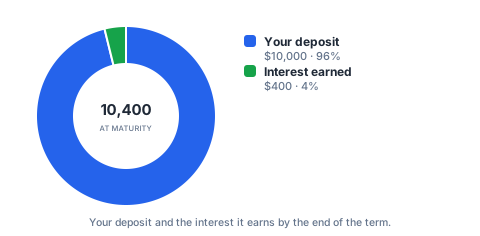
  • Your deposit$10,000 · 96%
  • Interest earned$400 · 4%
Your deposit and the interest it earns by the end of the term.

If you enter an APY, the balance at maturity is deposit × (1 + APY)^(months ÷ 12), whatever the compounding. If you enter an interest rate (APR), it is first turned into an APY with APY = (1 + APR ÷ n)^n − 1, where n is the number of compounding periods a year. The penalty is estimated as the stated number of months of interest at the CD's rate on the full deposit; banks' exact rules vary.

Source: National average deposit rates from the FDIC's National Rates and Rate Caps (September 2026): 12-month CD 1.73%, savings 0.37%. Deposit insurance limit of $250,000 per depositor, per insured bank, per ownership category from the FDIC. APY definition from the Truth in Savings Act (Regulation DD).

Written by
MPhil in Mathematics, Founder of Mathovia
Updated

Mathematics verification: Mathematical formulas, calculations, worked examples and solutions are reviewed for accuracy before publication. How we check our work

A certificate of deposit (CD) is a bank deposit with a fixed rate and a fixed term. You agree to leave the money alone for, say, a year. In return the bank usually pays more than a savings account and guarantees the rate for the whole term. This calculator shows exactly what a CD will pay: the balance when it matures, the interest before and after tax, and what cashing out early would cost.
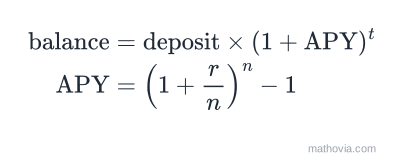
CD formulas: balance at maturity equals the deposit times one plus the APY raised to the term in years, and the APY equals one plus the interest rate over n, to the n, minus one
Maturity value from the APY, and the APY from an interest rate

How CD interest is calculated

Banks advertise CDs by their annual percentage yield (APY), the rate you actually earn in a year once compounding is included. If you know the APY, the value at maturity is simply:

where is the term in years (12 months is 1, 6 months is 0.5).

Some banks, and most loan-style quotes, give an interest rate or APR before compounding. To turn that into an APY, apply the compounding times a year:

Worked example: $10,000 for 12 months at 4% APY

These are the calculator’s default values.

Step 1 — balance at maturity.

So the CD earns $400 of interest.

Step 2 — after tax. CD interest is taxed as ordinary income. In the 22% federal bracket you keep:

That’s an after-tax yield of 3.12%, before any state income tax.

Step 3 — the same CD quoted as an interest rate. A 4% APY compounded monthly corresponds to an interest rate of:

Going the other way, a CD advertising a 4% interest rate compounded monthly pays a slightly better 4.074% APY.

Step 4 — breaking it early. With a penalty of 3 months’ interest, cashing out would cost about $98.21. Check your CD’s terms, because penalties vary widely.
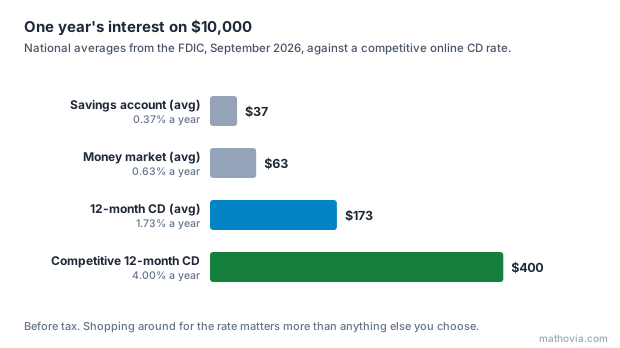
Bar chart of one year's interest on 10,000 dollars: 37 dollars in an average savings account, 63 in an average money market account, 173 in an average 12-month CD and 400 in a competitive 12-month CD at 4 percent
The rate you shop for matters more than the account type
CD Calculator worked example diagram
A visual read of the worked example above — the same numbers the calculator returns for its default inputs.

Shop the rate, not just the account

According to the FDIC’s national averages for September 2026, a typical savings account pays 0.37% and a typical 12-month CD 1.73%. Competitive online banks and credit unions often pay more than twice that average. On $10,000 for a year that’s the difference between $173 and $400 of interest, for the same safety, since both are federally insured.

Longer isn’t always better, either. In the FDIC’s September 2026 averages, 12-month CDs (1.73%) paid more than 36-month (1.36%) and 60-month (1.38%) ones. When long-term rates are lower than short ones, locking money up for five years earns you less, not more.

How compounding affects the result

4% interest rate compounded…APYInterest on $10,000 in one year
Annually4.000%$400.00
Quarterly4.060%$406.04
Monthly4.074%$407.42
Daily4.081%$408.08

The differences are small, and they only matter when banks quote interest rates. If two CDs both advertise a 4% APY, they earn exactly the same $400.

Building a CD ladder

A ladder spreads your money over CDs with staggered maturities. For example, you might put one-fifth each into 1-, 2-, 3-, 4- and 5-year CDs, then reinvest each one as it matures into a new 5-year CD. After the first few years, part of your savings matures every year. That gives you regular access to cash and a chance to catch higher rates, while the rest stays locked in at longer-term rates.

Common mistakes

  • Comparing an interest rate with an APY. Always compare APY to APY.
  • Forgetting the tax. Interest is taxed each year it’s credited, even inside a multi-year CD.
  • Ignoring the penalty. Only put money in a CD that you won’t need before it matures.
  • Letting it roll over automatically. Many CDs renew at the bank’s standard rate unless you act during the short grace period after maturity.

Estimates only. Rates, compounding and penalty rules vary by bank; your CD’s disclosure has the exact terms. Deposits are insured up to $250,000 per depositor, per insured bank, per ownership category.

Sources and assumptions

This calculator assumes:

  • The rate is fixed for the whole term and interest is left in the account.
  • The early-withdrawal penalty is estimated as months of interest on the full deposit; each bank sets its own rule.
  • Taxes on interest are not deducted.

Sources:

Figures last reviewed: . Educational estimates, not professional advice.

About the formula: If you enter an APY, the balance at maturity is deposit × (1 + APY)^(months ÷ 12), whatever the compounding. If you enter an interest rate (APR), it is first turned into an APY with APY = (1 + APR ÷ n)^n − 1, where n is the number of compounding periods a year. The penalty is estimated as the stated number of months of interest at the CD's rate on the full deposit; banks' exact rules vary.

Frequently Asked Questions

How much interest will a $10,000 CD earn?+

At 4% APY, a 12-month CD earns $400 on $10,000, leaving $10,400 at maturity. At the September 2026 national average of 1.73% for a 12-month CD, it would earn just $173. Over 5 years at 4% APY, the same deposit grows to $12,166.53.

What's the difference between APY and the interest rate?+

The interest rate (APR) is the rate before compounding. The APY includes the effect of interest earning interest over a year. A 4% rate compounded daily is a 4.081% APY; compounded monthly it's 4.074%. Banks must advertise the APY under the Truth in Savings Act, so use APY to compare CDs.

Does compounding frequency matter?+

Only if you're comparing interest rates. If two CDs quote the same APY, they earn exactly the same, whether they compound daily or monthly. Compounding is already built into the APY.

How is CD interest taxed?+

As ordinary income, at your regular federal rate plus any state income tax, in the year it's credited — even if you leave it in the CD. Your bank reports it on Form 1099-INT. CDs held in an IRA are taxed only when you withdraw (or not at all, in a Roth IRA).

What is the penalty for withdrawing a CD early?+

Usually a set number of months of interest, such as 3 months on a 1-year CD and 6 to 12 months on longer terms. On a $10,000 CD at 4% APY, 3 months of interest is about $98. If you haven't earned that much yet, the penalty can come out of your deposit.

Are CDs safe?+

CDs at FDIC-insured banks, or NCUA-insured credit unions, are protected up to $250,000 per depositor, per institution, per ownership category. The main risks are locking in a rate that later rises and inflation eating into the real return.

What is a CD ladder?+

Splitting your money across CDs that mature at different times, for example one-fifth each in 1-, 2-, 3-, 4- and 5-year CDs. Each year one matures, giving you access to cash and a chance to reinvest at current rates, while most of your money earns longer-term rates.

Related calculators