Mathovia

Financial / Loans & Interest

Credit Card Payoff Calculator

Enter your balance, APR and what you plan to pay each month. You'll see how long the card takes to clear and the total interest. You'll also get the payment that clears it by your chosen deadline, and a side-by-side look at what the minimum payment would cost.

Months to pay off at your payment
34 months
Does your payment cover the interest?
Yes — every payment covers the interest and reduces the balance
Total interest at your payment
1,749.88 $
Total paid (balance plus interest)
6,749.88 $
Interest charged in the first month
91.67 $
Monthly payment to be debt-free by your target
190.95 $
Total interest at that payment
1,874.28 $
Months to pay off with minimum payments only
197 months
Total interest with minimum payments only
7,673.04 $
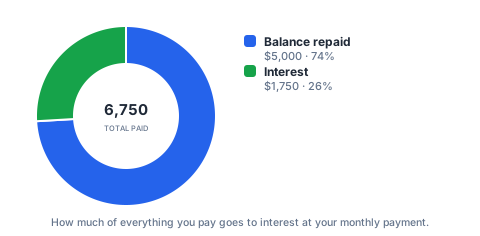
  • Balance repaid$5,000 · 74%
  • Interest$1,750 · 26%
How much of everything you pay goes to interest at your monthly payment.

With r = APR ÷ 12 ÷ 100, the number of payments is n = −ln(1 − r·B/P) ÷ ln(1 + r), rounded up; the last payment is smaller and interest is counted exactly. The payment that clears the balance in N months is P = r·B ÷ (1 − (1 + r)^−N). Minimum payments are modeled as the month's interest plus a percent of the balance, never less than the floor. Assumes no new purchases, fees or rate changes, and interest compounding monthly.

Source: Average credit card APR from the Federal Reserve's G.19 Consumer Credit release (Q2 2026: 22.15% on accounts assessed interest). Minimum payment disclosure requirements from the Credit CARD Act of 2009 as described by the Consumer Financial Protection Bureau. Payoff math is the standard amortization formula.

Written by
MPhil in Mathematics, Founder of Mathovia
Updated

Mathematics verification: Mathematical formulas, calculations, worked examples and solutions are reviewed for accuracy before publication. How we check our work

A credit card balance can feel like it never moves, and the reason is simple arithmetic. Every month, interest is added before your payment comes off, and at today’s rates that interest takes a big bite. This calculator shows exactly how long your balance will take to clear at the payment you choose. It also shows what that costs, the payment you’d need to be done by a date you pick, and how much slower and more expensive minimum payments would be.
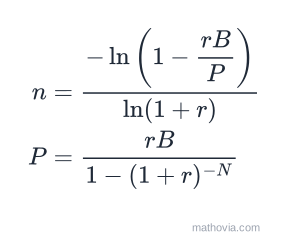
Credit card payoff formulas: number of months equals minus the natural log of one minus r times B over P, divided by the natural log of one plus r; the payment for N months equals r times B over one minus one plus r to the minus N
The two payoff formulas: months for a given payment, and payment for a given number of months

How the payoff is calculated

A credit card works like a loan with no fixed end date. Each month the balance grows by the monthly rate — the APR divided by 12 — and then your payment comes off. As long as is more than the month’s interest , the balance falls, and the number of payments it takes is:

Round that up to whole months. The last payment is just whatever is left. Turned around, the payment that clears the card in exactly months is:

If your payment is less than or equal to the monthly interest, the balance never falls. The calculator flags that straight away.

Worked example: $5,000 at 22% APR

Take a $5,000 balance at 22% APR, paid off at $200 a month with no new purchases. These are the calculator’s default values.

Step 1 — monthly rate and first month’s interest.

So of the first $200 payment, $91.67 is interest and only $108.33 reduces the balance.

Step 2 — number of payments.

That’s 34 payments: 33 of $200 and a final one of about $150.

Step 3 — total interest. Adding up every payment gives $6,749.88, so the interest comes to $1,749.88. That’s 35% on top of what you borrowed.

Step 4 — clearing it in three years instead.

Paying $190.95 a month clears the card in 36 months with $1,874.28 of interest. That’s slower and more expensive than $200, which shows how much a small extra amount each month is worth.
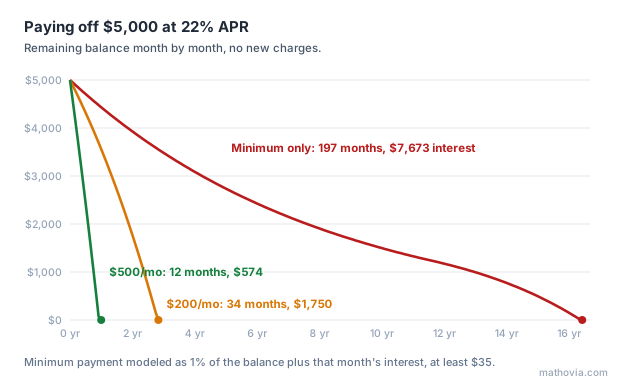
Line chart of a 5,000 dollar credit card balance at 22 percent APR falling to zero in 12 months at 500 dollars a month, 34 months at 200 dollars a month, and 197 months with minimum payments
The same $5,000 balance, three ways to pay it
Credit Card Payoff Calculator worked example diagram
A visual read of the worked example above — the same numbers the calculator returns for its default inputs.

How your payment changes the cost

For a $5,000 balance at 22% APR:

Monthly paymentMonths to pay offTotal interest
Minimum only (1% + interest, $35 floor)197$7,673
$15052$2,798
$20034$1,750
$30021$1,022
$50012$574

Going from $150 to $200 a month, just $50 more, cuts 18 months and over $1,000 of interest. The first extra dollars save the most, because they attack the balance while it is largest.

The minimum payment trap

Most issuers set the minimum at about 1% of the balance plus that month’s interest and fees, or a flat amount such as $25 to $40 if that’s higher. Because the minimum shrinks as the balance shrinks, you never get ahead. Each month you repay only about 1% of what you owe. On $5,000 at 22%, minimum payments stretch to 197 months, over 16 years, and cost $7,673 in interest.

That’s why the Credit CARD Act of 2009 requires your monthly statement to show how long payoff takes if you pay only the minimum. It must also show the monthly payment that would clear the balance in three years. The calculator’s target field defaults to 36 months so you can compare it with your statement. Your card’s exact minimum rule is in its terms; enter its percentage and floor to match it.

Ways to pay it off faster

  • Pay a fixed amount, not the minimum. Choose a payment and keep making it even as the balance drops. That alone turns a 16-year payoff into a few years.
  • Stop adding to the balance. Every new purchase restarts the clock. The calculator assumes no new charges.
  • Use a 0% balance transfer. Transfer fees are usually 3% to 5%. For $5,000 that’s $150 to $250, about what two to three months of interest cost at 22%. To clear it within an 18-month promotion, pay about $286 a month (the $5,000 plus a 3% fee, divided by 18).
  • Ask for a lower rate. Issuers sometimes cut the APR for customers with a good payment history, and every point lowers your interest.
  • Pick an order for several cards. The avalanche method, highest APR first, saves the most interest. The snowball method, smallest balance first, gives faster wins.

Common mistakes

  • Paying less than the monthly interest. The balance will grow, not shrink.
  • Using the purchase APR for a cash advance. Cash advances usually carry a higher rate and no grace period.
  • Forgetting the promotional rate ends. Anything left after a 0% period is charged the regular APR.
  • Counting on the minimum to finish the job. It’s designed to keep you paying for years.

Estimates only. Your issuer calculates interest daily on your average daily balance, so real statements differ by small amounts, and fees, new purchases or rate changes will change the result.

Sources and assumptions

This calculator assumes:

  • No new purchases, fees or rate changes while you pay the balance down.
  • Interest is charged monthly at APR ÷ 12 on the remaining balance.
  • Minimum payments are modeled as interest plus a percentage of the balance; card issuers set their own formulas.

Sources:

Figures last reviewed: . Educational estimates, not professional advice.

About the formula: With r = APR ÷ 12 ÷ 100, the number of payments is n = −ln(1 − r·B/P) ÷ ln(1 + r), rounded up; the last payment is smaller and interest is counted exactly. The payment that clears the balance in N months is P = r·B ÷ (1 − (1 + r)^−N). Minimum payments are modeled as the month's interest plus a percent of the balance, never less than the floor. Assumes no new purchases, fees or rate changes, and interest compounding monthly.

Frequently Asked Questions

How long will it take to pay off my credit card?+

It depends on the balance, the APR and your payment. At 22% APR, a $5,000 balance takes 34 months with $200 payments and 12 months with $500 payments. If you pay only the minimum, it can take more than 16 years. Enter your own numbers above to see your exact date.

How is credit card interest calculated?+

Card issuers charge interest daily on your average daily balance, using the APR divided by 365. Over a month that comes to roughly the APR divided by 12. So a $5,000 balance at 22% APR costs about $91.67 in interest in the first month.

What happens if I only pay the minimum?+

Most of each minimum payment goes to interest, and the payment shrinks as the balance shrinks, so it takes years to clear. With a typical rule of 1% of the balance plus interest, at least $35, a $5,000 balance at 22% takes 197 months and costs $7,673 in interest — more than the original balance.

How much do I need to pay to be debt-free in 3 years?+

Use the target field: for $5,000 at 22% APR, $190.95 a month clears the card in 36 months, with $1,874.28 of total interest. Your statement shows a similar 36-month figure, because the Credit CARD Act requires issuers to print it.

Is a balance transfer worth it?+

Often, if you can clear the balance during the 0% period. A typical transfer fee is 3% to 5%, so moving $5,000 costs about $150 to $250 upfront. That's far less than a year of interest at 22%. The risk is what's left when the promotional rate ends, so divide the balance by the number of 0% months to set your payment.

Should I pay off the highest-interest card first?+

Mathematically, yes. The avalanche method pays the minimum on every card and puts extra money toward the highest APR, which minimizes total interest. The snowball method clears the smallest balance first, which costs a little more but gives quick wins that help some people stick with it.

What is the average credit card interest rate?+

According to the Federal Reserve, the average rate on credit card accounts that were charged interest was 22.15% in the second quarter of 2026. The average across all accounts, including those that pay in full, was 20.94%.

Related calculators