
Dividends are the part of a company’s profit it pays out to shareholders, usually every quarter. They’re the closest thing investing has to a paycheck. This calculator answers the two questions most dividend investors ask. How much income does my money pay now, and how much will it pay later, especially if I reinvest the dividends instead of spending them?
Dividend income today
The starting point is the dividend yield — the annual dividend per share divided by the share price:
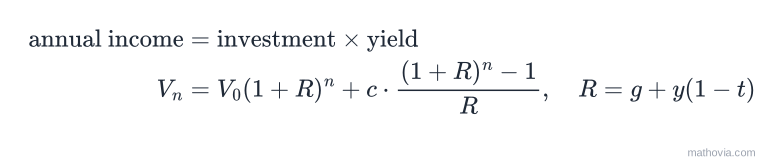
Your annual income is simply the amount invested times the yield. With $10,000 in a fund yielding 3.5%:
That’s about 29 dollars a month. Most US companies pay quarterly, so in practice it arrives as four payments of about 87.50 dollars.
How reinvesting makes dividends compound
If you reinvest your dividends, through your broker’s DRIP option or by buying more shares yourself, each payment buys shares that pay dividends of their own. After tax, the portfolio then grows each year at the share price growth
where
Worked example: $10,000 plus $6,000 a year for 20 years
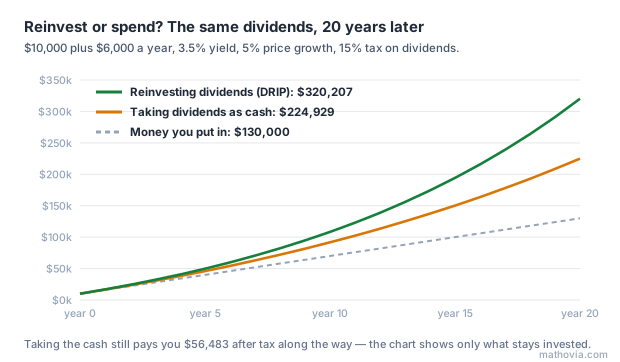
The calculator’s defaults: $10,000 to start, $6,000 added every year, a 3.5% yield, 5% share price growth and a 15% tax rate on dividends.
Step 1 — growth rate with reinvestment.
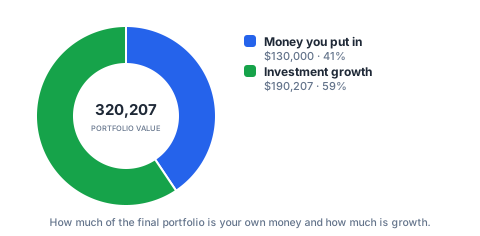
Step 2 — value after 20 years.
Step 3 — income by then. At the same 3.5% yield, that portfolio pays $11,207.24 a year, about $934 a month. That’s 32 times the $350 it paid in year one. In total you’d have received $83,476 of dividends along the way, all reinvested.
Step 4 — the same money, taking the cash. Without reinvesting, the portfolio grows at 5% and ends at $224,928.70, paying $7,872.50 a year. You’d have pocketed $56,482.58 of after-tax dividends over the 20 years. Even adding that cash back, you finish about $39,000 behind the reinvesting investor.
How much you need for a dividend income goal
Turn the yield formula around to find the portfolio needed for a target income:
| Monthly income wanted | At 3% yield | At 4% yield | At 5% yield |
|---|---|---|---|
| $500 | $200,000 | $150,000 | $120,000 |
| $1,000 | $400,000 | $300,000 | $240,000 |
| $2,000 | $800,000 | $600,000 | $480,000 |
| $5,000 | $2,000,000 | $1,500,000 | $1,200,000 |
These are before tax. A higher yield needs less money, but it usually comes with less growth, or more risk of a cut.
How dividends are taxed
In a regular brokerage account, dividends are taxed in the year they’re paid, even if they’re reinvested. Qualified dividends, from US companies and many foreign ones held for more than 60 days around the ex-dividend date, get the long-term capital gains rates. For 2026 those are 0% on taxable income up to $49,450 (single) or $98,900 (married filing jointly), 15% up to $545,500 or $613,700, and 20% above. Ordinary dividends, including most REIT distributions and interest-like payouts, are taxed at your regular income tax rate. Higher earners may also owe the 3.8% net investment income tax.
Inside an IRA, 401(k) or other tax-advantaged account, dividends aren’t taxed as they’re paid. For those, set the tax rate to 0.
Watch out for yield traps
A very high yield is often a sign that the share price has fallen because investors expect the dividend to be cut. When that happens you lose on both the price and the income. Check how much of its earnings the company pays out (the payout ratio). Look at whether its dividends have kept pace over the last decade, not just at this year’s yield.
Common mistakes
- Assuming the yield stays fixed while the price soars. If the dividend doesn’t grow with the price, the yield falls. This calculator assumes the two grow together.
- Forgetting the tax on reinvested dividends. It’s due each year even though you never see the cash.
- Comparing a DRIP with spending the dividends. The fair comparison adds back the cash you took, as in the worked example.
- Chasing the highest yield. Total return — price growth plus dividends — is what builds wealth.
Projections only. Real dividends, prices and tax rates change from year to year, and past yields don’t guarantee future income.
Sources and assumptions
This calculator assumes:
- The dividend yield and the share-price growth rate stay constant.
- Contributions are added once a year at the end of the year.
- One flat tax rate applies to dividends; brokerage fees are not included.
Sources:
- Topic no. 404, Dividends, Internal Revenue Service
- About Form 8960, Net Investment Income Tax, Internal Revenue Service
- Tax inflation adjustments for tax year 2026, Internal Revenue Service
Figures last reviewed: . Educational estimates, not professional advice.