Mathovia

Electrical / Power & Wattage

Kilowatt-Hours (kWh) to Kilowatts (kW) Conversion Calculator

Calculate average power from energy and operating hours.

Average Power
3.000 kW
0051.25102.5153.75205kWhkW12 kWh3 kW
1 kWh = 0.25 kW

Use the stated electrical relationship and enter values in the displayed units.

Source: Formula conventions follow standard electrical engineering relationships. Verify equipment ratings and local code requirements before installation.

Written by
MPhil in Mathematics, Founder of Mathovia
Published

Mathematics verification: Mathematical formulas, calculations, worked examples and solutions are reviewed for accuracy before publication. How we check our work

Kilowatt-Hours (kWh) to Kilowatts (kW) Conversion Calculator formula
The Kilowatt-Hours (kWh) to Kilowatts (kW) Conversion formula

Turning an energy total into a power figure

A kilowatt-hour is energy already spent; a kilowatt is the rate it was spent at. Divide the energy by the time it covered and you get the average power over that span. It’s the same arithmetic as getting average speed from distance and time.

This is useful for reading a bill or a meter backward: your utility statement gives total kWh over a billing period, a smart plug logs kWh for one device, and dividing by the hours involved tells you the average load.

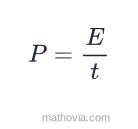
The kWh to kW formula

is average power in kW, is energy in kWh, and is time in hours. Both sides are kilowatt-based, so there’s no conversion factor.

Worked example

The calculator’s defaults are 12 kWh used over 4 hours.

The load averaged 3 kW. If it was a single appliance running steadily, 3 kW is also close to its actual draw. If it was a whole house, the 3 kW average hides big swings — near zero overnight, well above 3 kW when the oven and dryer ran together.
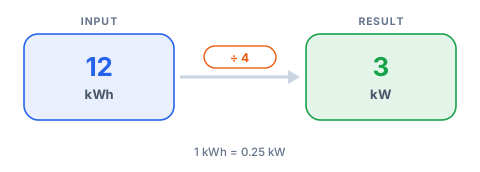
Kilowatt-Hours (kWh) to Kilowatts (kW) Conversion Calculator worked example diagram
A visual read of the worked example above — the same numbers the calculator returns for its default inputs.

Average power from a monthly bill

Monthly useHours in monthAverage power
300 kWh7300.41 kW
600 kWh7300.82 kW
900 kWh7301.23 kW
1,500 kWh7302.05 kW

A typical home’s round-the-clock average is only one to two kilowatts, even though its peak draw is several times that. The gap between average and peak is exactly what utility demand charges are built to capture.

What this doesn’t give you

The result is an average, not a peak. Loads that cycle — an AC compressor, a well pump, a thermostatically controlled heater — spend part of the time at full power and part at zero, so their instantaneous draw is higher than this figure whenever they’re actually running. For generator sizing or service-capacity questions, you need the peak, which comes from a demand meter or from adding up the largest loads that can run at once, not from a long-run average.

Common mistakes

  • Reading the average as a peak. They can differ by 3× or more for a house.
  • Mixing minutes and hours. 90 minutes is 1.5 hours.
  • Using it to size a generator. Size for peak, not average.

For the reverse, use the kW to kWh calculator. For the watt-scale version, see kWh to watts.

About the formula: Use the stated electrical relationship and enter values in the displayed units.

Frequently Asked Questions

How do I convert kWh to kW?+

Divide the energy in kilowatt-hours by the number of hours it was used over: kW = kWh ÷ hours. 12 kWh over 4 hours averages 3 kW.

What's the difference between kWh and kW?+

kW is power — the rate of energy use right now. kWh is energy — the total piled up over time. A 3 kW heater draws 3 kW whenever it's on; run it 4 hours and it uses 12 kWh.

My house used 900 kWh last month. What's my average power?+

A 30-day month is 720 hours, so 900 ÷ 720 = 1.25 kW average. Peak draw is much higher — several kW when the oven, dryer, or AC runs — but the round-the-clock average is modest.

Does this give my peak demand?+

No. It's the average over the period you enter. Utility demand charges are based on the highest short-window average (often 15 minutes), which a whole-day or whole-month average smooths away.

Can I use this to size a generator?+

Only loosely. A generator has to cover the peak load, not the average. If your daily average is 1.5 kW but the well pump and AC together pull 6 kW, size for the 6 kW.

How do I go the other way, from kW to kWh?+

Multiply power by hours: kWh = kW × hours. A steady 3 kW for 4 hours is 12 kWh.

Related calculators