
A 250 kg total is a big number for a 60 kg lifter and an ordinary one for a 140 kg lifter. DOTS turns a total into a score that accounts for that, so the best lifter at a meet can be picked across every weight class. This calculator gives your score, the multiplier behind it, and the total you’d need to hit a target.
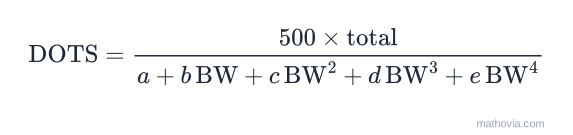
The DOTS formula
The total and bodyweight (BW) are both in kilograms. The five coefficients describe how strength typically rises with bodyweight, separately for men and women:
| Coefficient | Men | Women |
|---|---|---|
| a | −307.75076 | −57.96288 |
| b | 24.0900756 | 13.6175032 |
| c | −0.1918759221 | −0.1126655495 |
| d | 0.0007391293 | 0.0005158568 |
| e | −0.000001093 | −0.0000010706 |
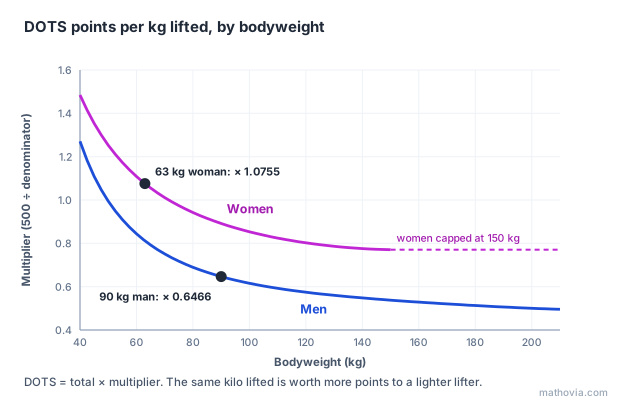
Bodyweight is held between 40 and 210 kg for men and 40 and 150 kg for women, the range the curve was fitted over. A 170 kg woman is scored as if she weighed 150 kg.
It helps to think of the bottom of the fraction as a multiplier.
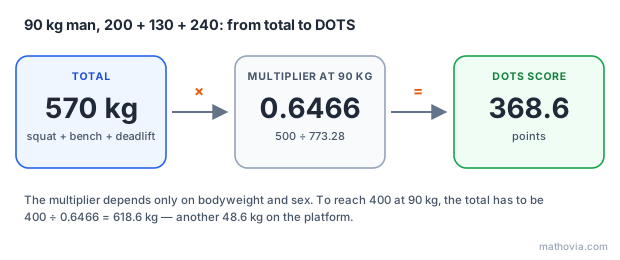
Worked example: a 90 kg man with a 570 kg total
He squats 200 kg, benches 130 kg and deadlifts 240 kg — the calculator’s default values.
Step 1 — the total.
Step 2 — the denominator at 90 kg, with the men’s coefficients:
Step 3 — the score.
Put another way, every kilo on his total is worth
Step 4 — a target. To reach 400 at the same bodyweight he needs a total of
A second example: a 63 kg woman
A woman weighing 63 kg totals 400 kg. With the women’s coefficients her denominator is 464.89, so her score is
Comparing lifters of different sizes
This is what DOTS is for. Take two men:
| Lifter | Bodyweight | Total | DOTS |
|---|---|---|---|
| A | 70 kg | 550 kg | 413.1 |
| B | 110 kg | 700 kg | 414.6 |
Lifter B totals 150 kg more, but on DOTS the two performances are almost identical, with B only just ahead. That matches the intuition most coaches have: gaining 40 kg of bodyweight should buy you a lot more total, and B got about what you’d expect for his size.
Two ways to raise your DOTS
There are only two levers: a bigger total or a lighter bodyweight. For the 90 kg man above:
| Change | New DOTS |
|---|---|
| None — 570 kg at 90 kg | 368.6 |
| Add 5 kg to the total | 371.8 |
| Lose 1 kg of bodyweight, same total | 370.7 |
| Cut to 83 kg, same total | 384.8 |
| Gain 10 kg of bodyweight, same total | 350.8 |
Near 90 kg, a kilo off bodyweight is worth about as much as 3 kg on the total, as long as strength holds. That’s why lifters chasing a best-lifter award often compete at the bottom of their natural weight range. It works the other way too. Gaining 10 kg only pays off if the total climbs by about 29 kg to 598.8 kg, just to stand still on DOTS.
In practice, total wins over time. Cutting weight has a floor and costs strength, while a total can keep rising for years.
DOTS, Wilks and IPF GL points
Several formulas do the same job, and the one that counts depends on the federation:
- DOTS — introduced in 2019 and the default ranking on OpenPowerlifting. Widely used for best-lifter awards.
- Wilks — the long-standing formula, criticised for favouring some weight classes; a revised version followed in 2020.
- IPF GL points — the IPF’s own formula, with separate coefficients for raw and equipped lifting and for full power and bench only.
Scores from different formulas are on different scales, so a 400 DOTS is not a 400 Wilks. Compare like with like.
Pounds and kilograms
The formula works in kilograms. If you lift in pounds, choose pounds and enter everything in pounds: the calculator divides by 2.20462262 before scoring, so the DOTS is exactly the same. A 198.4 lb lifter with a 1256.6 lb total scores the same 368.6 as the 90 kg, 570 kg example.
Common mistakes
- Mixing units. Bodyweight in pounds with a total in kilograms gives a meaningless score.
- Using gym numbers. DOTS rankings use competition lifts judged to a standard; a gym squat with generous depth isn’t the same.
- Comparing raw and equipped scores. Supportive suits and shirts add a lot of weight; compare within the same category.
- Reading DOTS as a strength level. It ranks totals against other lifters’ bodyweights. For a guide to where a single lift sits, use the strength level calculator.
Sources and assumptions
This calculator assumes:
- Bodyweight and lifts are in kilograms, using the DOTS coefficients for each sex.
- Bodyweight is clamped to the formula’s published range before scoring.
Sources:
- OpenPowerlifting (DOTS scoring), OpenPowerlifting
Figures last reviewed: . Educational estimates, not professional advice.