
A 529 plan is a state-sponsored investment account for education. What you put in grows free of federal income tax, and withdrawals are tax-free too when they pay for college and other qualified education costs. This calculator projects what your account will be worth by the time your child starts college. It sets that against what college is likely to cost by then, and tells you the monthly amount that would cover the whole bill.
How the projection works
Two numbers matter: what you’ll have, and what you’ll need.
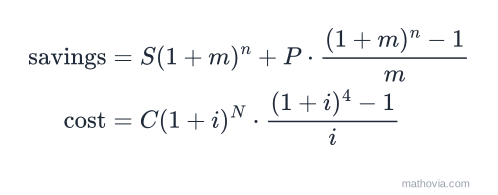
What you’ll have. With a current balance
What you’ll need. College prices rise every year. If a year costs
The calculator compares the two and, if there’s a gap, works out the monthly contribution
Worked example: a 5-year-old headed to a public university
Take a 5-year-old with $10,000 already saved and $250 added every month. The plan earns 6% a year, and today’s cost is $25,850 a year, the College Board’s average for in-state tuition, fees, housing and food at a public four-year college, rising 4% a year. These are the calculator’s default values.
Step 1 — savings at 18. That’s 13 years, or 156 months, at a monthly rate of 0.5%:
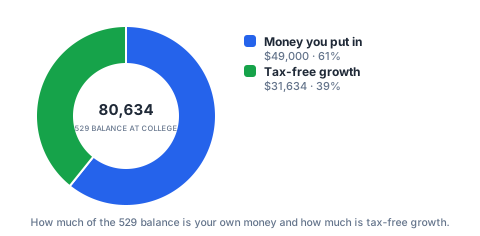
You’ll have put in $49,000; the other $31,634.20 is tax-free growth.
Step 2 — the cost of college by then. The first year, 13 years from now:
All four years together come to $182,776.94.
Step 3 — the gap. The plan covers 44.1% of that, leaving a shortfall of $102,142.74. To cover the full amount, the monthly contribution would need to rise from $250 to $683.82.
That doesn’t mean the plan is failing. Many families aim to cover part of the cost with savings and the rest from income during college, scholarships, grants or a modest loan. The point is to know the number, and to choose it rather than discover it.
Why starting early matters so much
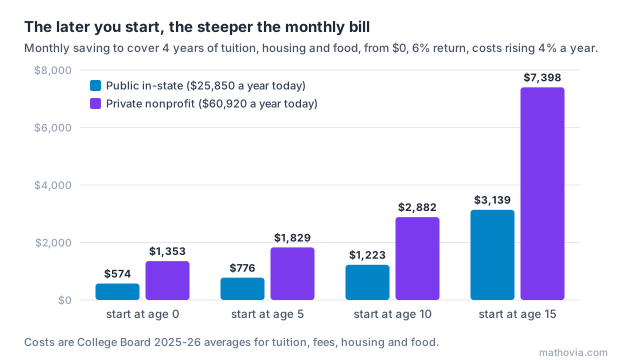
Time does two things for a 529. It spreads the cost over more months, and it gives the growth longer to compound. To fund four years at an average in-state public university from a zero balance, you’d need about $574 a month from birth, $776 from age 5, $1,223 from age 10 and $3,139 from age 15. For an average private college, multiply by roughly 2.4. The same age-5 start needs about $1,829 a month.
College costs to plan for
| Type of college (2025-26 average) | Tuition and fees | Plus housing and food | Full budget with books, transport and other costs |
|---|---|---|---|
| Public two-year, in-district | $4,150 | $15,000 | $21,320 |
| Public four-year, in-state | $11,950 | $25,850 | $30,990 |
| Public four-year, out-of-state | $31,880 | $45,780 | $50,920 |
| Private nonprofit four-year | $45,000 | $60,920 | $65,470 |
These are published prices before grants. Many students pay less: the College Board estimates that average grant aid covers much of the tuition at public four-year colleges. Use the price of the kind of school you have in mind, and remember that published prices have risen about 3% to 4% a year before inflation adjustment recently.
529 rules to know in 2026
- Qualified expenses: college tuition, fees, books, supplies and computers, plus housing and food for students enrolled at least half-time. They also cover registered apprenticeship costs, up to $10,000 of lifetime student loan repayments and, from 2026, up to $20,000 a year of K-12 tuition (raised from $10,000 by the One Big Beautiful Bill Act).
- Contributions: there’s no federal annual limit. Gifts up to $19,000 per person per beneficiary in 2026 need no gift tax paperwork, and five-year “superfunding” allows up to $95,000 at once ($190,000 for a married couple). Each state caps the total balance.
- State tax breaks: more than 30 states give a deduction or credit for contributions, usually only to their own state’s plan.
- Unused money: change the beneficiary to another family member, or roll up to $35,000 over a lifetime into the beneficiary’s Roth IRA once the account is 15 years old, within the yearly Roth limit.
- Non-qualified withdrawals: the earnings are taxed and hit with a 10% penalty. The penalty is waived up to the amount of a tax-free scholarship.
Common mistakes
- Planning with today’s prices. A $25,850 year today is about $43,000 a year when a 5-year-old reaches college, at 4% a year.
- Leaving the plan too aggressive near college. Most age-based portfolios shift toward bonds and cash as college approaches, so a market drop just before tuition is due does less damage.
- Forgetting housing and food. Tuition is less than half of the cost at a public university.
- Waiting for a raise to start. Even small amounts early beat larger amounts later.
Projections only. Investment returns and college prices vary, and state plan fees and tax rules differ. Check your state’s plan for its own limits and benefits.
Sources and assumptions
This calculator assumes:
- Contributions are made monthly and earn a constant return until college starts, then stop growing.
- College costs rise at the constant rate you enter.
- Plan fees, taxes on non-qualified withdrawals and financial aid are not modeled.
Sources:
- Trends in College Pricing, College Board
- 529 plans: questions and answers, Internal Revenue Service
- Tax inflation adjustments for tax year 2026, Internal Revenue Service
Figures last reviewed: . Educational estimates, not professional advice.