Most of a graph is hard to pin down to exact numbers. The places where it crosses the axes are the exception — those points almost always have clean coordinates, and they are the ones a graph gets labelled with. They are called the intercepts.
There are two to find. The

The Intercept Rules
The
Why Setting a Variable to Zero Works
Every point on the
The
Finding Intercepts Algebraically
Take
Two points, and for a line that is all you need. Plot
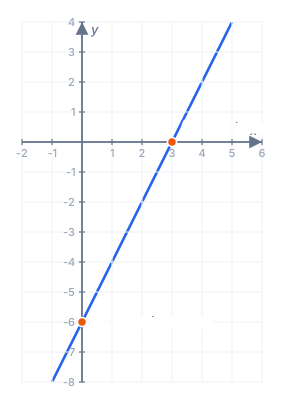
Intercepts of an equation in standard form
When the equation is written as
- Set
: , so . -intercept . - Set
: , so . -intercept .
Each intercept only involves one term, which is why standard form is convenient for sketching.
Reading Intercepts off a Graph
Going the other way, if the graph is already drawn:
- The
-intercept(s) are wherever the curve touches or crosses the horizontal axis. Read the -value there; the -value is . - The
-intercept is where the curve touches the vertical axis. Read the -value there; the -value is .
A function has at most one
When There Are None, or Many
No
No
Two
One
Infinitely many. The line
Worked Example A: Line From Slope-Intercept Form
Find both intercepts of
So
Worked Example B: Line in Standard Form
Find the intercepts of
Set
Set
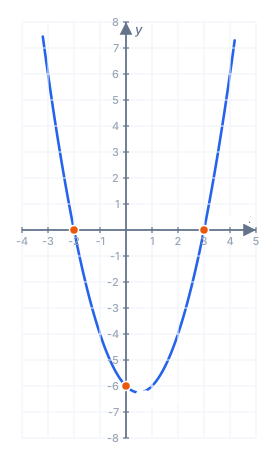
Worked Example C: A Parabola
Find the intercepts of
So
Worked Example D: No Real x-Intercept
Does
Set
Worked Example E: Intercepts of a Horizontal and a Vertical Line
: every point has . Setting gives the -intercept . Setting gives , false — no -intercept. : every point has . Setting gives the -intercept . Setting contradicts — no -intercept.
Common Mistakes to Avoid
- Swapping the two rules.
-intercept comes from ; -intercept comes from . Set the other variable to zero. - Writing an intercept as a single number. An intercept is a point. The
-intercept of is , not just , though “the -intercept is at ” is acceptable shorthand. - Stopping after one intercept on a parabola. Quadratics can cross the
-axis twice. Solve the whole equation. - Declaring “no intercept” too early.
is solvable — an -intercept exists. Only a contradiction like means there is none. - Forgetting the
-intercept is free in . It is — no work required. - Mixing up roots and the
-intercept. The -intercepts are the roots of the equation; the -intercept is the constant term when .
Where Intercepts Show Up Next
- Graphing lines. Two intercepts define a line, so this is the fastest sketch method for most linear equations.
- Slope-intercept form. The
in is the -intercept, read directly from the equation. - Solving equations. Finding
-intercepts of is the same as solving . - Quadratics. The
-intercepts of a parabola are its roots; the discriminant predicts how many there are. - Rational and higher-degree functions. Intercepts are among the first features you locate before sketching.
Practice Problems
Work each one before opening the answer.
Problem 1. Find the
Show answer
Problem 2. Find the intercepts of
Show answer
Problem 3. Find the intercepts of
Show answer
Problem 4. Find the intercepts of
Show answer
Problem 5. State the
Show answer
Slope-intercept form, so the
Problem 6. Find the intercepts of
Show answer
Problem 7. Find the intercepts of
Show answer
Problem 8. Does
Show answer
Set
Problem 9. What are the intercepts of the line
Show answer
Problem 10. What are the intercepts of the line
Show answer
Problem 11. A line has
Show answer
Plot
Problem 12. The
Show answer
Quick Reference
| Task | Do this | Result form |
|---|---|---|
| set | ||
| set | ||
| From | read off | |
| From | each intercept uses one term | |
| No real | graph misses the axis | |
| Parabola | up to two | solve the quadratic |
Intercepts are the fastest points to plot when graphing equations, and the