Slope is the number that answers two questions at once: how steep is this line, and which way does it lean? A road sign that says “8% grade” is reporting slope. So is the pitch of a roof, the gradient of a wheelchair ramp, and the rate on a pay-per-mile invoice.
For a straight line the slope is the same everywhere along it, which is what makes it a single, useful number. Pick any two points on the line, measure how much you go up and how much you go across between them, and divide.
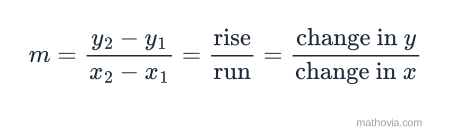
The Slope Formula
The rise is the vertical change between two points; the run is the horizontal change. Slope is rise divided by run.
The Four Kinds of Slope
The sign and size of
| Slope | Line looks like | Meaning |
|---|---|---|
| rises left to right | ||
| falls left to right | ||
| horizontal | no rise; | |
| vertical | no run; you would divide by zero |
Two lines with slopes
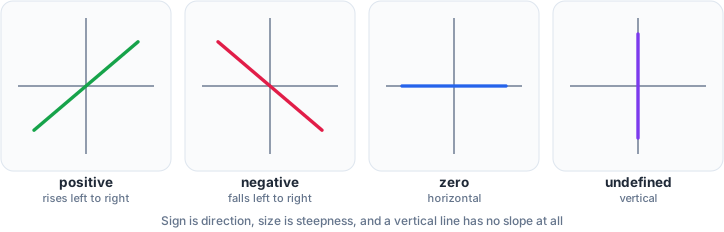
Zero versus undefined trips people up. A horizontal line has slope
Why the Order of the Points Does Not Matter
Take
Computing with the points swapped:
Swapping the points flips the sign of the top and the bottom, and two sign flips cancel. The only rule is consistency: whatever order you subtract the
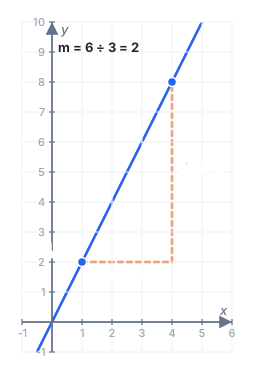
Reading Slope From a Graph
- Find two points where the line passes cleanly through grid intersections.
- Count the rise: how many units up (positive) or down (negative) from the left point to the right point.
- Count the run: how many units right (positive) — moving left to right keeps the run positive so the sign lives entirely in the rise.
- Divide rise by run and simplify.
If the line goes up as you read left to right, the slope is positive; if it goes down, negative. A quick gut check before you compute anything.
Slope as a Rate of Change
Slope is not only a geometry idea. Whenever a graph plots one real quantity against another, the slope is a rate:
- distance vs time → slope is speed (e.g. km per hour)
- cost vs number of items → slope is price per item
- water in a tank vs time → slope is fill rate (litres per minute)
- earnings vs hours worked → slope is the hourly wage
The units come straight from the axes: slope is measured in
Worked Example A: Positive Slope
Find the slope through
Positive, so the line rises. For every step right, it climbs two.
Worked Example B: Negative Slope
Find the slope through
Negative, so the line falls — down two for every one across.
Worked Example C: Zero Slope
Find the slope through
The
Worked Example D: Undefined Slope
Find the slope through
The
Worked Example E: A Fractional Slope
Find the slope through
Leave it as
Worked Example F: Slope as Speed
A car’s distance from home is
The slope is
Common Mistakes to Avoid
- Inconsistent subtraction order.
mixes the order and flips the sign. Subtract both the same way. - Run over rise. Slope is rise over run —
-change on top. - Calling a vertical line “zero slope.” Vertical is undefined; horizontal is zero.
- Dropping a sign when subtracting a negative.
, not . Negatives in the coordinates cause most slope errors. - Simplifying a fraction to a “nicer” wrong value.
is , not . - Reading rise and run off a graph without the scale. If one square is
units, a rise of “3 squares” is . - Assuming slope changes along a straight line. It does not — any two points give the same
. If yours do not, one point is misread.
Where Slope Shows Up Next
- Lines. Slope-intercept form
and point-slope form are both built around . - Parallel and perpendicular lines. Parallel lines share a slope; perpendicular slopes are negative reciprocals.
- Systems of equations. Two lines with the same slope never meet (no solution) or coincide (infinitely many).
- Calculus. The derivative is the slope of a curve at a single point — the same rise-over-run idea taken to a limit.
- Applications. Speed, unit price, interest rate, and rate of flow are all slopes of the right graph.
Practice Problems
Work each one before opening the answer.
Problem 1. Slope through
Show answer
Problem 2. Slope through
Show answer
Problem 3. Slope through
Show answer
Horizontal line.
Problem 4. Slope through
Show answer
Vertical line.
Problem 5. Slope through
Show answer
Problem 6. Compute the slope through
Show answer
Problem 7. A line rises
Show answer
Slope
Problem 8. A phone plan costs
Show answer
The slope is
Problem 9. The points
Show answer
Problem 10. A ramp rises
Show answer
Slope
Problem 11. A line has slope
Show answer
From
Problem 12. Two points on a line are
Show answer
The unknown
Quick Reference
| Idea | Detail |
|---|---|
| Formula | |
| In words | rise over run; change in |
| line rises left to right | |
| line falls left to right | |
| horizontal line | |
| vertical line (run | |
| Point order | either way, but subtract |
| As a rate |
Slope is the