A line is the simplest graph there is: any equation in which
There are three standard ways to write a line’s equation. They describe the same set of points; they just start from different information. Knowing which form fits the situation saves a lot of algebra.

The Three Forms
Slope-intercept form uses the slope
Slope-Intercept Form:
This is the form to graph from and to read from.
is the slope — the coefficient of . is the -intercept — the constant, giving the point .
To graph
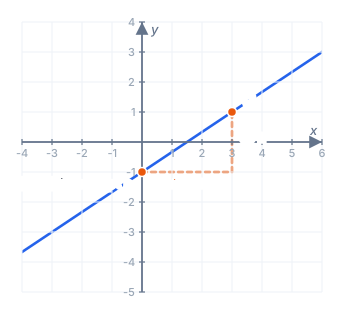
To read a line’s slope and intercept, get it into this form first.
Point-Slope Form:
This is the form to build a line from. Whenever you know a slope and a point, substitute and you are done — no solving for
Line with slope
The last step converts to slope-intercept form, which is usually the expected final answer. Point-slope is the scaffold; you rarely leave the equation in it.
Standard Form:
Conventionally
- Intercepts fast. Set
for the -intercept, for the -intercept — each uses only one term. - Vertical lines.
fits standard form ( ) but cannot be written as .
Convert
Writing a Line Through Two Points
- Slope from the two points:
. - Point-slope with that slope and either point.
- Simplify to the requested form.
Through
Using the other point,
Parallel and Perpendicular Lines
- Parallel lines have equal slopes and different
-intercepts. Parallel to means slope , so for any . - Perpendicular lines have slopes that are negative reciprocals — flip the fraction and change the sign. Perpendicular to slope
is slope . The product of perpendicular slopes is always (the one exception is a horizontal and a vertical line, where one slope is undefined).
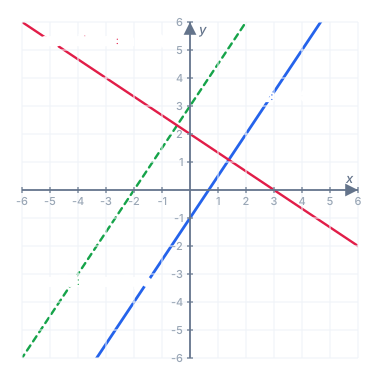
Line through
Horizontal and Vertical Lines
These are the two lines that break the usual pattern:
| Line | Equation | Slope | Notes |
|---|---|---|---|
| Horizontal | every point has height | ||
| Vertical | undefined | every point has |
A horizontal line has no
Worked Example A: Graph From Slope-Intercept Form
Graph
Start at
Worked Example B: Equation From a Point and a Slope
Write the line with slope
Worked Example C: Equation From Two Points
Write the line through
Check with the other point:
Worked Example D: Convert Between Forms
Put
Multiply by
Worked Example E: Parallel and Perpendicular
Line
- Parallel to
through : same slope , intercept → . - Perpendicular to
through : slope , then → .
Worked Example F: Horizontal and Vertical Through a Point
Give the horizontal and the vertical line through
- Horizontal: the height is fixed at
→ . - Vertical: the
-value is fixed at → .
Common Mistakes to Avoid
- Reading
as the slope. In , the slope is the number multiplying , not the constant. - Not solving for
before reading slope. has slope , not — rearrange to first. - Forgetting the negative when making a perpendicular slope. Perpendicular to
is ; flipping and sign-changing are both required. - Sign slips in point-slope.
becomes . Subtracting a negative point coordinate turns into addition. - Calling a vertical line “slope zero.” Vertical is undefined slope; horizontal is zero.
- Leaving fractions in standard form. Standard form wants integer
, , ; clear denominators first. - Assuming the two points must be used in a fixed order. Either point works in point-slope, and either order works in the slope formula, as long as
and subtractions match.
Where Lines Show Up Next
- Systems of equations. Two lines meet at the system’s solution — or never meet (parallel) or coincide (same line).
- Linear inequalities. Shading one side of a line is how a linear inequality is graphed.
- Functions. A non-vertical line is a linear function
; its rate of change is constant. - Regression and modelling. A line of best fit summarises a scatter of data with one slope and one intercept.
- Calculus. The tangent line to a curve is the straight line matching the curve’s slope at a point.
Practice Problems
Work each one before opening the answer.
Problem 1. State the slope and
Show answer
Slope
Problem 2. Rearrange
Show answer
Problem 3. Write the line with slope
Show answer
Problem 4. Write the line through
Show answer
Problem 5. Write the line through
Show answer
Problem 6. Convert
Show answer
Multiply by
Problem 7. Give a line parallel to
Show answer
Same slope:
Problem 8. Give a line perpendicular to
Show answer
Negative reciprocal slope
Problem 9. Write the equations of the horizontal and vertical lines through
Show answer
Horizontal
Problem 10. Are
Show answer
The second rearranges to
Problem 11. A line has
Show answer
Problem 12. Line
Show answer
The given line has slope
Quick Reference
| Form | Equation | Best for |
|---|---|---|
| Slope-intercept | graphing, reading slope and intercept | |
| Point-slope | building a line from a slope + a point | |
| Standard | fast intercepts, vertical lines | |
| Parallel | same slope | |
| Perpendicular | negative reciprocal slope | product of slopes |
| Horizontal | ||
| Vertical | not a function |
Every form is built on slope, the fastest points to plot are the x- and y-intercepts, and the table method for any equation is in Graphing Equations. For solving linear equations in one variable first, see Linear Equations. More Algebra lessons are available too.