Give a point on a flat surface a name and you can talk about it precisely. An ordered pair is that name: two numbers in parentheses, separated by a comma, that fix one location in the plane.
The idea is small, but it is the piece every graph is built from. A line is a collection of ordered pairs. A parabola is a collection of ordered pairs. When you check whether a point “is on” a graph, what you are really asking is whether its ordered pair makes the equation true. Get comfortable with the notation now and the rest of graphing stops feeling like guesswork.

The Ordered Pair Formula
A point is named by its horizontal position first and its vertical position second. Reverse the two numbers and, in every case except when they are equal, you have named a different point.
What the Two Numbers Mean
The pair
- The
-coordinate comes first. It is how far the point sits left or right of the origin — positive to the right, negative to the left. Older textbooks call it the abscissa. - The
-coordinate comes second. It is how far the point sits above or below the origin — positive up, negative down. The old name is the ordinate.
You will rarely need the words abscissa and ordinate again, but you will see them in exam questions and older books, so it helps to have met them once.
Why the Order Is Not Optional
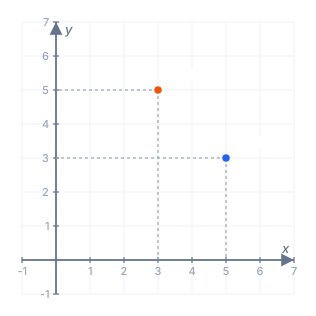
The whole reason these are called ordered pairs is that the sequence carries meaning. Compare:
The first is three units right and five units up. The second is five units right and three units up. Plot both and you get two clearly different dots. They only coincide when the coordinates match, as in
If you ever blank on which number comes first, the alphabet settles it:
Plotting an Ordered Pair
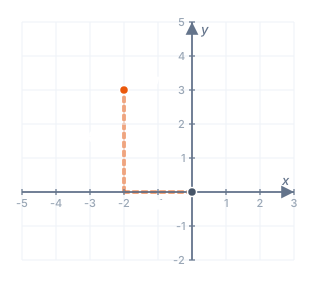
Plotting is always the same two moves, in the same order:
- Start at the origin,
. - Move horizontally by the
-coordinate — right if it is positive, left if it is negative. - Move vertically by the
-coordinate — up if positive, down if negative. - Mark and label the point.
For
Reading an Ordered Pair off a Graph
Going the other way — reading a point that is already drawn — is the same process reversed:
- From the point, drop a straight vertical line to the
-axis. Where it lands is the -coordinate. - From the point, run a straight horizontal line to the
-axis. Where it lands is the -coordinate. - Write them as
, first number horizontal.
A point that sits directly above the
Ordered Pairs as Solutions to an Equation
This is where ordered pairs earn their keep in algebra. An equation in
Take
Both sides equal
Six does not equal five, so
A Few Ordered Pairs Worth Recognising
is the origin. sits on the -axis — its height is zero. This is an -intercept when it belongs to a graph. sits on the -axis — its horizontal position is zero. This is a -intercept. sits on the diagonal line , where both coordinates agree.
Worked Example A: Plot a Set of Points
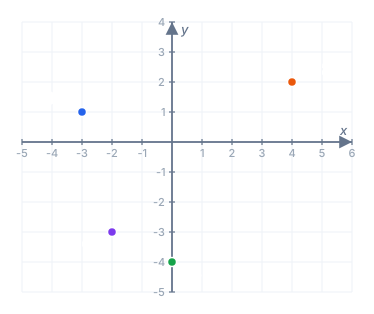
Plot
: 4 right, 2 up. : 3 left, 1 up. : no horizontal move, 4 down — this one lands on the -axis. : 2 left, 3 down.
The point with a zero first coordinate is the giveaway that it lives on an axis.
Worked Example B: Read Points From a Description
A point is 5 units to the left of the
Left of the
Worked Example C: Test Several Pairs Against One Equation
Which of
The first two are solutions; the third is not.
Worked Example D: Complete an Ordered Pair
Find the missing coordinate so that
Substitute
The completed pair is
Worked Example E: Order Matters
The point
They are different points — the coordinates are swapped, not equal.
Common Mistakes to Avoid
- Reversing the coordinates. Horizontal first, always.
and are different points. - Attaching the sign to the wrong number. In
the minus belongs to the -coordinate — move left, then up. - Treating a pair like an unordered set.
and are not interchangeable the way and are. - Substituting into the wrong variable. When you test a pair, the first number replaces
and the second replaces — not the other way round. - Dropping a coordinate that is zero.
is a complete ordered pair; the zero is information, not a blank. - Assuming a pair is a solution because it “looks close.” Only substitution decides.
misses by one, and one is enough.
Where Ordered Pairs Show Up Next
- Graphing equations. You build a table of ordered pairs, plot them, and join them into a curve.
- The quadrants. The signs of the two coordinates place every point in one of four regions, or on an axis.
- Intercepts. An
-intercept is an ordered pair of the form ; a -intercept is . - Slope. The slope between two points is built from the differences of their coordinates.
- Functions. A function’s graph is the set of ordered pairs
, so this notation never goes away.
Practice Problems
Work each one before opening the answer.
Problem 1. Are
Show answer
No.
Problem 2. A point is 3 units left of the
Show answer
Left is negative
Problem 3. Name the coordinates of a point that lies on the
Show answer
On the
Problem 4. Is
Show answer
Yes — both sides equal 8, so the point is on the line.
Problem 5. Is
Show answer
No. The point is not on the line.
Problem 6. Complete the pair
Show answer
The pair is
Problem 7. Complete the pair
Show answer
Set
Problem 8. Which of
Show answer
The first two are on the line; the third is not.
Problem 9. Point
Show answer
Problem 10. Give three different ordered pairs that satisfy
Show answer
Pick any
Problem 11. The pair
Show answer
Set
Problem 12. Explain why
Show answer
Quick Reference
| Idea | Detail |
|---|---|
| Ordered pair | |
| first number; right if | |
| second number; up if | |
| Plotting | start at origin, move |
| Reading | drop to |
| Solution test | replace |
| On the | |
| On the |
The plane these pairs live on is set up in The Cartesian Coordinate System. Once you can test pairs, Graphing Equations turns a table of them into a curve, and Linear Equations are the first equations you will graph. More Algebra lessons are available too.