A number line gives every number an address. The Cartesian coordinate system does the same thing for a flat surface: cross two number lines at right angles and every point in the plane gets a unique address of its own, written as a pair of numbers.
That sounds like bookkeeping, and at first it is. What makes it one of the most useful ideas in mathematics is what follows from it — once points have numerical addresses, questions that look geometric turn into arithmetic. How far apart are these two things? Is this triangle a right triangle? Where is the exact centre of this line segment? All of it becomes calculation, no measuring involved.
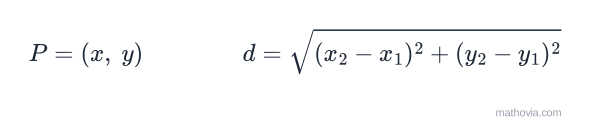
The Cartesian Coordinate System Formula
A point is named by an ordered pair — horizontal position first, vertical second. The distance between two points is the Pythagorean theorem applied to the gaps between their coordinates.
The Two Axes and the Origin
The horizontal number line is the
The axes carry the same conventions as an ordinary number line, applied in two directions:
- On the
-axis, values increase to the right and decrease to the left. - On the
-axis, values increase upward and decrease downward.
Together the two axes divide the plane into four regions, and the plane as a whole is often called the coordinate plane or the Cartesian plane.
Ordered Pairs: Why the Order Matters
Every point is written
This is why they are called ordered pairs. Swap the numbers and you get a different point:
The first sits three units right and five units up. The second sits five right and three up. They are only the same point when the two coordinates happen to be equal, as in
If you ever lose track of which comes first, the alphabet settles it:
The Four Quadrants
The axes cut the plane into four regions, numbered with Roman numerals anticlockwise starting from the top right. Which quadrant a point lands in is decided entirely by the signs of its two coordinates:
| Quadrant | Signs | Position | Example |
|---|---|---|---|
| I | right and up | ||
| II | left and up | ||
| III | left and down | ||
| IV | right and down |
The numbering direction is worth committing to memory, because it runs anticlockwise while almost everything else in everyday life runs clockwise.
Points That Belong to No Quadrant
A quadrant is one of the four open regions between the axes, so a point sitting exactly on an axis is not inside any of them. This catches people out because the question “which quadrant?” seems to demand one of four answers.
lies on the -axis. lies on the -axis. is the origin, on both.
The rule is simply that a zero in either coordinate puts the point on an axis. “On the
Plotting a Point
Plotting is two moves, always in the same order:
- Start at the origin.
- Move horizontally by the
-coordinate — right if positive, left if negative. - Move vertically by the
-coordinate — up if positive, down if negative. - Mark the point and label it.
Reading a point off an existing graph is the same process in reverse: drop straight down to the
Distance Between Two Points
Two points and the right angle between their horizontal and vertical gaps form a right triangle. The horizontal leg has length
The absolute value signs disappear because each difference gets squared, and squaring destroys the sign. That also means the order of the two points is irrelevant — subtracting the other way round flips the sign of both differences, and both get squared away.
A distance is never negative, so the answer is always the positive square root. If the number under the root is not a perfect square, leave it exact —
The Midpoint of a Segment
The midpoint is the point exactly halfway between two others, and it is found by averaging each coordinate on its own:
Notice the structural difference from the distance formula: this one adds and halves, that one subtracts and squares. Mixing them up is common, and the sanity check is easy — a midpoint must land between the two original points, so if your answer sits outside them, you have subtracted somewhere you should have added.
Worked Example A: Plotting a Point
Plot
Step 1 — read the coordinates. The
Step 2 — move horizontally. From the origin, go
Step 3 — move vertically. From there, go
Right and down puts the point in Quadrant IV, which matches the sign pattern
Worked Example B: Naming Quadrants
State the quadrant, or the axis, for each point:
Read the signs, nothing else:
is → Quadrant II is → Quadrant I is → Quadrant III has → on the -axis, no quadrant is → Quadrant IV
Worked Example C: Distance Between Two Points
Find the distance between
Step 1 — substitute into the formula:
Step 2 — evaluate inside the root:
Step 3 — take the positive root:
The gaps of
Worked Example D: A Distance That Is Not a Whole Number
Find the distance between
Note the double negative in the first bracket:
Worked Example E: Finding a Midpoint
Find the midpoint of the segment joining
Average each coordinate separately:
Check it against the sanity rule:
Worked Example F: Classifying a Triangle
The points
Find all three side lengths:
Two sides measure
Common Mistakes to Avoid
- Reversing the coordinates.
and are different points. Horizontal always comes first. - Numbering the quadrants clockwise. They run anticlockwise from the top right, so Quadrant II is the top left.
- Forcing an axis point into a quadrant. A zero in either coordinate means the point is on an axis and in no quadrant.
- Losing a sign when subtracting a negative. In the distance formula,
is , not . - Mixing up the two formulas. Distance subtracts and squares; midpoint adds and halves. If a “midpoint” lands outside the two points, they have been swapped.
- Reporting a negative distance. The square root here is the principal one, so a distance is always zero or positive.
- Averaging the wrong pairs for a midpoint. Average the two
-values together and the two -values together — never an with a .
Where This Shows Up Later
- Graphing equations. Every line, parabola and curve you draw is a set of ordered pairs that satisfy an equation, plotted on this plane.
- Slope and linear equations. Slope is the vertical change divided by the horizontal change between two points, built from the same coordinate differences as the distance formula.
- Functions. A function’s graph is the set of points
, so the vocabulary here is the vocabulary of every function you will meet. - Circles and conic sections. The equation of a circle is the distance formula rearranged: every point a fixed distance from a fixed centre.
- Vectors and later mathematics. Coordinates extend to three dimensions and beyond with the same logic and an almost identical distance formula.
Practice Problems
Work each problem yourself before opening the answer.
Problem 1. In which quadrant does
Show answer
The signs are
Problem 2. In which quadrant does
Show answer
The signs are
Problem 3. Where is the point
Show answer
The
Problem 4. Are
Show answer
No.
Problem 5. Find the distance between
Show answer
Problem 6. Find the distance between
Show answer
The points share an
Problem 7. Find the distance between
Show answer
Problem 8. Find the distance between
Show answer
Problem 9. Find the midpoint of the segment joining
Show answer
Problem 10. Find the midpoint of the segment joining
Show answer
Problem 11. Find the exact distance between
Show answer
Problem 12. One endpoint of a segment is
Show answer
Let the missing point be
The other endpoint is
Quick Reference
| Idea | Detail |
|---|---|
| Ordered pair | |
| Origin | |
| Quadrant I | |
| Quadrant II | |
| Quadrant III | |
| Quadrant IV | |
| On an axis | a zero in either coordinate; no quadrant |
| Distance | |
| Midpoint | |
| Sanity check | a midpoint always lands between the two points |
The square roots in the distance formula are simplified using Radicals and Simplifying Radicals. Once points are plotted, Linear Equations are what get graphed on this plane first. More Algebra lessons are available too.