Draw the
The useful fact is that you never have to plot a point to know its quadrant. The two signs in its ordered pair tell you everything. A point like

The Quadrant Sign Pattern
The first symbol in each pair is the sign of the
How the Numbering Works
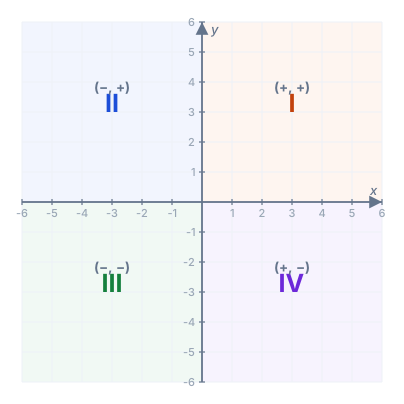
The quadrants are labelled with Roman numerals, and the order surprises people the first time:
- Quadrant I — top right. Both coordinates positive.
- Quadrant II — top left. Negative
, positive . - Quadrant III — bottom left. Both coordinates negative.
- Quadrant IV — bottom right. Positive
, negative .
The path I → II → III → IV runs anticlockwise, starting at the top right. Almost everything else you meet day to day — clock hands, screws, roundabouts in some countries — turns clockwise, so this ordering has to be learned deliberately. The reason it goes anticlockwise is that angles in mathematics are measured that way too, sweeping up from the positive
A quick way to hold it: Quadrant I is where you would expect it, and then you spin left.
The Full Table
| Quadrant | Signs | Location | Sample point |
|---|---|---|---|
| I | right and up | ||
| II | left and up | ||
| III | left and down | ||
| IV | right and down |
Notice how the four sample points are the same two numbers with the signs cycled. That is a good self-test: take
Points on an Axis: No Quadrant
This is the part that generates the most confusion, because “which quadrant?” sounds like it must have one of four answers. It does not.
A quadrant is one of the four open regions between the axes. The axes themselves are the boundaries, and a point sitting on a boundary is not inside any region. So:
has → it lies on the -axis. has → it lies on the -axis. has both zero → it is the origin, on both axes.
The rule is short: a zero in either coordinate means the point is on an axis and in no quadrant. “On the
Reading Signs From a Situation
Word problems often describe a point without giving its coordinates. Translate the description into signs:
- “3 units right and 6 units down” →
→ Quadrant IV. - “to the left of the
-axis and above the -axis” → → Quadrant II. - “below the
-axis, on the -axis” → , → on the -axis, no quadrant.
Worked Example A: Name the Quadrants
State the quadrant, or the axis, for
Read the signs, nothing else:
→ → Quadrant II → → Quadrant I → → Quadrant III → → on the -axis → → Quadrant IV → → on the -axis
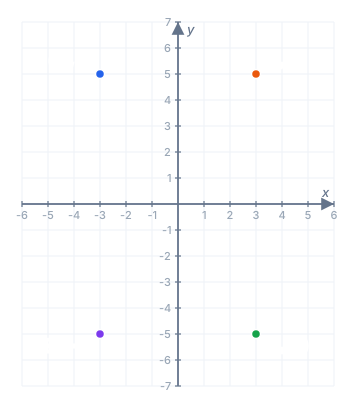
Worked Example B: Same Numbers, Four Quadrants
Write the point
- Quadrant I:
- Quadrant II:
- Quadrant III:
- Quadrant IV:
The magnitude of each coordinate is fixed; only the signs move.
Worked Example C: Which Quadrant Contains No Solutions?
The line
Quadrant IV needs
Worked Example D: A Point That Moves
A point starts at
Reflecting across the
Common Mistakes to Avoid
- Numbering clockwise. The quadrants run anticlockwise from the top right, so Quadrant II is the top left, not the bottom right.
- Forcing an axis point into a quadrant. A zero in either coordinate means “on an axis,” and that is the answer.
- Putting the origin in Quadrant I.
is on both axes and in no quadrant. - Swapping the sign pattern for II and IV. Quadrant II is
(left and up); Quadrant IV is (right and down). They are easy to mix up because both have one of each sign. - Letting the size of the numbers distract you. Only the signs matter.
is still Quadrant II.
Where Quadrants Show Up Next
- Graphing. Knowing which quadrants a line or curve passes through is a quick check that your sketch is sensible.
- Intercepts. The
- and -intercepts are exactly the points where a graph leaves the quadrants and touches an axis. - Trigonometry. The sign of sine, cosine, and tangent depends on the quadrant of the angle, and the “all, sin, tan, cos” rule is built on this same numbering.
- Transformations. Reflections and rotations move points between quadrants in predictable sign patterns.
Practice Problems
Work each one before opening the answer.
Problem 1. Which quadrant is
Show answer
Signs
Problem 2. Which quadrant is
Show answer
Signs
Problem 3. Where is
Show answer
The
Problem 4. Where is
Show answer
The
Problem 5. A point is to the left of the
Show answer
Left is
Problem 6. Write
Show answer
Both signs negative:
Problem 7. The point
Show answer
Reflecting across the
Problem 8. The point
Show answer
Flip the
Problem 9. In which quadrants can a point have a positive
Show answer
Quadrants I and II — those are the two above the
Problem 10. Does the line
Show answer
Quadrant I needs
Problem 11. A point has
Show answer
If it is on the
Problem 12. A point is rotated
Show answer
A
Quick Reference
| Quadrant | Signs | Where |
|---|---|---|
| I | top right | |
| II | top left | |
| III | bottom left | |
| IV | bottom right | |
| On | horizontal boundary — no quadrant | |
| On | vertical boundary — no quadrant | |
| Origin | both axes — no quadrant | |
| Numbering | anticlockwise from top right |
The plane and its axes are set up in The Cartesian Coordinate System, and the signs come straight from an ordered pair. Where a graph crosses the axes is covered in x- and y-Intercepts. More Algebra lessons are available too.