
A receipt, a lump-sum invoice or a “price includes tax” sign all hide the same thing: how much of the money was the product and how much went to the state. Reverse sales tax gets it back. You take the total and strip out the tax to find the price before tax. It sounds like subtraction, but it’s actually division, and that’s where most people go wrong.

The reverse sales tax formula
When a store charges sales tax, it multiplies the pre-tax price by one plus the rate:
Here
The tax is whatever’s left over:
That second form is handy because it gives you the tax directly. At 8.25%,
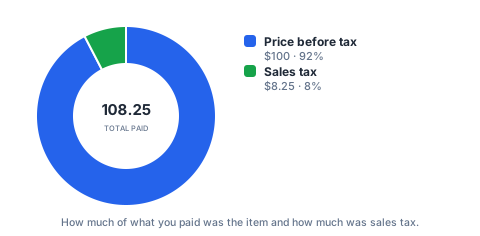
Worked example: a $108.25 receipt at 8.25%
These are the calculator’s default values. A 6.25% state rate plus 2% local tax gives 8.25%, which is the combined rate across much of Texas.
Step 1: combine the rates.
Step 2: divide the total by one plus the rate.
Step 3: subtract to find the tax. $108.25 − $100.00 = $8.25.
Now check the shortcut people usually try. Taking 8.25% off the total gives
Two more examples
A $54.00 dinner bill in Indiana (7%, no local sales tax).
The food cost $50.47 and the tax was $3.53. This is useful if you’re splitting a bill or tipping on the pre-tax amount.
A $2,000 laptop in Chicago (10.25% combined).
The tax was $185.94. The subtract-the-rate shortcut would have said $1,795.00, which is $19.06 off. That’s enough to matter if you’re filing an expense report or claiming the sales tax deduction.
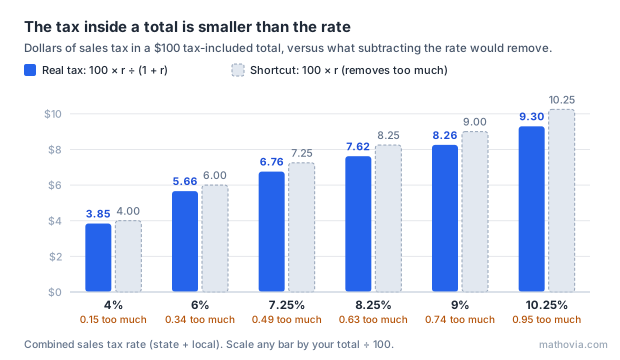
Price before tax for a $100 total
Each row shows how much of every $100 you pay is tax. For any other total, divide by the same 1 + r. A $250 total at 7% is $250 ÷ 1.07 = $233.64 before tax.
| Combined rate | Price before tax | Tax inside the $100 | Tax as % of total |
|---|---|---|---|
| 4% | $96.15 | $3.85 | 3.85% |
| 5% | $95.24 | $4.76 | 4.76% |
| 6% | $94.34 | $5.66 | 5.66% |
| 6.25% | $94.12 | $5.88 | 5.88% |
| 7% | $93.46 | $6.54 | 6.54% |
| 7.25% | $93.24 | $6.76 | 6.76% |
| 8% | $92.59 | $7.41 | 7.41% |
| 8.25% | $92.38 | $7.62 | 7.62% |
| 8.875% | $91.85 | $8.15 | 8.15% |
| 9% | $91.74 | $8.26 | 8.26% |
| 9.5% | $91.32 | $8.68 | 8.68% |
| 10.25% | $90.70 | $9.30 | 9.30% |
Finding your combined sales tax rate
Most people get the rate wrong, not the math. In most states the rate at the register is the state rate plus one or more local rates: county, city and sometimes a transit or special district. California’s statewide base is 7.25%, and local add-ons push it past 10% in some cities. Texas starts at 6.25% and caps local tax at 2%, so no Texas rate goes above 8.25%. Five states (Alaska, Delaware, Montana, New Hampshire and Oregon) have no statewide sales tax, though Alaska lets towns charge their own.
If you don’t know the local part, your receipt often shows it. Otherwise your state’s department of revenue has a lookup by address. Enter the state and local parts in the two boxes above, or put the whole combined rate in the state box and leave local at zero. The result is the same.
When part of the receipt wasn’t taxed
Plenty of states don’t tax groceries, or tax them at a lower rate. Prescription drugs are almost always exempt, and some states skip clothing under a price limit. If your receipt mixes taxed and untaxed items, reversing the whole total gives the wrong answer.
Say you paid $80.00, and $20.00 of it was untaxed groceries, at 8.25%:
The tax was $4.57. Reversing the full $80 would have said $73.90, which understates the pre-tax spend by $1.53. Put the untaxed amount in the optional box and the calculator only reverses the taxable part.
Where people actually use this
- Expense reports and bookkeeping. Many accounting systems want the net amount and the tax on separate lines. A reverse calculation is quicker than hunting for the original invoice.
- Sales tax deduction. If you itemize and deduct state sales tax instead of income tax, you can add the actual tax paid on certain big purchases, such as a car, boat or materials for building a home, to the IRS table amount.
- Businesses quoting tax-included prices. A food truck or market stall that charges a round $10 has to report the pre-tax sales and remit the tax. At 8.25%, that $10 is $9.24 of sales and $0.76 of tax.
- Reverse VAT or GST abroad. The math is the same. At 20% VAT, divide by 1.20. At 10% GST, divide by 1.10.
Common mistakes
- Subtracting the rate from the total. It always removes too much. Divide by
instead. - Using only the state rate. Leave out the local portion and you’ll overstate the pre-tax price.
- Entering the rate as a whole number in the formula. 8.25% is 0.0825 when you’re working by hand. The calculator takes 8.25 and converts it for you.
- Reversing untaxed items. Groceries, prescriptions and exempt services shouldn’t be divided by
. - Forgetting shipping and tips. Whether shipping is taxed depends on the state. A tip added after the bill is never part of the taxable total, so take it out before you reverse.
This calculator does the arithmetic of reversing a sales tax. It doesn’t look up rates or decide what’s taxable in your state. Confirm those with your state’s revenue department.
Sources and assumptions
This calculator assumes:
- State and local rates are added together into one combined rate.
- Tax is rounded once on the total; receipts that round line by line can differ by a cent.
Sources:
- State and local sales tax rates, Tax Foundation
Figures last reviewed: . Educational estimates, not professional advice.