Mathovia

Algebra / Solving Equations and Inequalities

Equations with Radicals

A radical equation has the variable under a root. The method is to isolate the radical, then raise both sides to the power that cancels it — square for a square root, cube for a cube root. Squaring can create solutions that don't actually work in the original equation, so every candidate must be checked. This lesson covers one radical, two radicals, higher roots, and the extraneous-solution check that is not optional here.

Practice Problems
M
Written by
Mathovia Team
Editorial Team

A radical equation has the variable inside a root: , , . The idea for solving is simple — undo the root by raising both sides to the matching power — but square roots come with a catch that no earlier lesson has: squaring both sides can create solutions that do not satisfy the original equation.

Those false answers are called extraneous solutions, and the check that catches them is mandatory here, not optional. This is the lesson Linear Equations warned you about when it said checking would eventually become required.

The Radical Equation Formula
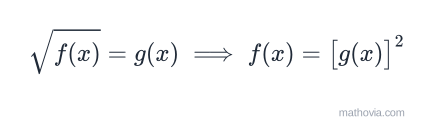
Equations with Radicals — key formula
Key formula

Squaring both sides removes the square root. The resulting equation is often linear or quadratic. Because squaring can introduce extraneous solutions, each answer must be tested in the original equation.

The Method: One Square Root

  1. Isolate the radical on one side by itself.
  2. Square both sides. ; the other side is squared as a whole.
  3. Solve the resulting equation.
  4. Check every candidate in the original equation. Discard any that fail.

Two Square Roots: Square Twice

  1. Isolate one radical, square both sides. One radical remains.
  2. Isolate the remaining radical, square again.
  3. Solve, then check every candidate.

Higher Roots

For a cube root, cube both sides: . Odd roots are reversible over the reals, so a single cube-root equation does not produce extraneous solutions — though checking is still wise.

Why Squaring Creates False Solutions

The equation carries a hidden requirement: the principal square root on the left is never negative, so must be for any solution to be real. Squaring both sides throws that requirement away. After squaring, is satisfied equally by the case and by the case , because both produce the same square. Any candidate that actually belonged to the second case is extraneous.

That gives you a way to anticipate trouble. In Worked Example B, needs ; the candidate violates that before you even substitute, so it is doomed. Checking the sign of the isolated non-radical side against each candidate is often faster than a full substitution, though the full substitution is the definitive test.

Spotting a “No Solution” Early

If isolating the radical leaves , stop — there is no real solution, and squaring would only manufacture a false one. Likewise, if the radicand itself can never be non‑negative for any real (rare, but it happens with expressions like ), the solution set is empty. Recognizing these at a glance saves a page of algebra.

Worked Example A: One Square Root, Linear Result

Solve .

Step 1 — the radical is already isolated. Square both sides:

Step 2 — solve:

Step 3 — check: . ✓

Answer: .

Worked Example B: An Extraneous Solution Appears

Solve .

Step 1 — square both sides:

Step 2 — standard form and factor:

Step 3 — check both in the original:

  • : . ✓
  • : , but the right side is . . ✗ extraneous

Answer: only. The value solves the squared equation but not the original.

Worked Example C: Two Square Roots

Solve .

Step 1 — isolate one radical:

Step 2 — square both sides:

Step 3 — square again:

Step 4 — check: . ✓

Answer: .

Worked Example D: A Cube Root

Solve .

Step 1 — cube both sides:

Step 2 — solve:

Step 3 — check: . ✓

Answer: . No extraneous solution risk with an odd root.

Worked Example E: Both Candidates Fail

Solve .

Step 1 — isolate the radical:

The isolated square root equals a negative number. A principal square root is never negative, so there is no real solution — the answer is .

If you had missed that and squared anyway, you would get , so . Checking: . The lone candidate is extraneous, confirming the empty solution set. This is why the “isolated radical equals a negative” check comes before squaring.

Common Mistakes to Avoid

  • Skipping the check. With square roots, checking is required. An unchecked extraneous solution is a wrong answer.
  • Squaring before isolating. squared as-is gives , which still has a radical. Isolate first.
  • Squaring term by term. , not .
  • Forgetting the middle term. Squaring a binomial with a radical always produces a cross term: .
  • Accepting a negative isolated radical. has no real solution; do not square and report an answer.
  • Missing that a “no real solution” answer is complete. An empty solution set is a legitimate final answer.

Where This Shows Up Later

  • Equations Reducible to Quadratic Form. is quadratic in ; the extraneous-solution logic carries over.
  • Distance and rate formulas. and similar relationships are solved by squaring.
  • Distance formula and circle equations. Setting two distance expressions equal produces a radical equation.
  • Functions and domains. A radical function’s domain is exactly the set where the radicand is nonnegative — the same condition that makes a candidate solution valid.

Practice Problems

Work each problem yourself before opening the answer.

Problem 1. Solve .

Show answer

Check: . ✓

Problem 2. Solve .

Show answer

Check: . ✓

Problem 3. Solve .

Show answer

Isolate: . Square: . Check: . ✓

Problem 4. Solve .

Show answer

Check: gives and . ✓ gives but . ✗

Answer: .

Problem 5. Solve .

Show answer

Square both sides: . Check: . ✓

Problem 6. Solve .

Show answer

Check: and . ✓

Problem 7. Solve .

Show answer

A principal square root is never negative, so there is no real solution.

Problem 8. Solve .

Show answer

Cube: . Check: . ✓

Problem 9. Solve .

Show answer

Isolate and square: , so . Square again: , so . Candidates .

Check: gives . ✓ gives . ✓

Answer: or .

Problem 10. Solve .

Show answer

Check: gives . ✓ gives . ✗

Answer: .

Problem 11. Solve .

Show answer

Isolate: . Square: , so , .

Check: gives . ✓ gives . ✗

Answer: .

Problem 12. Solve .

Show answer

Square: , so , giving and . Check: and . ✓

Answer: .

Problem 13. Solve .

Show answer

Isolate: . Square: , so , giving . Square again: .

Check: . ✓

Answer: .

Problem 14. Solve .

Show answer

Domain note: the right side must be , so . Square: , so . Candidates .

Check: gives and . ✓ fails and gives . ✗

Answer: .

Quick Reference

SituationMove
One square rootisolate it, square both sides once
Two square rootsisolate one, square; isolate the other, square again
Cube rootisolate it, cube both sides (no extraneous risk)
Isolated radical equals a negativeno real solution
Squaring a binomial with a radical — keep the middle term
Every square-root equationcheck every candidate in the original

The root-and-power rules behind this are in Radicals. When a square root sits inside a quadratic-shaped equation, see Equations Reducible to Quadratic Form. The squared-out equations are finished with factoring or the quadratic formula. More Algebra lessons are available too.

Frequently Asked Questions

How do I solve an equation with a square root?+

Isolate the radical on one side, then square both sides to remove it. Solve the resulting equation, then substitute every answer back into the original equation to check for extraneous solutions.

Why do radical equations produce extraneous solutions?+

Squaring is not reversible: implies , but also allows . Squaring can therefore satisfy a false equation like as , even though . Checking catches these.

What if there are two square roots in the equation?+

Isolate one radical, square both sides, then isolate the remaining radical and square again. Two radicals usually means squaring twice, with an ordinary equation in between.

Do cube-root equations also need an extraneous check?+

Cubing is reversible for real numbers, so a cube-root equation with one radical does not introduce extraneous solutions. It is still good practice to check, and mixed equations (a cube root plus other structure) can still lose or gain solutions elsewhere.

Can a radical equation have no solution?+

Yes. If isolating the radical leaves it equal to a negative number, like , there is no real solution, because a principal square root is never negative. Sometimes every candidate from squaring turns out to be extraneous, and the solution set is empty.

Do I have to isolate the radical before squaring?+

Yes, whenever possible. Squaring directly gives , which still has a radical. Isolating first — — makes one squaring finish the job.

Can I tell which candidate is extraneous without substituting?+

Often. After isolating, the non-radical side must be for a real solution, since a principal square root is never negative. Any candidate that makes that side negative is extraneous. It is a fast pre-screen, but substituting into the original equation is still the definitive check.

What does it mean if every candidate fails the check?+

The equation has no real solution, and is the complete, correct answer. This commonly happens when the isolated radical was forced to equal a negative number, so the squaring step only produced a false candidate.

Related lessons