Factoring is fast when it works, and completing the square shows why the method works — but for actually solving an arbitrary quadratic, the quadratic formula is the workhorse. It is the result of completing the square on the general equation
This lesson is about using it without error: getting to standard form, reading
The Quadratic Formula
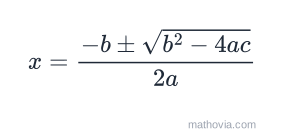
Here
The Discriminant: Predicting the Solutions
Compute
| Discriminant | Solutions |
|---|---|
| two distinct rational solutions (the quadratic factors) | |
| two distinct irrational solutions | |
| one repeated real solution | |
| two complex-conjugate solutions |
Using the Formula: The Routine
- Standard form. Move every term to one side; the other side is
. - Identify
, , with signs included. - Compute the discriminant
. - Substitute into
. - Simplify the radical, then reduce any common factor across the whole fraction.
Reading a, b, and c without sign errors
The coefficient carries its sign with it. In
(a squared quantity is never negative) (the two minus signs multiply to a plus)
Almost every wrong answer from the quadratic formula is a dropped negative in one of these three places. Write
Simplifying the radical answer
Two things can usually be tidied in
- Simplify the square root.
may have a perfect-square factor: ; . - Reduce the whole fraction — but only if one number divides every term of the numerator.
reduces to because divides and . does not reduce, because does not divide .
When there is no b term or no c term
The formula still applies, but there is usually a faster route. With no
Worked Example A: Two Rational Solutions
Solve
Coefficients:
Discriminant:
Substitute:
Answer:
Worked Example B: Two Irrational Solutions
Solve
Coefficients:
Discriminant:
Substitute:
Simplify:
Answer:
Worked Example C: One Repeated Solution
Solve
Coefficients:
Discriminant:
Substitute:
Answer:
Worked Example D: Complex Solutions
Solve
Coefficients:
Discriminant:
Substitute:
Answer:
Worked Example E: Rearranging Before Applying the Formula
Solve
Step 1 — move every term to one side so the other side is zero:
Coefficients:
Discriminant:
Substitute:
Simplify:
Answer:
Common Mistakes to Avoid
- Not writing standard form first.
must become before reading , . - Dropping a negative sign. If
, then and . Track the sign carefully. - Only dividing part of the numerator by
. The entire is over . - Simplifying incorrectly.
reduces to only because divides every term of the numerator. does not reduce. - Forgetting
includes the sign of . With , . - Using the formula on a non-quadratic.
must be nonzero; if , the equation is linear.
Where This Shows Up Later
- Quadratic Applications. Word problems that end in a messy quadratic are finished with the formula.
- Polynomial and Rational Inequalities. Finding where a quadratic factor changes sign starts with its roots from the formula.
- Graphing. The roots are the parabola’s
-intercepts; the discriminant tells you whether the parabola crosses the -axis, touches it, or misses it. - Equations Reducible to Quadratic Form. After the substitution
, the formula solves the resulting quadratic in . - Complex numbers. A negative discriminant is the standard entry point to complex solutions.
Practice Problems
Work each problem yourself before opening the answer.
Problem 1. Solve
Show answer
Problem 2. Solve
Show answer
Problem 3. Solve
Show answer
Discriminant
Problem 4. Solve
Show answer
Discriminant
Problem 5. Solve
Show answer
Discriminant
Problem 6. Solve
Show answer
Discriminant
Problem 7. Solve
Show answer
Standard form:
Problem 8. Solve
Show answer
Discriminant
Problem 9. Solve
Show answer
Discriminant
Problem 10. Solve
Show answer
Discriminant
Problem 11. Without solving, state the number and type of solutions of
Show answer
Discriminant
Problem 12. Solve
Show answer
Discriminant
Problem 13. Solve
Show answer
Standard form:
Problem 14. Solve
Show answer
Discriminant
Quick Reference
| Item | Value |
|---|---|
| Formula | |
| Discriminant | |
| two rational solutions (factors) | |
| two irrational solutions | |
| one repeated real solution | |
| two complex solutions | |
| Before using | put the equation in standard form; keep signs on |
The formula is Completing the Square solved once for all; the other methods and the method-choosing guide are in Quadratic Equations. Word problems that land here are in Quadratic Applications. More Algebra lessons are available too.