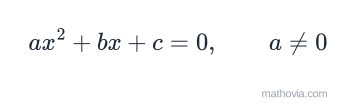
A quadratic equation is any equation that rearranges to
Geometrically, the two solutions are the two places where the parabola
There are four standard methods. This lesson covers the two quickest — factoring and the square-root property — and gives you a decision guide for all four. Completing the Square and the Quadratic Formula each get their own lesson because they carry more machinery. Whichever method you use, the first job is almost always the same: get the equation into standard form with zero on one side, combining like terms, distributing parentheses, and clearing fractions with the LCD along the way.
The Quadratic Equation Formula
Method 1: Factoring and the Zero-Product Property
The zero-product property: if
To use it, get one side equal to zero, factor the other side, set each factor to zero, and solve each small equation.
The factoring itself is the Factoring Quadratics skill; the new part here is the zero-product step that turns a factored quadratic into two linear equations.
Why the property holds: if two numbers multiply to zero, at least one of them must be zero — there is no other way for a product to vanish. So once the quadratic is written as a product of two factors equal to zero, the only way the equation can be true is for one factor or the other to be zero, and each of those is a small linear equation you already know how to solve. This is exactly why one side has to be zero before you factor.
A repeated root
If the quadratic is a perfect square, both factors are the same and the two solutions coincide.
The parabola for a perfect-square quadratic just touches the
The no-constant-term case
If
Never divide both sides by
Method 2: The Square-Root Property
When there is no
The
If
When to reach for the square-root property
Use it whenever the equation has no plain
Method 3 and Method 4
- Completing the square rewrites
as , turning any quadratic into a square-root-property problem. Full treatment in Completing the Square. - The quadratic formula,
, is completing the square done once, in general. It solves every quadratic. Full treatment in The Quadratic Formula.
Choosing a Method
| The quadratic… | Best method |
|---|---|
| factors quickly by inspection | factoring + zero-product property |
| has no middle ( | square-root property |
| is already | square-root property |
| does not factor nicely | quadratic formula |
| needs to be in vertex form | completing the square |
| you’re unsure | quadratic formula — it always works |
Worked Example A: Factoring
Solve
Step 1 — factor: two numbers multiplying to
Step 2 — zero-product property:
Answer:
Worked Example B: Factoring with a GCF and a Leading Coefficient
Solve
Step 1 — factor out the GCF
Step 2 — the constant factor
Answer:
Worked Example C: The Square-Root Property
Solve
Step 1 — isolate the square:
Step 2 — take the square root of both sides, with
Step 3 — solve both:
Answer:
Worked Example D: Rearranging First
Solve
Step 1 — move every term to one side so the equation equals zero:
Step 2 — factor and apply the zero-product property:
Answer:
Worked Example E: A No-Constant-Term Quadratic
Solve
Step 1 — move every term to one side:
Step 2 — factor out the greatest common factor,
Step 3 — the constant
Answer:
Worked Example F: A Quadratic Hiding Behind Parentheses
Solve
Step 1 — expand the left side:
Step 2 — move the
Step 3 — factor and apply the zero-product property:
Answer:
Common Mistakes to Avoid
- Applying the zero-product property when one side isn’t zero.
does not give ; expand and set equal to zero first. - Dropping a solution. A quadratic has two roots. Reporting only
when also works is the most common error. - Forgetting the
with the square-root property. has solutions and . - Dividing both sides by
. In , dividing by loses the solution . Factor instead: . - Only taking the square root of one term.
becomes , not with the forgotten, and not . - Not factoring out a GCF first.
is much easier as .
Where This Shows Up Later
- Completing the Square and the Quadratic Formula are the methods for the quadratics that do not factor.
- Quadratic Applications. Area, projectile, and product word problems all end in a quadratic equation solved by these methods.
- Polynomial Inequalities. Solving
starts by finding the roots of . - Graphing parabolas. The solutions of
are the -intercepts of the parabola . - Equations Reducible to Quadratic Form. Equations like
become quadratics after a substitution.
Practice Problems
Work each problem yourself before opening the answer.
Problem 1. Solve
Show answer
Problem 2. Solve
Show answer
Problem 3. Solve
Show answer
Problem 4. Solve
Show answer
Problem 5. Solve
Show answer
Problem 6. Solve
Show answer
Problem 7. Solve
Show answer
Problem 8. Solve
Show answer
Problem 9. Solve
Show answer
Problem 10. Solve
Show answer
Two complex solutions.
Problem 11. Solve
Show answer
Problem 12. Solve
Show answer
Quick Reference
| Step | Detail |
|---|---|
| Standard form | |
| Zero-product property | |
| Square-root property | |
| No constant term | factor out |
| Does not factor | use the quadratic formula |
| Every quadratic has | up to two solutions — report both |
The factoring itself is Factoring Quadratics. For quadratics that don’t factor, continue to Completing the Square and The Quadratic Formula. Word problems that end in a quadratic are in Quadratic Applications. More Algebra lessons are available too.