
Board feet measure volume, not length — which is exactly why lumber priced this way can be confusing the first few times you buy it.
Board feet vs. linear feet
A linear foot just measures length, regardless of the board’s thickness or width. A board foot measures the actual volume of wood: a piece 12” long, 12” wide, and 1” thick equals exactly one board foot. Two boards of the same length can contain very different amounts of wood if their thickness or width differs — which is why hardwood suppliers price by board foot instead of length alone. A quote of “$3 a foot” and “$3 a board foot” are very different numbers for anything wider than a 1x12.
Why the formula divides by 144
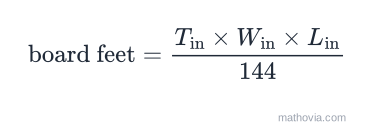
The board foot formula is:
Board feet = (Thickness in inches × Width in inches × Length in inches) ÷ 144
The 144 comes from converting cubic inches into the standard board-foot unit: a 12” × 12” × 1” board contains 144 cubic inches, and that’s defined as one board foot. Dividing your board’s total cubic inches by 144 tells you how many of those “units” it contains. If it’s easier to keep the length in feet, divide by 12 instead.
A worked example
A board that’s 1” thick, 6” wide, and 8 feet (96”) long:
(1 × 6 × 96) ÷ 144 = 4 board feet
If lumber is priced at $4.50 per board foot, that single board costs $18.00 before tax.
Board feet by common size (8-foot lengths)
| Nominal size | Board feet |
|---|---|
| 1x4 | 2.67 |
| 1x6 | 4.00 |
| 1x8 | 5.33 |
| 1x12 | 8.00 |
| 2x4 | 5.33 |
| 2x6 | 8.00 |
| 2x8 | 10.67 |
| 2x10 | 13.33 |
Halve these for a 4-foot piece, or scale proportionally for any other length.
The quarter system for hardwood thickness
Rough-sawn hardwood is quoted in quarters of an inch: 4/4 is 1 inch, 5/4 is 1.25, 6/4 is 1.5, and 8/4 is 2 inches. A 4/4 board 6 inches wide and 8 feet long is 4 board feet; the same footprint in 8/4 stock is 8, because it’s twice as thick. When a dealer measures a random-width board, they usually round the width to the nearest inch before figuring the board feet.
Estimating a full project’s cost
Multiply the board-foot count by how many identical pieces you need, then by the price per board foot. That gives the net material — the wood that ends up in the project. Real buying needs a margin on top: add 15–20% for a straightforward run with long, clear parts, or 30–40% when parts are short or you’re working around knots in lower grades. And you can’t buy 4.6 board feet of a single plank; you buy the plank.
Our Board Foot Calculator does this multiplication automatically — enter thickness, width, length, quantity, and price per board foot, and it returns both the per-piece and total board footage along with the estimated cost.
A note on nominal vs. actual dimensions
Softwood dimensional lumber (like a “2x4”) is sold by its nominal size, but the actual finished size is smaller — a 2x4 is really about 1 1/2” × 3 1/2”. Use the nominal size in the formula, because that’s what the price is based on. Hardwood sold by board foot is priced and measured using its actual rough-cut dimensions. For how much rough stock loses as it dries and is milled, see the lumber shrinkage calculator.