Work problems are the “if it takes Ann 4 hours and Bob 6 hours, how long together” questions. They feel like a special trick, but they are really just Distance, Rate, and Time with the word “job” swapped in for “distance” and “rate of work” swapped in for “speed.” The Word Problems five-step method still runs the show.
The one idea to hold onto: rates of work add. A worker who finishes in
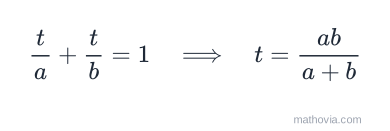
The Work-Rate Formula
Building the Equation with a Chart
The distance-rate-time chart carries over, relabeled:
| Worker | Rate (job/hr) | Time worked | Part of job done |
|---|---|---|---|
| Worker A | |||
| Worker B |
The “Part of job done” column adds to
Two Workers, Full Time Each
Both work the entire time until the job is finished.
Three or More Workers
Every worker adds a term. Three workers finishing alone in
A Worker Who Joins Late or Leaves Early
Give the part-time worker their own time expression. If A works the whole time
Filling While Draining
A drain removes work, so its term is subtracted. A tank filled in
This only has a positive solution when
Worked Example A: Two Workers
Ann paints a room in
Chart:
| Worker | Rate | Time | Part done |
|---|---|---|---|
| Ann | |||
| Bob |
Equation:
Multiply every term by the LCD,
Answer:
Worked Example B: Three Pipes
Three pipes fill a pool in
Equation:
Multiply every term by the LCD,
Answer:
Worked Example C: One Worker Leaves Early
A machine can complete an order in
Let
Multiply every term by the LCD,
Answer: the job takes
Worked Example D: Fill and Drain
A tank fills in
Multiply every term by the LCD,
Answer:
Common Mistakes to Avoid
- Adding the times instead of the rates. ”
hours and hours, so hours together” is the classic wrong answer. Rates add; times do not. - Averaging the solo times. The average of
and is , which is also wrong — and larger than one worker’s solo time, which is impossible. - Forgetting to invert. The combined rate is
; the combined time is the reciprocal of that sum, not the sum itself. - Using the same time for a part-time worker. A worker who stops early gets
, not . - Adding a drain’s term instead of subtracting it. A drain does negative work.
- Accepting an answer bigger than the fastest solo time (for a “working together” problem). That is a guaranteed sign of an error.
Where This Shows Up Later
- Rational Expressions and rational equations. Every work equation with the variable in a denominator is a rational equation; the LCD-clearing step and the extraneous-solution check both apply.
- Systems of Equations. Problems that give two combined-time facts about three workers are solved as a system.
- Distance, Rate, and Time. The chart and the reciprocal idea are identical; only the labels change.
- Uniform-motion round trips. A round trip with a stated total time produces the same “reciprocals add” structure as a fill-and-drain problem.
Practice Problems
Work each problem yourself before opening the answer.
Problem 1. Carla mows a lawn in
Show answer
Problem 2. One printer prints a batch in
Show answer
Problem 3. Three workers finish a task alone in
Show answer
Multiply by
Problem 4. Pipe A fills a tank in
Show answer
Problem 5. Ed can roof a house in
Show answer
Let the apprentice’s solo time be
Problem 6. A tub fills in
Show answer
Multiply by
Problem 7. Two crews clean a stadium in
Show answer
Problem 8. Two hoses fill a pool in
Show answer
In
Problem 9. A machine fills bottles in
Show answer
Let
Multiply by
Problem 10. Pipe A fills a tank in
Show answer
Multiply by
Problem 11. Working together, Ravi and Sam assemble a set of shelves in
Show answer
Let Sam’s solo time be
Multiply by
Problem 12. A large pump empties a flooded basement in
Show answer
In
Quick Reference
| Situation | Equation |
|---|---|
| Two workers, full time | |
| Three workers | |
| One worker part-time (stops | |
| Fill with a drain open | |
| Two workers, closed form | |
| Sanity check | together-time |
Clearing the denominators is the Linear Equations with Fractions step, and when a variable sits in a denominator the equation becomes rational — see Rational Expressions. The chart comes straight from Distance, Rate, and Time, and the overall setup is the Word Problems method. More Algebra lessons are available too.