Fractions make a linear equation look harder than it is. The equation
That step is multiplying every term on both sides by the least common denominator (LCD) of all the fractions. This lesson is about doing that step cleanly: finding the right denominator, distributing it to every term without missing one, and handling the situations that trip people up — a whole number sitting next to the fractions, a binomial like
The Fraction-Clearing Formula
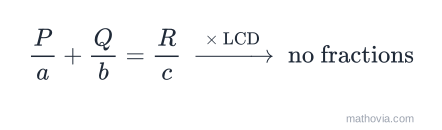
The reason this is legal is the multiplication property of equality: you may multiply both sides of a true equation by the same nonzero number and it stays true. The LCD is a fixed number (never zero, since the denominators are nonzero constants), so multiplying by it changes how the equation looks without changing which value of
Step 1: Find the Least Common Denominator
Write down every denominator in the equation, on both sides of the equals sign. Their least common multiple is the LCD.
When the denominators share no common factor
Then the LCD is simply their product. For denominators
When the denominators share a factor
Then the LCD is smaller than the product. For
A quick way to build the LCD: factor each denominator into primes, then take the highest power of each prime that appears anywhere. For
Step 2: Multiply Every Term by the LCD
Every term on both sides is multiplied by the LCD — the fractions, and any plain numbers too. Write the multiplication out term by term the first several times; skipping straight to the cleared line is where a term gets dropped.
For each fraction, divide the LCD by that fraction’s denominator, then multiply the result by the numerator:
Step 3: Solve the Fraction-Free Equation
From here it is the ordinary four-step method from Linear Equations: simplify each side, gather the variable on one side, gather constants on the other, divide by the coefficient.
Nothing new happens in this step. Every technique — distributing, combining like terms, handling variables on both sides — is exactly as it was before fractions entered the picture.
Handling a Binomial Numerator
When a numerator is a binomial like
The most common error in the whole lesson is dropping those parentheses and multiplying only the first term of the numerator. The fraction bar acts as a grouping symbol: everything on top of it is being divided by the denominator, so everything on top must be multiplied by whatever replaces that denominator.
Watch the sign carefully when the term is subtracted and the numerator has a minus inside it:
Coefficients Written as Fractions
An equation might present a fractional coefficient two different ways:
Clearing Fractions and Decimals Together
If an equation somehow has both fractions and decimals, convert the decimals to fractions first (
Revisiting Identities and Contradictions
Occasionally, after clearing fractions and simplifying, the variable cancels out entirely. If a true statement remains (like
Worked Example A: Fractions on One Side
Solve
Step 1 — the denominators are
Step 2 — combine like terms:
Step 3 — divide by
Answer:
Worked Example B: Fractions on Both Sides, with a Whole Number
Solve
Step 1 — the denominators are
Step 2 — gather the variable on the left, the constants on the right:
Step 3 — divide by
Answer:
Worked Example C: A Binomial Numerator
Solve
Step 1 — the LCD of
Step 2 — distribute:
Step 3 — combine like terms:
Step 4 — solve:
Answer:
Worked Example D: A Proportion
Solve
Step 1 — the LCD of
Step 2 — distribute both sides:
Step 3 — solve:
Answer:
Worked Example E: A Fractional Coefficient Form
Solve
Step 1 — the denominators are
Step 2 — solve:
Answer:
Worked Example F: An Identity
Solve
Step 1 — the LCD of
Step 2 — simplify:
The variable cancelled and left a true statement. Answer: an identity — every real number is a solution,
Common Mistakes to Avoid
- Multiplying only the fractions by the LCD. Every term gets multiplied, including whole numbers like the
in Worked Example B. - Dropping the parentheses on a binomial numerator.
, which is , not . - Using the product of the denominators when a smaller LCD exists. It still works, but the numbers get large fast —
and have LCD , not . - Forgetting a denominator on the other side of the equals sign. The LCD has to account for every fraction in the whole equation, left and right.
- Distributing the LCD before cancelling the denominator. Cancel first (
), then attach the to the numerator. - Mishandling a minus sign in front of a fraction with a binomial numerator.
is , not . - Expecting an integer answer. Clearing fractions makes the work fraction-free; the solution can still be a fraction.
Where This Shows Up Later
- Solving for a Variable. Formulas with fractional coefficients, like
, are rearranged by clearing the fraction first — the same opening move as here. - Rational Expressions and rational equations. The LCD step is identical; the new wrinkle is that a variable in the denominator forces you to check every answer for extraneous solutions.
- Systems of equations. A system with fractional coefficients is almost always cleared to integers first, one equation at a time, before elimination or substitution.
- Quadratic equations with fractions. Multiplying through by the LCD is still step one; it just leaves a quadratic instead of a linear equation.
- Work-rate word problems. “Together they finish in
hours” produces an equation like , cleared with exactly this method.
Practice Problems
Work each problem yourself before opening the answer.
Problem 1. Solve
Show answer
Step 1 — LCD of
Step 2 — solve:
Answer:
Problem 2. Solve
Show answer
Step 1 — multiply every term by
Step 2 — solve:
Answer:
Problem 3. Solve
Show answer
Step 1 — LCD of
Step 2 — solve:
Answer:
Problem 4. Solve
Show answer
Step 1 — LCD of
Step 2 — distribute:
Step 3 — solve:
Answer:
Problem 5. Solve
Show answer
Step 1 — LCD of
Step 2 — solve:
Answer:
Problem 6. Solve
Show answer
Step 1 — LCD of
Step 2 — distribute and combine:
Step 3 — solve:
Answer:
Problem 7. Solve
Show answer
Step 1 — LCD of
Step 2 — distribute:
Step 3 — solve:
Answer:
Problem 8. Solve
Show answer
Step 1 — LCD of
Step 2 — solve:
Answer:
Problem 9. Solve
Show answer
Step 1 — LCD of
Step 2 — distribute and combine:
Step 3 — solve:
Answer:
Problem 10. Solve
Show answer
Step 1 — LCD of
Step 2 — solve:
Answer:
Problem 11. Solve
Show answer
Step 1 — LCD of
Step 2 — distribute and combine:
Step 3 — solve:
Answer:
Problem 12. Solve
Show answer
Step 1 — LCD of
Step 2 — distribute (watch the sign on the second group):
Step 3 — solve:
Answer:
Quick Reference
| Situation | What to do |
|---|---|
| Fractions with constant denominators | Multiply every term on both sides by the LCD of all denominators |
| A whole number term is present | Multiply it by the LCD too |
| A binomial numerator like | Keep it in parentheses while multiplying; distribute after the denominator cancels |
| A minus sign in front of such a fraction | The whole binomial changes sign: |
| Denominators share no common factor | LCD is their product |
| Denominators share a factor | LCD is smaller than the product — use the least common multiple |
| Coefficient written as | Same as |
| One fraction equals one fraction | Cross-multiply, or multiply both sides by the LCD (same result) |
| Variable cancels, true statement remains | Identity — solution set |
| Variable cancels, false statement remains | Contradiction — solution set |
| After clearing fractions | Finish with the standard method from Linear Equations |
Once the denominators are gone, every remaining step comes straight from Linear Equations. Rearranging a formula that contains fractions uses this same first move — see Solving for a Variable. When a variable lands in a denominator, Rational Expressions picks up with the extra extraneous-solution check. The rest of the Algebra lessons are there when you want more.