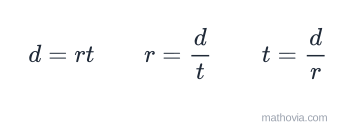
Motion problems intimidate people out of proportion to how hard they are. There is exactly one formula,
The whole trick is filling the chart with one row per moving thing, using a single variable, and then finding the one sentence in the problem that relates the distances. That sentence becomes the equation, and the equation is linear.
The Distance, Rate, and Time Formula
The Distance-Rate-Time Chart
Set up a table with one row per object:
| Object | Rate | Time | Distance |
|---|---|---|---|
| Object 1 | |||
| Object 2 |
Fill in every rate and time you are given. Name one unknown with a variable and write the others in terms of it. The Distance column is always rate times time — you never enter a distance directly, you compute it. The equation comes from a relationship between the two Distance entries.
Scenario 1: Moving Toward Each Other (or Apart)
Two objects start at different points and move toward each other, or start at the same point and move in opposite directions. Their distances add to the total gap.
If they start at the same time, both travel for the same
Scenario 2: Same Direction, One Catches the Other
A faster object leaves after a slower one and catches up. At the moment it catches up, the two distances are equal.
The times differ by the head start: if the slow object left
Scenario 3: Round Trip
An object travels out at one speed and back over the same route at another speed. The two distances are equal (it is the same route), and the equation usually comes from a stated total time.
Scenario 4: Current or Wind
An object with still-water (or no-wind) speed
The two legs cover the same distance, so
Worked Example A: Toward Each Other
Two cars leave towns
Chart:
| Car | Rate | Time | Distance |
|---|---|---|---|
| A | |||
| B |
Equation — the distances add to
Answer: they meet after
Worked Example B: One Catches the Other
A freight train leaves a station traveling
Chart — let
| Train | Rate | Time | Distance |
|---|---|---|---|
| Freight | |||
| Passenger |
Equation — the distances are equal when it catches up:
Answer: the passenger train travels
Worked Example C: A Round Trip
A boater travels upstream at
Chart — let
| Leg | Rate | Time | Distance |
|---|---|---|---|
| Upstream | |||
| Downstream |
Equation — the times add to
Multiply every term by the LCD,
Answer: the boater went
Worked Example D: A Current Problem
A plane flies
Chart — let
| Trip | Rate | Time | Distance |
|---|---|---|---|
| With wind | |||
| Against wind |
Two equations — each distance is
Add the equations:
Answer: the plane’s still-air speed is
Common Mistakes to Avoid
- Entering a distance directly. The Distance column is always rate times time. If you know a distance, use it in the equation, not as a chart entry you also compute.
- Giving both objects the same time when one has a head start. Different departure times mean different time expressions, like
and . - Adding distances when they should be equal, or vice versa. Toward-each-other and opposite-directions add; same route (round trip, catch-up) sets equal.
- Mixing units. Convert minutes to hours and feet to miles before building the chart.
- Adding rates in a current problem. The effective rate is
or ; you cannot just average the two trip speeds. - Forgetting to answer the actual question. If the problem asks for total distance or the meeting point, solving for
is only step one.
Where This Shows Up Later
- Work Problems. Same chart idea, with “rate of work” instead of speed and “job done” instead of distance.
- Systems of Equations. Current and wind problems with two unknowns (still speed and current) are solved cleanly as a two-equation system, as in Worked Example D.
- Rational Equations. Round-trip problems that give a total time lead to an equation with the variable in a denominator.
- Quadratic Applications. A few motion problems — a boat whose speed relates to the current in a nonlinear way — end in a quadratic.
Practice Problems
Work each problem yourself before opening the answer.
Problem 1. Two hikers start
Show answer
Answer:
Problem 2. A car and a truck leave the same point at the same time in opposite directions. The car goes
Show answer
Answer:
Problem 3. A runner leaves a park at
Show answer
Let
Answer:
Problem 4. A boat travels
Show answer
Adding:
Problem 5. Two trains leave stations
Show answer
Let the slower speed be
Answer:
Problem 6. A jogger runs out at
Show answer
Multiply by
Problem 7. A plane flies
Show answer
Adding:
Problem 8. A family drives to a lake at
Show answer
Multiply by
Problem 9. Car A leaves at noon going
Show answer
Let
Answer: Car B catches Car A
Problem 10. Two cyclists
Show answer
Let the slower speed be
Answer:
Problem 11. A boat’s speed in still water is
Show answer
Let
Multiply by
Problem 12. Maria leaves home at
Show answer
Distance:
Quick Reference
| Scenario | Distance relationship |
|---|---|
| Toward each other / opposite directions | |
| Same direction, faster catches slower | |
| Round trip with known total time | |
| With current / wind | rate |
| Every object, always |
The setup routine is the Word Problems five-step method with a chart bolted on. Work Problems reuse the chart with rates of work, and round-trip problems that lead to a variable in the denominator connect to Rational Expressions. See Applications of Linear Equations for geometry and interest problems, and the full Algebra lessons for everything else.