Mathovia

Algebra / Solving Equations and Inequalities

Rational Inequalities

A rational inequality has a variable in a denominator. The sign-chart method from polynomial inequalities carries over with two changes: you must move everything to one side and combine into a single fraction before factoring, because multiplying both sides by a denominator of unknown sign is not allowed; and the values that make the denominator zero are always excluded from the solution, even for a non-strict inequality.

Practice Problems
M
Written by
Mathovia Team
Editorial Team

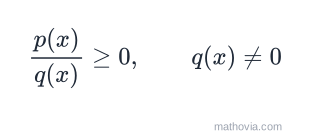
A rational inequality compares a fraction with a variable in its denominator to zero (or to another value): , . It is solved with the same sign chart as a Polynomial Inequality, with two adjustments.

First, you cannot clear the denominator by multiplying — its sign is unknown, and multiplying an inequality by a negative flips it. So you get everything onto one side and combine into a single fraction first. Second, the values that make the denominator zero are always excluded, because the expression is undefined there — even when the inequality is or .

The Rational Inequality Formula

Rational Inequalities — key formula
Key formula

Numerator zeros can be included (for ); denominator zeros never can.

The Method

  1. Move every term to one side so the other side is .
  2. Combine into a single fraction over a common denominator.
  3. Factor the numerator and the denominator.
  4. Find all critical values — set the numerator to zero, and set the denominator to zero.
  5. Split the number line at every critical value.
  6. Test one point per interval in the factored fraction; record or .
  7. Select the matching intervals. For / , include numerator zeros (brackets); never include denominator zeros.
  8. Write the answer in interval notation.

Worked Example A: Already One Fraction

Solve .

Steps 1–3 — already a single fraction, already factored.

Step 4 — critical values: numerator zero at ; denominator zero at (excluded).

Steps 5–6 — test the three intervals:

IntervalTest pointSign

Step 7 — want : the positive intervals; include (numerator zero), exclude .

Answer: .

Worked Example B: Combine First

Solve .

Step 1 — subtract :

Step 2 — common denominator:

Step 4 — critical values: numerator zero at ; denominator zero at (excluded).

IntervalTest pointSign

Step 7 — want : the negative intervals; strict, so no endpoints, and excluded anyway.

Answer: .

Worked Example C: Quadratic Numerator

Solve .

Factor: .

Critical values: (numerator, includable); (denominator, excluded).

IntervalTest pointSign

Want : the negative intervals, plus numerator zeros and ; exclude .

Answer: .

Worked Example D: A Common Trap

Solve .

Do not cross-multiply. Subtract and combine:

Critical values: (numerator), (denominator, excluded).

IntervalTest pointSign

Want : the middle interval, strict.

Answer: . Cross-multiplying would have given , i.e. — wrong, because it silently assumed .

Why Cross-Multiplying Is Illegal Here

With an equation like , cross-multiplying is fine: multiply both sides by and the equals sign is unaffected. With an inequality, multiplying both sides by an expression flips the symbol whenever that expression is negative — and the sign of a variable expression like is not fixed. Since you cannot know in advance whether you are multiplying by a positive or a negative, there is no single valid version of the multiplication. Combining into one fraction and reading its sign directly sidesteps the whole problem.

The trap in Worked Example D shows this concretely: cross-multiplying to silently assumes , and gets the wrong answer for the half of the number line where .

The Two Kinds of Critical Value

Every critical value comes from either the numerator or the denominator, and they behave differently at the endpoints:

  • Numerator zeros make the whole fraction equal to . For a non-strict inequality ( or ), they satisfy it, so they are included — bracket.
  • Denominator zeros make the fraction undefined. They can never satisfy anything, so they are always excluded — parenthesis, no matter which inequality symbol is used.

Both kinds still split the number line into test intervals, because the fraction can change sign at either.

Worked Example E: A Quadratic in Both Numerator and Denominator

Solve .

Step 1 — factor top and bottom:

Step 2 — critical values: makes both top and bottom zero (a hole, not an asymptote); is a numerator zero (includable); is a denominator zero (excluded).

Step 3 — test each interval in the factored form:

IntervalTest pointSign

Step 4 — we want : the negative interval, plus the numerator zero ; exclude (the fraction is undefined there — it is a hole) and .

Answer: . The value is excluded even though it “looks like” a numerator zero, because it also makes the denominator zero.

Common Mistakes to Avoid

  • Cross-multiplying or clearing the denominator. The denominator’s sign is unknown; combine into one fraction instead.
  • Including a denominator zero. Never — the expression is undefined there, even for / . Always a parenthesis.
  • Forgetting the denominator’s zeros as critical values. The sign can change there too, so they must split the number line.
  • Leaving the inequality as “fraction vs. a nonzero number.” Always reduce to “single fraction vs. ” first.
  • Excluding a numerator zero on a non-strict inequality. For / , a numerator zero makes the fraction , which qualifies — include it.
  • Assuming the sign alternates every time. Test each interval; a repeated factor does not flip the sign.

Where This Shows Up Later

  • Graphing rational functions. The sign chart tells you where the graph is above or below the -axis and how it behaves on each side of a vertical asymptote (a denominator zero).
  • Domains. A rational expression’s domain excludes exactly its denominator zeros — the same points excluded here.
  • Limits and asymptotes in calculus. Behavior near a vertical asymptote is a sign question about the intervals on either side.
  • Optimization with a rational model. Constraints like “average cost below \$5” become rational inequalities.

Practice Problems

Work each problem yourself before opening the answer. Give solutions in interval notation.

Problem 1. Solve .

Show answer

Critical values (num), (den, excluded). Test: , , .

Answer: .

Problem 2. Solve .

Show answer

Critical values (num, include), (den, exclude). Negative between.

Answer: .

Problem 3. Solve .

Show answer

Numerator is always positive; the fraction is negative exactly where the denominator is negative.

Answer: .

Problem 4. Solve .

Show answer

Critical values (num, include), (den, exclude). Test: , , .

Answer: .

Problem 5. Solve .

Show answer

. Positive where .

Answer: .

Problem 6. Solve .

Show answer

.

Critical values (num, include), (den, exclude). Test: on , on , on .

Answer: .

Problem 7. Solve .

Show answer

. Critical values (num, include), (den, exclude). Test: , , , .

Answer: .

Problem 8. Solve .

Show answer

. Critical values (num, include), (den, exclude). Positive on .

Answer: .

Problem 9. Solve .

Show answer

Critical values . Negative between.

Answer: .

Problem 10. Solve .

Show answer

Critical values (num, from squared factor), (den, exclude). Sign: on , on , on — no flip at .

Want : , plus (numerator zero).

Answer: .

Problem 11. Solve .

Show answer

. Critical values (num, include), (den, exclude). Negative on .

Answer: .

Problem 12. Solve .

Show answer

. Critical values (num), (den, exclude). Test: , , , .

Answer: .

Problem 13. Solve .

Show answer

Factor: . The factor is in both numerator and denominator, so is a hole — it must be excluded no matter what sign the rest of the expression has. Away from that point the expression simplifies to .

Critical values: (numerator zero, include for ), (denominator zero, exclude), and (hole, exclude). Test each interval in : on both factors negative ; on ; on .

Want : , then remove the hole at .

Answer: .

Problem 14. Solve .

Show answer

Move everything to one side: . Common denominator :

Critical values: (numerator zero, include), and (denominator zeros, exclude). Sign of across the four intervals: .

Want : .

Answer: .

Quick Reference

StepDetail
1Move all terms to one side; other side
2Combine into a single fraction (never cross-multiply)
3Factor numerator and denominator
4Critical values: numerator and denominator
5Split the number line at all critical values
6Test one point per interval
7Match the sign; include numerator zeros for ; exclude denominator zeros always

The sign-chart mechanics are the same as Polynomial Inequalities; combining fractions is the Rational Expressions skill; the answer format is Interval Notation. More Algebra lessons are available too.

Frequently Asked Questions

Why can't I just multiply both sides by the denominator to clear the fraction?+

The denominator's sign is unknown — it is sometimes positive, sometimes negative depending on — and multiplying an inequality by a negative flips it. Since you cannot flip 'sometimes,' you instead move everything to one side, combine into one fraction, and analyze its sign directly.

What are the critical values for a rational inequality?+

Two kinds: the values that make the numerator zero (where the fraction can equal zero and possibly change sign) and the values that make the denominator zero (where the fraction is undefined and can also change sign). Both kinds split the number line into test intervals.

Are denominator zeros ever part of the solution?+

Never. The expression is undefined there. Even for a or inequality, a value that makes the denominator zero is always excluded — use a parenthesis, never a bracket, at those points.

How do I handle a non-strict inequality's numerator zeros?+

Include them. For , a value that makes the numerator zero makes the whole fraction zero, which satisfies , so it is part of the solution (bracket).

Why do I need to combine into a single fraction first?+

An inequality like cannot be sign-charted as written. Subtracting and combining gives , a single fraction versus zero, which the method can handle.

Does the sign alternate at every critical value?+

Only at critical values coming from a factor of odd multiplicity, in either the numerator or the denominator. A squared factor does not flip the sign. Testing each interval with a point avoids having to reason about this.

Why do denominator zeros split the number line if they are not solutions?+

A rational expression can flip sign as it passes through a value that makes its denominator zero — that is where a graph has a vertical asymptote, with the expression heading to on one side and on the other. So those values must be boundaries of the test intervals, even though they are always excluded from the answer.

What is the fastest way to check my answer?+

Pick a number inside one of your solution intervals and one outside, and substitute both into the original inequality. The inside value should make it true, the outside value false. This catches a flipped sign or a mishandled denominator zero immediately.

Related lessons