Mathovia

Algebra / Solving Equations and Inequalities

Interval Notation

Interval notation is a compact way to write a set of real numbers using brackets and parentheses. A square bracket includes the endpoint; a parenthesis excludes it. Infinity always gets a parenthesis. Disconnected sets are joined with the union symbol. This lesson gives the full rulebook and drills converting between inequalities, number-line graphs, and interval notation in every direction.

Practice Problems
M
Written by
Mathovia Team
Editorial Team

Once you start solving inequalities, the answers stop being single numbers and become sets of numbers. Interval notation is the standard shorthand for those sets. It replaces phrases like “all greater than and less than or equal to ” with the compact .

The whole system rests on one distinction — bracket means included, parenthesis means excluded — plus a few conventions for infinity and for sets that come in more than one piece. This lesson is the full rulebook, with practice converting between inequalities, graphs, and intervals in every direction.

The Interval Notation Formula
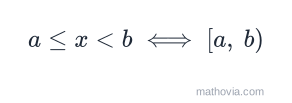
Interval Notation — key formula
Key formula

The bracket on matches the (endpoint included); the parenthesis on matches the (endpoint excluded). Read the symbols and the brackets follow.

The Core Rule

Symbol at an endpointBracketNumber-line dot
or (included) or filled
or (excluded) or open
or always or (arrow)

The smaller number is always written first (on the left). This is not a style preference — an interval means “every real number strictly between and ,” and that phrase only makes sense when . Writing would describe an empty region. If a solution lands in the wrong order, like , rewrite the inequality first so reads left to right: , then .

Set-Builder Notation Alongside

Interval notation is one of two standard ways to write a solution set. The other is set-builder notation, which spells out a membership condition:

The same set in interval notation is . Use interval notation whenever the set is a connected piece or a union of pieces — it is shorter and standard for the answers in this chapter. Set-builder is the fallback when the condition cannot be captured by intervals, such as or (though the last one is also ).

The Four Bounded Intervals

InequalityIntervalMeaning
open — neither endpoint included
closed — both endpoints included
half-open — left included
half-open — right included

Unbounded Intervals

InequalityInterval
all real numbers

Unions: Sets in More Than One Piece

When a solution set has a gap, write each piece as an interval and join them with .

The Empty Set and a Single Point

No solutions at all is written (or ) — not an interval, because there is nothing to bound. It shows up when a contradiction like appears while solving.

Exactly one solution is written . It can also be forced into the degenerate closed interval , but the set notation is clearer. A single-point solution appears in cases like , which is true only at .

Removing a Point from an Interval

If a set is an interval with one interior value excluded — common when a value makes a denominator zero — split it into two intervals at that point and join with :

The removed point gets a parenthesis on both of the new inner endpoints, because it is not in the set.

Worked Example A: Inequality to Interval

Write in interval notation.

Left endpoint has — bracket. Right endpoint has — parenthesis.

Answer: .

Worked Example B: Interval to Inequality and Graph

Describe as an inequality and as a graph.

Parenthesis on (always), bracket on (included). The set is everything up to and including .

Inequality: . Graph: filled dot at , arrow shading left.

Worked Example C: Graph to Interval

A number line shows an open dot at , a filled dot at , and shading between them. Write the interval.

Open dot at — parenthesis, not included. Filled dot at — bracket, included. Shaded between.

Answer: , equivalently .

Worked Example D: A Union

Write “all real numbers except those between and , inclusive” in interval notation.

Excluded region is , so the set is everything to the left of (not including ) together with everything to the right of (not including ).

Answer: .

Worked Example E: Set-Builder to Interval

Write in interval notation.

The condition is . Left endpoint is included () — bracket. Right endpoint is excluded () — parenthesis.

Answer: .

Worked Example F: A Domain with an Excluded Value

A function is defined for all real numbers except . Write its domain in interval notation.

Everything to the left of , together with everything to the right, with itself left out of both pieces.

Answer: .

Common Mistakes to Avoid

  • Bracket on infinity. Always a parenthesis: , never .
  • Mismatched bracket and symbol. is , not .
  • Larger number first. is wrong; write .
  • Turning an “or” set into one interval. or is , not .
  • Using a comma instead of to join pieces.
  • Writing as or . The empty set is or .

Where This Shows Up Later

  • Every inequality answer from here on. Linear, compound, polynomial, rational, and absolute-value inequalities are all reported in interval notation.
  • Domain and range of functions. Both are described as intervals or unions of intervals.
  • Continuity and limits in calculus. Statements about where a function is continuous use interval notation directly.
  • Solution sets in general. Set-builder notation and interval notation are the two standard ways to write the answer to any “solve” problem — see Solutions and Solution Sets.

Practice Problems

Work each problem yourself before opening the answer.

Problem 1. Write in interval notation.

Show answer

Problem 2. Write in interval notation.

Show answer

Problem 3. Write in interval notation.

Show answer

Problem 4. Convert to an inequality.

Show answer

Problem 5. Convert to an inequality.

Show answer

Problem 6. Write or in interval notation.

Show answer

Problem 7. A number line has an open dot at with shading to the right. Write the interval.

Show answer

Problem 8. Write “all real numbers” in interval notation.

Show answer

Problem 9. Convert to an inequality and describe the graph.

Show answer

. Graph: open dots at and , shaded between.

Problem 10. Write the domain ”” in interval notation.

Show answer

Problem 11. Write or in interval notation.

Show answer

Problem 12. Convert to a compound inequality.

Show answer

or

Problem 13. Write in interval notation.

Show answer

Problem 14. Write “all real numbers except and ” in interval notation.

Show answer

Problem 15. Convert to a set-builder condition.

Show answer

Problem 16. Write the solution of as a set.

Show answer

An absolute value is never negative, so it equals only when the inside is : . Answer: .

Quick Reference

WantUse
endpoint included ()bracket , filled dot
endpoint excluded ()parenthesis , open dot
unbounded side or with a parenthesis
set in two piecesjoin with
all real numbers
no solutions
ordersmaller number on the left

This is the output format for Linear Inequalities, Compound Inequalities, and every inequality lesson that follows. The broader picture of writing solution sets is in Solutions and Solution Sets. More Algebra lessons are available too.

Frequently Asked Questions

When do I use a bracket and when do I use a parenthesis?+

A square bracket means the endpoint is included in the set — it goes with and and with a filled dot on a number line. A parenthesis means the endpoint is excluded — it goes with and and with an open dot. Infinity always takes a parenthesis.

Why does infinity always get a parenthesis?+

A bracket marks an included endpoint, and infinity is not a number, so there is no actual endpoint there to include. and describe an unbounded direction, not a value, so and are the correct forms.

What does the union symbol mean in interval notation?+

joins two or more intervals into one set, used when the solution is not a single connected piece. means 'everything less than , together with everything greater than .'

How do I write 'all real numbers' and 'the empty set'?+

All real numbers is . The empty set — no solutions at all — is or .

How do I convert x ≥ -3 to interval notation?+

The set starts at , which is included (), and continues upward without bound: . Bracket on the included endpoint, parenthesis on infinity.

Can an interval like [5, 2] be valid?+

No. The smaller number always goes on the left. is not standard; if a solution comes out as , rewrite it as , which is .

How does interval notation relate to set-builder notation?+

They describe the same sets. Set-builder reads 'the set of all x such that 2 < x ≤ 7'; the interval says the same thing more compactly. Interval notation is preferred for connected pieces and unions; set-builder is used when a condition is hard to express as intervals, like .

Is a single point like {3} an interval?+

It can be written as the degenerate closed interval , but the set notation is clearer and more common. A single point comes up as the solution of things like .

How do I write 'x is between -1 and 4, but not equal to 2' in interval notation?+

Remove the single point by splitting: if the outer endpoints are excluded, or if they are included. Each side of the removed point becomes its own interval joined with .

Related lessons