Mathovia

Algebra / Solving Equations and Inequalities

Completing the Square

Completing the square turns any quadratic into a perfect-square trinomial plus a constant, which reduces solving to the square-root property. The key move is adding (b/2)² to manufacture the square. This lesson walks through the procedure for a leading coefficient of 1, then for a leading coefficient that isn't, then shows the two things the technique is really used for: vertex form and the derivation of the quadratic formula.

Practice Problems
M
Written by
Mathovia Team
Editorial Team

Some quadratics do not factor with integers, and The Quadratic Formula can feel like a black box. Completing the square is the method underneath both. It reshapes into a perfect square plus a leftover constant, and once you have a perfect square, the square-root property finishes the job.

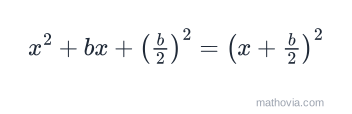
The one move to learn is this: to make into a perfect square, add . Everything else in the procedure is bookkeeping around that step.

Why that specific number? A perfect-square trinomial always looks like . Compare that to : the middle term must match , so , and the constant it needs is . You are simply supplying the constant that a perfect square would have had.

The Completing-the-Square Formula

Completing the Square — key formula
Key formula

The added constant, , is the square of half the coefficient of . It is exactly what a perfect-square trinomial needs, because — the constant is always the square of half the middle coefficient.

Procedure: Leading Coefficient of 1

To solve :

  1. Move the constant to the right side: .
  2. Add to both sides.
  3. Write the left side as a squared binomial and simplify the right side.
  4. Apply the square-root property (with ).
  5. Solve for .

Procedure: Leading Coefficient Not 1

If the coefficient is , divide every term by first, then follow the steps above.

Dividing every term includes the constant: . Some textbooks instead factor out of the first two terms and complete the square inside the parentheses; that works too, but it forces you to multiply the completing constant by when you move it across the equals sign, which is one more place to slip. Dividing first keeps the coefficient at and the arithmetic simplest.

When the Middle Coefficient Is Odd

If is odd, is a fraction, and is a fraction over . This is normal — it is not a sign that you took a wrong turn. For : half of is , squared is , and the binomial is . Keep the right side as a single fraction with denominator so that the square root at the end is clean:

The in the denominator becomes , which is why the whole answer lands over .

Worked Example A: Leading Coefficient 1

Solve .

Step 1 — move the constant:

Step 2 — half of is ; . Add to both sides:

Step 3 — write the left side as a square:

Step 4 — square-root property:

Step 5 — solve:

Answer: or .

Worked Example B: An Odd Middle Coefficient

Solve .

Step 1 — move the constant:

Step 2 — half of is ; its square is . Add to both sides:

Step 3 — write as a square:

Step 4 — square-root property:

Step 5 — solve:

Answer: . An irrational answer is normal for a quadratic that does not factor.

Worked Example C: Leading Coefficient Not 1

Solve .

Step 1 — divide every term by :

Step 2 — half of is ; . Add :

Step 3 — square-root property:

Answer: .

Worked Example D: Vertex Form

Rewrite in vertex form and state the vertex.

Step 1 — group the -terms and complete the square inside, adding and subtracting the same amount:

Step 2 — write the square and combine constants:

Vertex form is ; the vertex is . Here the added is subtracted back out in the same line, because this is an expression, not an equation — you cannot add to just one side.

Worked Example E: A Negative Discriminant

Solve by completing the square.

Step 1 — move the constant:

Step 2 — half of is ; . Add to both sides:

Step 3 — square-root property; the right side is negative, so the root is imaginary:

Step 4 — solve:

Answer: , a complex-conjugate pair — the same result the quadratic formula would give from the discriminant .

Deriving the Quadratic Formula

Completing the square on in general:

That last line is the quadratic formula — one completing-the-square calculation, done once and for all.

Common Mistakes to Avoid

  • Adding to only one side of an equation. Both sides get it. (In an expression, you add and immediately subtract it — see Worked Example D.)
  • Forgetting to divide by first when the leading coefficient isn’t 1.
  • Squaring instead of . You halve first, then square.
  • Dropping the at the square-root step.
  • Sign error on . For , the binomial is , not .
  • Not simplifying the right side before taking the square root — combine the constants first.

Where This Shows Up Later

  • The Quadratic Formula is this method, pre-computed.
  • Graphing parabolas. Vertex form, produced by completing the square, gives the vertex and the axis of symmetry directly.
  • Conic sections. Completing the square on both and puts a circle or ellipse equation into standard form.
  • Integration and other later math. Completing the square is a standard preprocessing step for certain integrals and for analyzing quadratic expressions.

Practice Problems

Work each problem yourself before opening the answer.

Problem 1. What constant completes the square for ?

Show answer

Half of is ; .

Problem 2. Solve by completing the square.

Show answer

Problem 3. Solve by completing the square.

Show answer

Problem 4. Solve by completing the square.

Show answer

Problem 5. Solve by completing the square.

Show answer

Problem 6. Solve by completing the square.

Show answer

Divide by : .

Problem 7. Solve by completing the square.

Show answer

Problem 8. Rewrite in vertex form and give the vertex.

Show answer

Vertex: .

Problem 9. Solve by completing the square.

Show answer

Divide by : .

Problem 10. Solve by completing the square.

Show answer

Problem 11. What constant completes the square for ?

Show answer

Half of is ; its square is .

Problem 12. Solve by completing the square.

Show answer

Divide by : .

Problem 13. Solve by completing the square.

Show answer

Quick Reference

StepDetail
The number to add — half the -coefficient, squared
Leading coefficient divide every term by first
In an equationadd to both sides
In an expression (vertex form)add and subtract in the same line
After the squareapply the square-root property with
Result of doing this in generalthe quadratic formula

Once you have , the finish is the square-root property from Quadratic Equations. For a faster route to the same roots, The Quadratic Formula is this method pre-solved. More Algebra lessons are available too.

Frequently Asked Questions

What number completes the square for x² + bx?+

, which is . Adding it produces . For , you add to get .

Why does completing the square work?+

A perfect-square trinomial expands to , so its constant term is always the square of half its middle coefficient. Completing the square just supplies that missing constant so the expression can be written as a single squared binomial.

What do I do when the leading coefficient isn't 1?+

Divide every term by the leading coefficient first, so the term has coefficient 1, then complete the square as usual. Some texts instead factor out of the first two terms; both routes give the same result.

How is completing the square related to the quadratic formula?+

The quadratic formula is the result of completing the square on the general equation once, symbolically. Every time you use the formula, you are using a pre-solved completing-the-square calculation.

What is vertex form and how does completing the square produce it?+

Vertex form is , where is the vertex of the parabola. Completing the square on rewrites it in that form, making the vertex readable directly.

When should I complete the square instead of using the quadratic formula?+

For pure solving, the quadratic formula is usually faster. Complete the square when you need vertex form, when you are deriving a result, or when a course specifically asks for the method. It is a technique worth knowing even where it isn't the quickest.

Why do I add the number to both sides of an equation but add and subtract it in an expression?+

An equation stays balanced only if you do the same thing to both sides, so is added to the left and the right. An expression like has only one side; adding a number would change its value, so you add and immediately subtract it in the same line, a net change of zero.

What does completing the square give me when the discriminant is negative?+

The right side of comes out negative. Taking the square root then introduces , and you get a pair of complex-conjugate solutions — the same answer the quadratic formula gives from a negative discriminant.

Related lessons