Mixture problems come in a few disguises — acid solutions, coffee blends, nut mixes, coin jars, investment splits — but they are all the same problem. Something is combined from parts of different strength or value, and you track one quantity across the combination: the pure amount of a substance, or the total dollar value.
The Word Problems five-step method still applies. What this lesson adds is a chart, much like the one in Distance, Rate, and Time, that makes the “before equals after” balance almost fill itself in.
The Mixture Formula
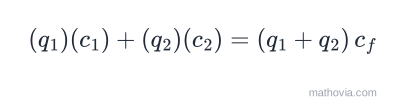
The Mixture Chart
| Part | Quantity | Concentration / value | Pure amount |
|---|---|---|---|
| Ingredient 1 | |||
| Ingredient 2 | |||
| Mixture |
The Pure-amount column adds down: the two ingredient rows sum to the mixture row. That is the equation.
Percent-Solution Mixtures
Two solutions of different concentration are combined. Concentrations are decimals:
The final concentration must be between the two starting concentrations, or no positive amount works.
Adding Pure Substance or Pure Water
- Pure water dilutes: concentration
, so its term is , but it still adds to the total quantity. - Pure substance (100% acid, salt, alcohol) strengthens: concentration
, so its term is just its amount.
Dry Mixtures with Prices
The same structure, with “value per unit” in place of concentration. A blend of
where
Coin and Ticket Problems
The “concentration” is the value of each item. For a jar of nickels and dimes with
Write
Worked Example A: Two Acid Solutions
How many liters of a
Chart — let
| Part | Quantity | Concentration | Pure acid |
|---|---|---|---|
| Mixture |
Equation:
Answer:
Worked Example B: Diluting with Water
A chemist has
Let
Answer: add
Worked Example C: A Coffee Blend
A shop wants
Let
Answer:
Worked Example D: A Coin Problem
A jar has
Let
Answer:
Common Mistakes to Avoid
- Using percents instead of decimals.
is in the equation. - Forgetting that water or a diluent still adds to the total quantity. Its concentration term is
, but the mixture row’s quantity is still . - Setting the final concentration outside the range of the two ingredients. Mixing
and can only produce something between and . - Mislabeling the second quantity. If the total is fixed at
and one part is , the other is , not another free variable. - Adding concentrations directly.
; you multiply each concentration by its amount first. - Dropping a unit-value term in a coin problem. Every coin type contributes (count)(value); a missing term throws off the total.
Where This Shows Up Later
- Systems of Equations. Coin, ticket, and investment problems with two genuinely independent unknowns are naturally two-equation systems (count and value).
- Applications of Linear Equations. Simple-interest “split investment” problems are mixture problems where the “concentration” is an interest rate.
- Rational Equations. A few dilution problems that ask for a final concentration after repeated dilution lead to fractional equations.
- Weighted averages and statistics. The mixture balance is exactly a weighted average: the final concentration is the amount-weighted mean of the parts.
Practice Problems
Work each problem yourself before opening the answer.
Problem 1. How many liters of a
Show answer
Answer:
Problem 2. How much pure water must be added to
Show answer
Answer:
Problem 3. A nut mixture worth
Show answer
Let
Answer:
Problem 4. A jar of nickels and dimes has
Show answer
Let
Answer:
Problem 5. How much pure antifreeze must be added to
Show answer
Pure antifreeze has concentration
Answer:
Problem 6. A
Show answer
Let
Answer:
Problem 7. A theater sells
Show answer
Let
Answer:
Problem 8. How many liters of pure water must evaporate from
Show answer
The salt amount is fixed at
Answer:
Problem 9. A grocer mixes
Show answer
Let
Answer:
Problem 10.
Show answer
Let
Answer:
Problem 11. How much of an
Show answer
Answer:
Problem 12. A jar has three times as many dimes as quarters and is worth
Show answer
Let
Answer:
Quick Reference
| Mixture type | Balance equation |
|---|---|
| Two percent solutions | |
| Add pure water | one term has concentration |
| Add pure substance | one term has concentration |
| Priced dry mix | |
| Coins / tickets | count equation + value equation |
| Split investment | “concentration” is the interest rate |
| Sanity check |
The decimals-and-parentheses algebra is Linear Equations; if you prefer to clear the decimals first, that is the Linear Equations with Fractions move. Split-investment problems overlap with the interest work in Applications of Linear Equations, and the chart is the same one from Distance, Rate, and Time. The rest of the Algebra lessons are there when you want more.