
Fabric yardage estimates go wrong most often because people forget that bolt width limits how many pieces fit across each row — not just how long the fabric needs to be.
Start with your piece size, including seam allowance
If a pattern piece needs to finish at 18” × 24”, add your seam allowance to both dimensions before doing any layout math. A 1/2” seam allowance on each edge adds a full inch to each dimension, giving you an actual cutting size of 19” × 25”.
Bolt width decides how many pieces fit per row
Standard quilting cotton is usually 42”–44” wide, while apparel and home-decor fabrics vary more. The number on the bolt includes the selvedges — the tightly woven edges you normally trim off — so the usable width is 1”–2” less. Divide the usable width by your piece’s cutting width to find how many pieces fit across one row, always rounding down, since a partial piece isn’t usable.
| Fabric type | Typical labeled width |
|---|---|
| Quilting cotton | 42–44 in |
| Apparel / dress fabric | 45 in |
| Home-decor / upholstery | 54 in |
| Muslin, sheeting, wide backing | 90–108 in |
Rows, then total length
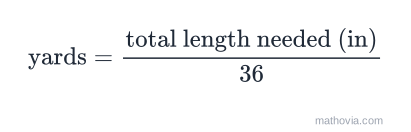
Once you know how many pieces fit per row, divide your total piece count by that number (rounding up) to get the number of rows you need. Multiply the number of rows by your piece’s cutting height to get the total fabric length required, then divide by 36 to convert inches to yards.
A worked example
Six pieces at 18” × 24” (plus a 1/2” seam allowance, so 19” × 25” actual), on 44”-wide fabric:
- Pieces per row: 44 ÷ 19 = 2 (rounded down)
- Rows needed: 6 ÷ 2 = 3
- Fabric length: 3 × 25” = 75”
- Yardage: 75 ÷ 36 ≈ 2.08 yards, so ask for 2 1/4 yards
When the simple grid breaks down
Three things pull your yardage above a plain grid estimate:
- Directional prints and napped fabric (velvet, corduroy, one-way patterns) have to be cut with every piece facing the same way, which removes the option of rotating pieces to nest them. Add roughly 15–25%.
- Large pattern repeats that need to match across seams cost up to one extra repeat length per piece, because each cut has to start at the same point in the pattern.
- Pre-washing natural fibers like cotton and linen before cutting is worth it — but they shrink 2–5% in the wash, so buy about 10% extra so you still have enough afterward.
Buy a little extra
Most fabric shops cut only to the nearest 1/4 yard, so round your total up rather than down, and add a small margin — a quarter to a half yard — for a miscut or a change of plan.
Our Fabric Yardage Calculator runs this exact layout math — enter your piece size, quantity, bolt width, and seam allowance, and it returns pieces per row, rows needed, and total yardage. To sanity-check a yardage figure against inches or meters, the length converter handles all three.