Formulas almost never arrive in the form you need. The area of a triangle is written
Nothing about the algebra changes. Every move — add the same thing to both sides, multiply both sides by the same nonzero thing, distribute, combine like terms, factor — is exactly as it was before. What changes is that the “constants” you are working around are now written as letters, and the only genuinely new technique appears when the target variable shows up in more than one place. This lesson is a companion to Equations with More Than One Variable: it turns the routine into a decision checklist, then works case by case through fractions in the formula, the target appearing twice, the target in a denominator, and the target locked inside a power or a root.
The Solving-for-a-Variable Formula
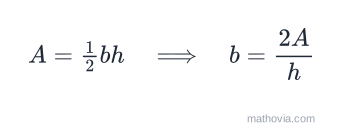
Every other letter — here
The Checklist
- Name the target variable. Circle it in the formula. Every move from here is aimed at isolating that one letter, and nothing else.
- Clear fractions. Multiply every term by the LCD of all denominators, or multiply both sides by the reciprocal of a lone fractional coefficient.
- Distribute any parentheses that contain the target variable, so you can see every term it appears in.
- Collect the target variable on one side, everything else on the other, using addition and subtraction.
- If the target now appears in more than one term, factor it out so it appears exactly once.
- Divide both sides by whatever is multiplying the target.
- If the target is inside a power or a root, undo that last — take
of both sides for a square, or square both sides for a square root.
Not every problem needs every step. A formula like
Target Variable Appears Once
When the target shows up in exactly one term, the checklist finishes it directly: peel away everything attached to it by addition or subtraction, then divide by whatever multiplies it.
Notice that both
Target Variable Appears More Than Once
This is the one situation that needs a move you have not used before. Gather every term containing the target onto one side, factor the target out of those terms, then divide by whatever is left in the parentheses.
If the target starts on both sides of the equation, first move those terms together, then factor:
Factoring only works once the target is a common factor of every term on that side. Trying to divide
Target Variable Inside a Fraction
If the target sits in a numerator, clearing the fraction is the usual multiply-by-the-denominator move. If it sits in a denominator, multiplying both sides by the target lifts it out, and then you isolate it normally.
Target Variable Inside a Power or a Root
Undo the outermost operation last. To free a variable that is squared, isolate the square, then take the square root of both sides:
To free a variable that is under a square root, isolate the root, then square both sides:
For
Common Formulas Rearranged
| Formula | Solved for | Rearranged |
|---|---|---|
Worked Example A: The Simple Interest Formula for t
Solve
Step 1 — the target is
Step 2 — divide both sides by everything currently multiplying
Answer:
Worked Example B: A Variable That Appears Twice
Solve
Step 1 — collect the
Step 2 — factor
Step 3 — divide by
Answer:
Worked Example C: A Formula with a Fraction
Solve
Step 1 — multiply both sides by
Step 2 — subtract
Answer:
Worked Example D: Fahrenheit and Celsius
Solve
Step 1 — clear the fraction by multiplying both sides by
Step 2 — add
Answer:
Worked Example E: The Variable Under a Root
Solve
Step 1 — square both sides to remove the root:
Step 2 — divide by
Answer:
Worked Example F: Standard Form to Slope-Intercept Form
Solve
Step 1 — move the
Step 2 — divide both sides by
Answer:
Common Mistakes to Avoid
- Combining unlike letters.
is not or ; and are not like terms just because they are both made of symbols. - Dividing before factoring when the target appears twice.
must become before you can divide by . - Dividing only one term. In
, both and are over the . - Forgetting the
when taking a square root in a context where the variable could be negative. - Squaring only one term instead of the whole side.
is ; is — square each entire side. - Reversing which fraction gets used when clearing a fractional coefficient. Multiplying both sides by
is the same as dividing by ; swapping them flips the formula. - Losing track of the target. Decide which letter you are solving for before the first move, and keep aiming at it.
Where This Shows Up Later
- Systems of Equations. The substitution method starts by solving one equation for one variable in terms of the others.
- Functions and graphing. Rewriting a line from standard form
to is a solve-for- problem, and it is what makes slope and intercept readable off the equation. - Science and finance. Every formula in physics, chemistry, and finance eventually needs to be solved for a variable other than the one it is written for — exactly this skill, applied to a new formula each time.
- Rational and radical equations. Isolating a variable inside a fraction or a root is the same technique those lessons build on, with the added extraneous-solution check when an even power or root is involved.
- Word problems. Distance-rate-time, work, and mixture problems all use standard formulas (
, ) rearranged for whichever quantity is unknown.
Practice Problems
Work each problem yourself before opening the answer.
Problem 1. Solve
Show answer
Divide both sides by
Problem 2. Solve
Show answer
Step 1 — multiply both sides by
Step 2 — divide by
Problem 3. Solve
Show answer
Step 1 — subtract
Step 2 — divide by
Problem 4. Solve
Show answer
Problem 5. Solve
Show answer
Divide both sides by
Problem 6. Solve
Show answer
Step 1 — gather the
Step 2 — factor and divide:
Problem 7. Solve
Show answer
Divide both sides by
Problem 8. Solve
Show answer
Step 1 — multiply both sides by
Step 2 — add
Problem 9. Solve
Show answer
Step 1 — multiply by
Step 2 — subtract
Problem 10. Solve
Show answer
Step 1 — divide both sides by
Step 2 — subtract
Problem 11. Solve
Show answer
Step 1 — multiply both sides by
Step 2 — add
Problem 12. Solve
Show answer
Step 1 — divide both sides by
Step 2 — square both sides:
Step 3 — multiply by
Problem 13. Solve
Show answer
Step 1 — gather the
Step 2 — factor and divide:
Problem 14. Solve
Show answer
Step 1 — isolate
Step 2 — take the reciprocal of both sides:
Quick Reference
| The target variable is… | Move |
|---|---|
| in one term, multiplied by stuff | divide both sides by that stuff |
| added to or subtracted from stuff | move that stuff to the other side |
| in a fraction with a constant denominator | multiply every term by the LCD |
| in the denominator | multiply both sides by the target, then isolate |
| in two or more terms | collect them, factor the target out, then divide |
| squared | isolate the square, then take |
| under a square root | isolate the root, then square both sides |
| the whole side is a reciprocal, like | flip both sides |
This is the Linear Equations routine with letters for constants; the fraction-clearing step is Linear Equations with Fractions, and the deeper treatment with more literal-equation examples is Equations with More Than One Variable. More Algebra lessons are available too.