A compound inequality joins two inequalities with the word and or the word or. That single word decides everything about the answer.
- “and” means intersection: the solution is the set of values that satisfy both inequalities. Graphically, it is the overlap of the two shaded regions.
- “or” means union: the solution is the set of values that satisfy at least one. Graphically, it is everything either region covers.
Each individual inequality is solved with the method from Linear Inequalities. The compound part is just deciding how to combine the two solution sets.
A quick way to keep the words straight: an and compound is stricter — a value has to clear two hurdles, so the solution set is usually smaller than either piece alone, and often a single bounded interval. An or compound is looser — clearing one hurdle is enough, so the solution set is usually larger than either piece, and often two disconnected rays.
The Compound Inequality Formula
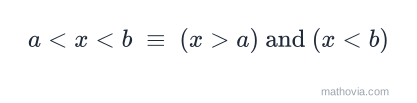
The three-part form on the left is a compact “and”. The “or” form on the right stays as two separate pieces.
Solving an “and” Compound (Three-Part Form)
Keep the variable in the middle and apply every operation to all three parts.
Add
Divide every part by
Interval:
Solving an “and” Compound Written as Two Inequalities
Solve each separately, then take the overlap.
Interval:
Solving an “or” Compound
Solve each separately, then take the union — keep both pieces.
Interval:
Graphing: Intersection vs. Union
Graph both pieces on the same number line first, then read off the result:
- “and” — the solution is where the two shadings overlap. If they never meet, there is no solution. The three-part form always graphs as one connected segment.
- “or” — the solution is everything either shading covers. If the two shadings together leave no gap, the solution is the whole line.
A useful check: an “and” answer written as an interval should have the smaller number on the left and be a single connected piece; an “or” answer should be two intervals joined by
Worked Example A: Three-Part “and”
Solve
Step 1 — subtract
Step 2 — divide all three parts by
Answer:
Worked Example B: “and” With No Overlap
Solve
Solve each:
Overlap: there is no number that is both less than
Answer: no solution,
Worked Example C: “or” With Two Pieces
Solve
Solve each:
Union: keep both pieces.
Answer:
Worked Example D: Dividing the Three-Part Form by a Negative
Solve
Step 1 — subtract
Step 2 — divide all three parts by
Step 3 — rewrite with the smaller number on the left:
Answer:
Worked Example E: An “or” That Covers Everything
Solve
Solve each:
Union: graph
Answer:
Worked Example F: A Word Condition
A recipe works only when the oven temperature
Both conditions must hold at once, so this is an “and” compound, and it fits the three-part form directly:
Answer:
Common Mistakes to Avoid
- Operating on only two of the three parts. In the three-part form, every step touches all three parts.
- Turning an “or” into a single interval.
or stays as two pieces joined by ; it is not (that would be the region between, which is exactly what the “or” excludes). - Forgetting to flip in the three-part form. Dividing all three parts by a negative flips both symbols; then reorder so the smaller value is on the left.
- Reporting an “and” with no overlap as an interval. No overlap means
. - Missing that an “or” can be all reals. If the pieces cover everything, the answer is
. - Confusing “at least” / “at most” wording. “At least
” is ; “at most ” is ; “between and ” is usually unless “inclusive” is stated.
Where This Shows Up Later
- Absolute Value Inequalities.
is exactly the “and” compound ; is the “or” compound or . - Domain of a function. A domain like ”
and ” is a compound condition. - Polynomial and Rational Inequalities. The solution is often a union of intervals, read the same way as an “or” result.
- Systems of linear inequalities. In two variables, the feasible region is the intersection (“and”) of several half-planes.
Practice Problems
Work each problem yourself before opening the answer. Write solutions in interval notation.
Problem 1. Solve
Show answer
Subtract
Problem 2. Solve
Show answer
Add
Problem 3. Solve
Show answer
Problem 4. Solve
Show answer
Problem 5. Solve
Show answer
Multiply all parts by
Problem 6. Solve
Show answer
Subtract
Problem 7. Solve
Show answer
Problem 8. Solve
Show answer
The two pieces cover the entire line. Answer:
Problem 9. Solve
Show answer
Subtract
Problem 10. Solve
Show answer
Problem 11. Solve
Show answer
Subtract
Problem 12. Solve
Show answer
Problem 13. Solve
Show answer
Multiply all parts by
Problem 14. Solve
Show answer
Quick Reference
| Compound | Meaning | Typical result |
|---|---|---|
| intersection — both true | one interval, or | |
| union — at least one true | two pieces joined by | |
| compact “and” | operate on all three parts | |
| divide all three parts by a negative | flip both symbols | then reorder smaller-on-left |
| “and” pieces don’t overlap | ||
| “or” pieces cover the line |
Each half is a Linear Inequality; the answer format is Interval Notation. Compound inequalities are the engine behind Absolute Value Inequalities. More Algebra lessons are available too.